Watch This SpaceX Rocket Abort Its Launch at the Last Second

A SpaceX Falcon 9 rocket aborted a planned launch on Sunday morning at the last second due to an engine power issue. The event produced confusion at the Kennedy Space Center in Florida, where countdown appeared to be proceeding normally. However, the rocket stayed where it was.

In a video published by SpaceX, you can hear a commentator begin to count down. At this moment, the rocket still looks like it’s getting ready to take off, and no one seems to suspect that something is wrong. Once the commentator gets to zero and says liftoff, they immediately add, “Disregard. We have an abort.”

According to Space.com, apparently, the Falcon 9’s onboard computer aborted the launch just before liftoff because it detected an issue with one of the rocket’s nine Merlin 1D engines. Michael Andrews, a supply chain supervisor at SpaceX, said in the launch commentary that they had a “condition regarding engine power that caused us to abort today’s launch.”

Andrews added that the vehicle appeared to be in good health, but the company would no longer try to launch today.

SpaceX itself weighed in on the matter on Twitter shortly after.

“Standing down today; standard auto-abort triggered due to out of family data during engine power check,” SpaceX said. “Will announce next launch date opportunity once confirmed on the Range.”

SpaceX was planning to launch a batch of 60 new Starlink satellites, part of an initiative to provide low-cost Internet to remote locations worldwide where it’s hard to obtain online services. CEO Elon Musk has said that the Starlink constellation system will be available once 400 satellites are in orbit and activated. He claims that it will achieve “significant operational capacity” with 800 satellites.

Today’s launch was significant because it would have been the first Falcon 9 rocket booster, or first stage, to launch five times. The first time this booster launched was in 2018, per Ars Technica. SpaceX had also announced that it would be reusing the rocket’s payload fairing. Overall, this meant that the only part of this Falcon 9 rocket that was not being reused was the second stage.

SpaceX aims to reduce the price of rocket launches by reusing parts of its rockets. There isn’t any word yet on when the company will try to launch this Falcon 9 rocket again. Even though it’s a small bummer, it’s better safe than sorry when you’re launching an expensive rocket, even if you do plan to reuse it. Better luck next time.

Source: Watch This SpaceX Rocket Abort Its Launch at the Last Second
139 minor planets were spotted at the outer reaches of our Solar System.

Astronomers have discovered 139 minor planets lurking at the edge of the Solar System after examining a dataset collected to study dark energy in the universe.

Small worlds that circle our Sun in orbits further out than Neptune are labelled trans-Neptunian objects (TNO), with one being the relegated-planet Pluto. Eggheads, led by those at the University of Pennsylvania (UPenn) in the US, identified 316 TNOs in the dark-energy dataset, of which 139 bodies were previously unknown. That’s according to a study published in The Astrophysical Journal this week.

Specifically, the dataset features images snapped by the Dark Energy Survey (DES), a project that used the Victor M. Blanco Telescope at the Cerro Tololo Inter-American Observatory in Chile to study the role of dark energy in the universe’s rate of expansion. The pictures were taken of the southern hemisphere for six years, from 2013 to 2019.

“The number of TNOs you can find depends on how much of the sky you look at and what’s the faintest thing you can find,” said Gary Bernstein, co-author of the study and a Professor of Astronomy and Astrophysics at UPenn.

Unlike stars or supernovas, TNOs don’t emit a lot of light. The trick to spotting TNOs among all the other stuff in the images is to look for things that move. TNOs orbit the Sun whereas stars and distant galaxies appear more fixed. “Dedicated TNO surveys have a way of seeing the object move, and it’s easy to track them down,” said Pedro Bernardinelli, first author of the paper and a graduate student at UPenn. “One of the key things we did in this paper was figure out a way to recover those movements.”

The academics began with seven billion objects in the DES dataset. After they removed static objects – things that appeared in the same spot on multiple nights – they were left with a list of 22 million transient objects.

Each one looks like a dot, and the goal was to track each dot as it traveled across the sky to see if it really was an individual object. That narrowed the list down to 400 candidates that warranted further study and verification.

“We have this list of candidates, and then we have to make sure that our candidates are actually real things,” Bernardinelli said. They then realized 316 of the 400 candidates were TNOs – and 139 of that 316 were previously undetected minor worlds.

The boffins only rifled through four years’ worth of data, and they believe that, by using their method, many more TNOs can be uncovered in the future.

Source: We’re not saying Earth is doomed… but 139 minor planets were spotted at the outer reaches of our Solar System. Just an FYI, that’s all • The Register

New type of pulsating star discovered

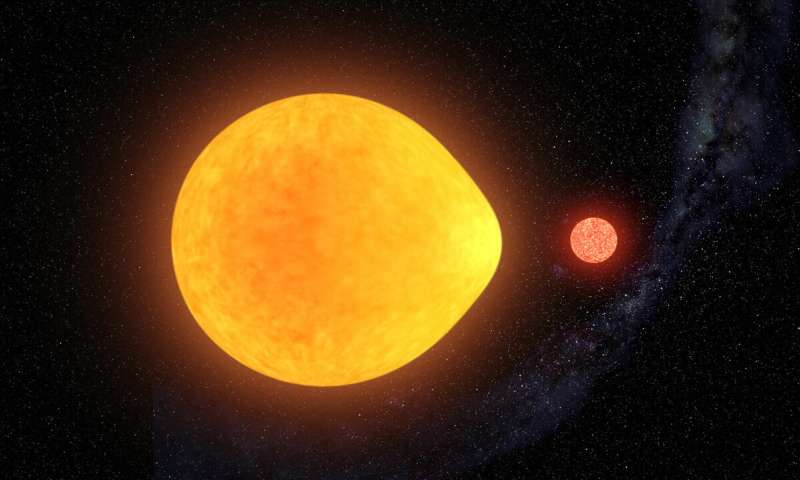
A star that pulsates on just one side has been discovered in the Milky Way about 1500 light years from Earth. It is the first of its kind to be found and scientists expect to find many more similar systems as technology to listen inside the beating hearts of stars improves.

[…]

Stars that pulsate have been known in astronomy for a long time. Our own Sun dances to its own rhythms. These rhythmic pulsations of the stellar surface occur in young and in old stars, and can have long or short periods, a wide range of strengths and different causes.

There is however one thing that all these stars had thus far in common: the oscillations were always visible on all sides of the star. Now an international team, including researchers from the University of Sydney, has discovered a star that oscillates largely over one hemisphere.

00:00
-00:15
Artist’s impression of pulsating star. Credit: Gabriel Pérez Díaz (IAC)

The scientists have identified the cause of the unusual single-sided : the star is located in a binary star system with a red dwarf. Its close companion distorts the oscillations with its . The clue that led to its discovery came from citizen scientists poring over public data from NASA’s TESS satellite, which is hunting for planets around distant stars.

The orbital period of the binary system, at less than two days, is so short that the larger star is being distorted into a tear-drop shape by the gravitational pull of the companion.

[…]

To their surprise the team observed that the strength of the pulsations depended on the aspect angle under which the star was observed, and the corresponding orientation of the star within the binary. This means the pulsation strength varies with the same period as that of the binary.

“As the binary stars orbit each other we see different parts of the pulsating star,” said Dr. David Jones at the Instituto de Astrofisica de Canarias and co-author of the study. “Sometimes we see the side that points towards the companion star, and sometimes we see the outer face.”

This is how the astronomers could be certain that the pulsations were only found on one side of the star, with the tiny fluctuations in brightness always appearing in their observations when the same hemisphere of the star was pointed towards the telescope.

Source: New type of pulsating star discovered

NASA declares Starliner mishap a “high visibility close call”

After pondering the totality of issues that arose during a December test flight of Boeing’s Starliner spacecraft this week, NASA chief of human spaceflight Doug Loverro said Friday that he decided to escalate the incident.

So he designated Starliner’s uncrewed mission, during which the spacecraft flew a shortened profile and did not attempt to dock with the International Space Station, as a “high visibility close call.” This relatively rare designation for NASA’s human spaceflight program falls short of “loss of mission” but is nonetheless fairly rare. It was last used by NASA after a spacewalk in 2013 when water began to dangerously pool in the helmet of astronaut Luca Parmitano.

Asked to explain during a conference call with reporters why he did this, Loverro said, “We could have lost a spacecraft twice during this mission.”

In this, Loverro referred to two software errors that occurred during the two-day flight. The first problem occurred when Starliner captured the wrong “mission elapsed time” from its Atlas V launch vehicle—it was supposed to pick up this time during the terminal phase of the countdown, but instead it grabbed data 11 hours off of the correct time. This led to a delayed push to reach orbit. The second error, caught and fixed just a few hours before the vehicle returned to Earth through the atmosphere, was due to a software mapping error that would have caused thrusters on Starliner’s service module to fire in the wrong manner.

NASA and Boeing officials held Friday’s teleconference to announce the conclusion of a report from an Independent Review Team established after December’s flight. These reviewers made 60 recommendations to NASA and Boeing for corrective actions that ranged from fixing these software issues to ferreting out others that may still exist in the spacecraft’s flight code. The investigative team is also still looking into an issue that led to multiple dropouts in communications between the ground and spacecraft during key moments of the flight.

Corrective action plan

By declaring the Starliner mishap a “close call,” Loverro also formally opened a process during which the space agency’s Safety Office will investigate the organization elements that may have led to the incident—likely focusing on why NASA did not detect the errors in Starliner’s flight software.

Loverro said no decisions are close to being made on when Starliner will return to flight or whether Boeing will have to fly another uncrewed demonstration test flight before NASA astronauts fly on Starliner. The next step, he said, is for Boeing to prepare a “corrective action plan” to implement the review team’s findings, and that will include a schedule. NASA will evaluate that plan and then it may be in a position to decide whether another test flight is needed.

Source: NASA declares Starliner mishap a “high visibility close call” | Ars Technica

Watch Elon Musk’s Mars ferry prototype explode on the pad during liquid nitrogen test

The Starship SN1 prototype was undergoing pressure testing at the Musketeers’ factory at Boca Chica in Texas, USA, by filling its tanks with liquid nitrogen. The base of the rocket appears to have ruptured, sending the structure crashing to the ground, which you can see here:

SpaceX supremo Elon Musk himself seemed sanguine about the whole affair, taking to Twitter to say: “It’s fine, we’ll just buff it out. Where’s Flextape when you need it!?”

It’s entirely possible this was a scheduled test-to-destruction for the prototype which, when ready and in its final form, Elon wants to use for regular trips to Mars. Or it could be that someone was lax on their welding, leading to Friday’s explosion.

A second prototype, SN2, is already being built, Musk said, and will be stripped down to the bare minimum of hardware before being filled with water and then cryogenic fuel for pressure testing. Many more iterations are planned before Musk can fulfill his dream of using the Starship as a vehicle to set up a self-sustaining colony on Mars.

Source: Starship bloopers: Watch Elon Musk’s Mars ferry prototype explode on the pad during liquid nitrogen test • The Register

Scientists Found Breathable Oxygen in Another Galaxy for the First Time

Astronomers have spotted molecular oxygen in a galaxy far far away, marking the first time that this important element has ever been detected outside of the Milky Way.

This momentous “first detection of extragalactic molecular oxygen,” as it is described in a recent study in The Astrophysical Journal, has big implications for understanding the crucial role of oxygen in the evolution of planets, stars, galaxies, and life.

Oxygen is the third most abundant element in the universe, after hydrogen and helium, and is one of the key ingredients for life here on Earth. Molecular oxygen is the most common free form of the element and consists of two oxygen atoms with the designation O2. It is the version of the gas that we humans, among many other organisms, need to breathe in order to live.

Yet despite its ubiquity and significance to habitability, scientists have struggled for decades to detect molecular oxygen in the wider cosmos.

Now, a team led by Junzhi Wang, an astronomer at the Shanghai Astronomical Observatory, reports the discovery of molecular oxygen in a dazzling galaxy called Markarian 231, located 581 million light years from the Milky Way.

The researchers were able to make this detection with ground-based radio observatories. “Deep observations” from the IRAM 30-meter telescope in Spain and the NOEMA interferometer in France revealed molecular oxygen emission “in an external galaxy for the first time,” Wang and his co-authors wrote.

Source: Scientists Found Breathable Oxygen in Another Galaxy for the First Time – VICE

SpaceX’s Starship SN1 prototype appears to burst during pressure test

SpaceX’s new Starship prototype appeared to burst during a pressure test late Friday (Feb. 28), rupturing under the glare of flood lights and mist at the company’s south Texas facility.

The Starship SN1 prototype, which SpaceX moved to a launchpad near its Boca Chica, Texas, assembly site earlier this week, blew apart during a liquid nitrogen pressure test according to a video captured by SPadre.com.

A separate video posted by NASASpaceflight.com member BocaChicaGal clearly shows the Starship SN1’s midsection buckle during the test, then shoot upward before crashing back to the ground.

Source: SpaceX’s Starship SN1 prototype appears to burst during pressure test | Space

Not a good moment for Elon Musk

Two private satellites just docked in space in historic first for orbital servicing

In a historic first for satellite operations, a commercial spacecraft “helper” has docked with a working communications satellite to provide life-extension services.

The companies involved in the meetup  — Northrop Grumman and Intelsat — hailed the operation, which took place Tuesday (Feb. 25), as the beginning of a new era that will see robotic spacecraft giving new life to older satellites that are low on fuel or require repairs.

Because launch costs constitute a large part of a satellite’s total price tag, the hope is that refurbishing aging satellites will eventually reduce the expense of services that satellites provide, such as telecommunications or weather monitoring.

Video: Watch Northrop Grumman’s MEV-1 dock with Intelsat 901!

In a historic first, Northrop Grumman’s privately built MEV-1 satellite servicing spacecraft captures the Intelsat 901 communications satellite on Feb. 25, 2020. MEV-1’s grappler (right) latched on to Intelsat’s engine nozzle at center.

The docking occurred Tuesday at 2:15 a.m. EST (0715 GMT). On one side of the meeting was a spacecraft called Mission Extension Vehicle-1 (MEV-1), overseen by Northrop Grumman and its subsidiary SpaceLogistics LLC; on the other was a telecommunications satellite, Intelsat’s IS-901, Northrop Grumman said in a statement.

This maneuver took place about 180 miles (290 kilometers) above geosynchronous orbit, which is at an altitude of 22,236 miles (35,786 km). That’s roughly 90 times higher than the International Space Station.

Intelsat IS-901 is low on fuel and was removed from service in December 2019 to prepare for this operation, according to the statement. Controllers raised the satellite’s orbit and awaited MEV-1’s arrival. Now that the pair have docked, MEV-1 will perform checkouts of IS-901, then push the satellite back to its normal orbit in late March, according to Northrop Grumman.

Source: Two private satellites just docked in space in historic first for orbital servicing | Space

A Map of Every Object in Our Solar System

View the high resolution version of this incredible map by clicking here

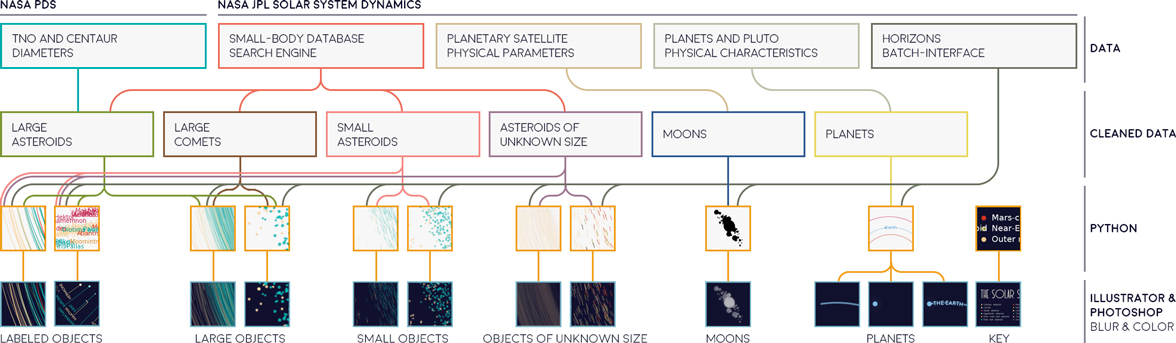
In this stunning visualization, biologist Eleanor Lutz painstakingly mapped out every known object in Earth’s solar system (>10km in diameter), hopefully helping you on your next journey through space.

Data-Driven Solar System

This particular visualization combines five different data sets from NASA:

Objects in solar system

Source: Tabletop Whale

From this data, Lutz mapped all the orbits of over 18,000 asteroids in the solar system, including 10,000 that were at least 10km in diameter, and about 8,000 objects of unknown size.

This map shows each asteroid’s position on New Year’s Eve 1999.

The Pull of Gravity

When plotting the objects, Lutz observed that the solar system is not arranged in linear distances. Rather, it is logarithmic, with exponentially more objects situated close to the sun. Lutz made use of this observation to space out their various orbits of the 18,000 objects in her map.

What she is visualizing is the pull of the sun, as the majority of objects tend to gravitate towards the inner part of the solar system. This is the same observation Sir Isaac Newton used to develop the concept of gravity, positing that heavier objects produce a bigger gravitational pull than lighter ones. Since the sun is the largest object in our solar system, it has the strongest gravitational pull.

If the sun is continually pulling at the planets, why don’t they all fall into the sun? It’s because the planets are moving sideways at the same time.

orbiting around the sun

Without that sideways motion, the objects would fall to the center – and without the pull toward the center, it would go flying off in a straight line.

This explains the clustering of patterns in solar systems, and why the farther you travel through the solar system, the bigger the distance and the fewer the objects.

The Top Ten Non-Planets in the Solar System

We all know that the sun and the planets are the largest objects in our corner of the universe, but there are many noteworthy objects as well.

Rank Name Diameter Notes
1 Ganymede 3,273 mi (5,268 km) Jupiter’s largest moon
2 Titan 3,200 mi (5,151 km) Saturn’s largest moon
3 Callisto 2,996 mi (4,821 km) Jupiter’s second largest moon
4 Io 2,264 mi (3,643 km) Moon orbiting Jupiter
5 Moon 2,159 mi (3,474 km) Earth’s only moon
6 Europa 1,940 mi (3,122 km) Moon orbiting Jupiter
7 Triton 1,680 mi (2,710 km) Neptune’s largest moon
8 Pluto 1,476 mi (2,376 km) Dwarf planet
9 Eris 1,473 mi (2,372 km) Dwarf planet
10 Titania 981 mi (1,578 km) Uranus’ largest moon

Source: Ourplnt.com

While the map only shows objects greater than 10 kilometers in diameter, there are plenty of smaller objects to watch out for as well.

An Atlas of Space

This map is one among many of Lutz’s space related visualizations. She is also in the process of creating an Atlas of Space to showcase her work.

As we reach further and further beyond the boundaries of earth, her work may come in handy the next time you make a wrong turn at Mars and find yourself lost in an asteroid belt.

Source: A Map of Every Object in Our Solar System – Visual Capitalist

US’s secret spy payload offloaded: Rocket Lab demos missile muscle with second Electron guided home

Small-sat flinger Rocket Lab beat the winds to get the mysterious National Reconnaissance Office (NRO) payload off the New Zealand launchpad this morning.

After multiple holds due to ground winds, the Electron lifted off at 02:56 UTC on 31 January from the company’s Launch Complex 1 on the New Zealand Mahia Peninsula.

Dubbed “Birds of a Feather”, the mission was the 11th of the company’s Electron booster. While the details of the payload were light (NRO doesn’t like talking too much about its toys), the launch represented the second time Rocket Lab attempted to steer the spent booster back to Earth.

The launch itself went nominally, with main engine cut-off occurring just after two minutes, 30 seconds. The first stage then separated and began its journey back home while the second stage ignited to send the payload to orbit. Rocket Labs’ Kick Stage was then used to shepherd the satellite to the desired orbit.

Chief exec Peter Beck is keen on recovering those first stages and, like the previous mission, the Electron was fitted with the equipment necessary to survive a return to Earth (right up until smacking into the sea).

A reaction control system on the first stage spun the booster around 180 degrees at the six minute, 30 second mark and then maintained the correct angle of attack during the descent. A minute later, the spent booster encountered what Rocket Lab calls “The Wall” as the atmosphere became denser and the rocket decelerated from supersonic to subsonic speeds.

Beck described the aerodynamic forces involved as akin to “perching three elephants atop the Electron stack” in a chat with The Register back in August last year.

As with its predecessor, the booster made it back to Earth and disintegrated upon impact with the ocean – as planned – approximately nine minutes after launch.

Those hoping for a SpaceX-style propulsive landing on legs will be disappointed. Rocket Labs’ plans will see the returning booster eventually equipped with a parachute and snatched by helicopter.

The gang will then recycle the things to augment the production lines should the launch frequency ramp up in the way Beck hopes.

Source: US’s secret spy payload offloaded: Rocket Lab demos missile muscle with second Electron guided home

NSF’s newest solar telescope produces first images, most detailed images of the sun

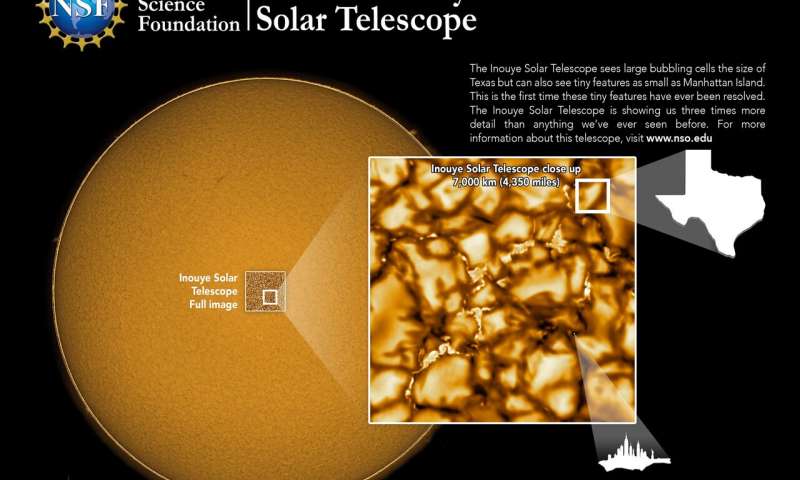
This first images from NSF’s Inouye Solar Telescope show a close-up view of the sun’s surface, which can provide important detail for scientists. The image shows a pattern of turbulent “boiling” plasma that covers the entire sun. The cell-like structures—each about the size of Texas—are the signature of violent motions that transport heat from the inside of the sun to its surface. That hot solar plasma rises in the bright centers of “cells,” cools off and then sinks below the surface in dark lanes in a process known as convection. (See video available with this news release.)

Solar magnetic fields constantly get twisted and tangled by the motions of the sun’s plasma. Twisted magnetic fields can lead to solar storms that can negatively affect our technology-dependent modern lifestyles. During 2017’s Hurricane Irma, the National Oceanic and Atmospheric Administration reported that a simultaneous space weather event brought down radio communications used by first responders, aviation and maritime channels for eight hours on the day the hurricane made landfall.

Finally resolving these tiny magnetic features is central to what makes the Inouye Solar Telescope unique. It can measure and characterize the sun’s magnetic field in more detail than ever seen before and determine the causes of potentially harmful solar activity.

“It’s all about the magnetic field,” said Thomas Rimmele, director of the Inouye Solar Telescope. “To unravel the sun’s biggest mysteries, we have to not only be able to clearly see these tiny structures from 93 million miles away but very precisely measure their strength and direction near the surface and trace the field as it extends out into the million-degree corona, the outer atmosphere of the sun.”

Better understanding the origins of potential disasters will enable governments and utilities to better prepare for inevitable future space weather events. It is expected that notification of potential impacts could occur earlier—as much as 48 hours ahead of time instead of the current standard, which is about 48 minutes. This would allow for more time to secure power grids and critical infrastructure and to put satellites into safe mode.

he Inouye Solar Telescope combines a 13-foot (4-meter) mirror—the world’s largest for a —with unparalleled viewing conditions at the 10,000-foot Haleakalā summit.

Focusing 13 kilowatts of solar power generates enormous amounts of heat—heat that must be contained or removed. A specialized cooling system provides crucial heat protection for the telescope and its optics. More than seven miles of piping distribute coolant throughout the observatory, partially chilled by ice created on site during the night.

00:00
00:00
The Daniel K. Inouye Solar Telescope has produced the highest resolution observations of the sun’s surface ever taken. In this movie, taken at a wavelength of 705 nanometers (nm) over a period of 10 minutes, we can see features as small as 30km (18 miles) in size for the first time ever. The movie shows the turbulent, Credit: NSO/AURA/NSF

The dome enclosing the telescope is covered by thin cooling plates that stabilize the temperature around the telescope, helped by shutters within the dome that provide shade and air circulation. The “heat-stop” (a high-tech, liquid-cooled metal donut) blocks most of the sunlight’s energy from the main mirror, allowing scientists to study specific regions of the sun with unparalleled clarity.

[…]

“This image is just the beginning,” said David Boboltz, program director in NSF’s division of astronomical sciences and who oversees the facility’s construction and operations. “Over the next six months, the Inouye telescope’s team of scientists, engineers and technicians will continue testing and commissioning the telescope to make it ready for use by the international solar scientific community. The Inouye Solar Telescope will collect more information about our sun during the first 5 years of its lifetime than all the solar data gathered since Galileo first pointed a telescope at the sun in 1612.”

Source: NSF’s newest solar telescope produces first images, most detailed images of the sun

NASA to launch projectile (DART) to see if it can deflect asteroids

DART is a planetary defense-driven test of technologies for preventing an impact of Earth by a hazardous asteroid.  DART will be the first demonstration of the kinetic impactor technique to change the motion of an asteroid in space.  The DART mission is in Phase C, led by APL and managed under NASA’s Solar System Exploration Program at Marshall Space Flight Center for NASA’s Planetary Defense Coordination Office and the Science Mission Directorate’s Planetary Science Division at NASA Headquarters in Washington, DC.

DART Spacecraft Bus
Two different views of the DART spacecraft. The DRACO (Didymos Reconnaissance & Asteroid Camera for OpNav) imaging instrument is based on the LORRI high-resolution imager from New Horizons. The left view also shows the Radial Line Slot Array (RLSA) antenna with the ROSAs (Roll-Out Solar Arrays) rolled up. The view on the right shows a clearer view of the NEXT-C ion engine.

The binary near-Earth asteroid (65803) Didymos is the target for the DART demonstration. While the Didymos primary body is approximately 780 meters across, its secondary body (or “moonlet”) is about 160-meters in size, which is more typical of the size of asteroids that could pose the most likely significant threat to Earth. The Didymos binary is being intensely observed using telescopes on Earth to precisely measure its properties before DART arrives.

Didymos and its moonlet
Fourteen sequential Arecibo radar images of the near-Earth asteroid (65803) Didymos and its moonlet, taken on 23, 24 and 26 November 2003. NASA’s planetary radar capabilities enable scientists to resolve shape, concavities, and possible large boulders on the surfaces of these small worlds. Photometric lightcurve data indicated that Didymos is a binary system, and radar imagery distinctly shows the secondary body.
Didymos system
Simulated image of the Didymos system, derived from photometric lightcurve and radar data. The primary body is about 780 meters in diameter and the moonlet is approximately 160 meters in size. They are separated by just over a kilometer. The primary body rotates once every 2.26 hours while the tidally locked moonlet revolves about the primary once every 11.9 hours. Almost one sixth of the known near-Earth asteroid (NEA) population are binary or multiple-body systems.
Credits: Naidu et al., AIDA Workshop, 2016
DART spacecraft with the Roll Out Solar Arrays (rOSA)
Illustration of the DART spacecraft with the Roll Out Solar Arrays (ROSA) extended. Each of the two ROSA arrays in 8.6 meters by 2.3 meters.

The DART spacecraft will achieve the kinetic impact deflection by deliberately crashing itself into the moonlet at a speed of approximately 6.6 km/s, with the aid of an onboard camera (named DRACO) and sophisticated autonomous navigation software. The collision will change the speed of the moonlet in its orbit around the main body by a fraction of one percent, but this will change the orbital period of the moonlet by several minutes – enough to be observed and measured using telescopes on Earth.

Once launched, DART will deploy Roll Out Solar Arrays (ROSA) to provide the solar power needed for DART’s electric propulsion system.  The DART spacecraft will demonstrate the NASA Evolutionary Xenon Thruster – Commercial (NEXT-C) solar electric propulsion system as part of its in-space propulsion.  NEXT-C is a next-generation system based on the Dawn spacecraft propulsion system, and was developed at NASA’s Glenn Research Center in Cleveland, Ohio.  By utilizing electric propulsion, DART could benefit from significant flexibility to the mission timeline while demonstrating the next generation of ion engine technology, with applications to potential future NASA missions.

the ROSA array on the ISS
The ROSA array was tested on board the International Space Station (ISS) in June 2017.

Once launched, DART will deploy Roll Out Solar Arrays (ROSA) to provide the solar power needed for DART’s electric propulsion system.  The DART spacecraft will demonstrate the NASA Evolutionary Xenon Thruster – Commercial (NEXT-C)solar electric propulsion system as part of its in-space propulsion.  NEXT-C is a next-generation system based on the Dawn spacecraft propulsion system, and was developed at NASA’s Glenn Research Center in Cleveland, Ohio.  By utilizing electric propulsion, DART could benefit from significant flexibility to the mission timeline while demonstrating the next generation of ion engine technology, with applications to potential future NASA missions.

The DART spacecraft launch window begins in late July 2021.  DART will launch aboard a SpaceX Falcon 9 rocket from Vandenberg Air Force Base, California. After separation from the launch vehicle and over a year of cruise it will intercept Didymos’ moonlet in late September 2022, when the Didymos system is within 11 million kilometers of Earth, enabling observations by ground-based telescopes and planetary radar to measure the change in momentum imparted to the moonlet.

Source: Double Asteroid Redirection Test (DART) Mission | NASA

Extraterrestrial ribose and other sugars found in primitive meteorites

Ribose is an essential sugar for present life as a building block of RNA, which could have both stored information and catalyzed reactions in primitive life on Earth. Meteorites contain a number of organic compounds including components of proteins and nucleic acids. Among the constituent molecular classes of proteins and nucleic acids (i.e., amino acids, nucleobases, phosphate, and ribose/deoxyribose), the presence of ribose and deoxyribose in space remains unclear. Here we provide evidence of extraterrestrial ribose and other bioessential sugars in primitive meteorites. Meteorites were carriers of prebiotic organic molecules to the early Earth; thus, the detection of extraterrestrial sugars in meteorites implies the possibility that extraterrestrial sugars may have contributed to forming functional biopolymers like RNA.

Source: Extraterrestrial ribose and other sugars in primitive meteorites | PNAS

Elon Musk’s Starlink Satellites Are Already Causing a Headache for Astronomers

Astronomers at a Chilean observatory were rudely interrupted earlier this week when a SpaceX satellite train consisting of 60 Starlink satellites drifted overhead, in what scientists are apparently going to have to accept as the new normal.

Launched into orbit on November 11, the Starlink smallsat train took five minutes to pass over the Cerro Tololo Inter-American Observatory in Chile, according to a tweet from astronomer Clarae Martínez-Vázquez.

“Wow!! I am in shock!!,” tweeted Martínez-Vázquez. “The huge amount of Starlink satellites crossed our skies tonight at [Cerro Tololo]. Our DECam [Dark Energy Camera] exposure was heavily affected by 19 of them!,” to which she added: “Rather depressing… This is not cool!”

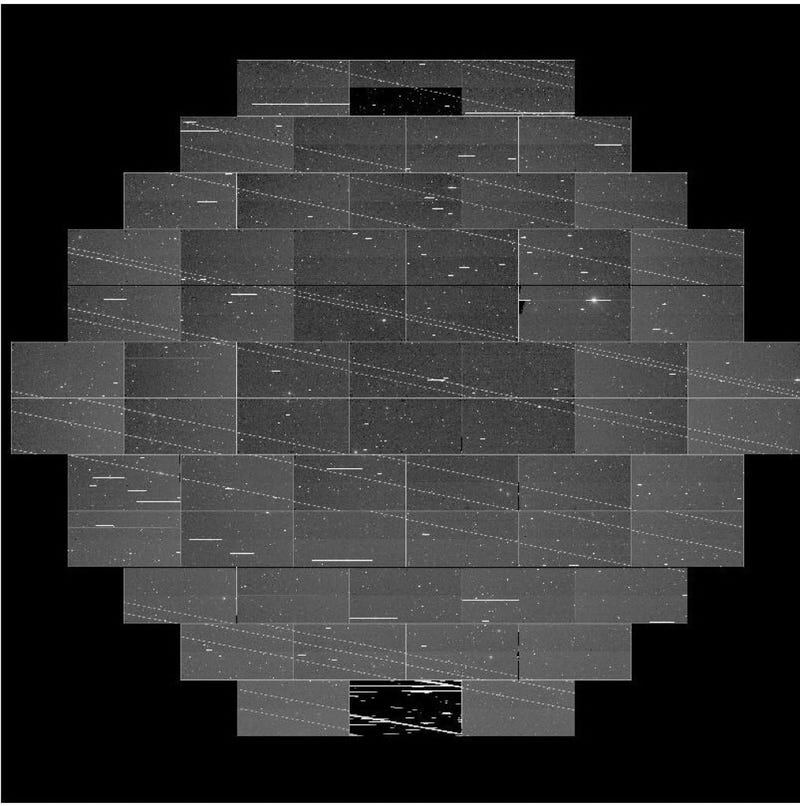
Responding to this tweet, astronomer Cliff Johnson, a team member and a CIERA Postdoc Fellow in Astronomy at Northwestern, tweeted out a view of the disrupted data, showing an array of satellite trails strewn across an image of space.

The astronomers were collecting data using the DECam instrument, a high-performance, wide-field imager on the CTIO Blanco 4-meter telescope, as part of the DELVE survey, which is currently mapping the outer fringes of the Large and Small Magellanic Clouds as well as a significant fraction of the southern sky at optical wavelengths. Key goals of the project are to study the stellar halo around the Magellanic Clouds and detect new dwarf galaxies in orbit around the Clouds or the nearby Milky Way.

The Starlink-tarnished DECam frame, showing satellite trails across the field of view.
Image: Clara Martínez-Vázquez, Cliff Johnson, CTIO/AURA/NSF

But this research was punctuated as the Starlink train passed overhead during the early morning of Monday, November 18.

Source: Elon Musk’s Starlink Satellites Are Already Causing a Headache for Astronomers

SpaceX Starship Mk1 explodes during cryogenic loading test

SpaceX’s first full-scale Starship prototype – Mk1 – has experienced a failure at its Boca Chica test site in southern Texas. The failure occurred late in the afternoon on Wednesday, midway through a test of the vehicle’s propellant tanks.

As of a few weeks ago, the Mk1 Starship – which was shown off to the world in September as part of SpaceX’s and Elon Musk’s presentation of the design changes to the Starship system – was to fly the first 20 km test flight of the program in the coming weeks.

The main event of today, the Mk1 Starship’s first cryogenic loading test, involved filling the methane and oxygen tanks with a cryogenic liquid.

During the test, the top bulkhead of the vehicle ruptured and was ejected away from the site, followed by a large cloud of vapors and cryogenic liquid from the tank.

The cryogenic liquid – likely liquid oxygen or liquid nitrogen – was carried by the wind and dispersed over the launch complex.

The top bulkhead was seen landing nearby, but its precise location is unknown.

The bottom tank bulkhead appeared to fail as well. A second cloud of vapor appeared out of the base of the vehicle at the same time that the top ruptured – signaling that the entire internal tank structure may have failed.

Source: SpaceX Starship Mk1 fails during cryogenic loading test – NASASpaceFlight.com

Elon Musk is fine with it though. I’m glad I’m not sitting in it!

China now launches more rockets than anyone in the world: Russia 2nd, US 3rd

In recent weeks, China’s space program has made news by revealing some of its long-term ambitions for spaceflight. These include establishing an Earth-Moon space economic zone by 2050, which, if successful, could allow the country to begin to dictate the rules of behavior for future space exploration.

Some have questioned whether China, which has flown six human spaceflights in the last 16 years, can really build a large low-Earth space station, send taikonauts to the Moon, return samples from Mars, and more in the coming decade or two. But what seems clear is that the country’s authoritarian government has long-term plans and is taking steps toward becoming a global leader in space exploration.

By one important metric—orbital launches—China has already reached this goal.

In 2018, the country set a goal of 35 orbital launches and ended up with 39 launch attempts. That year, the United States (29 flights) and Russia (20) trailed China, according to Space Launch Report. It marked the first time China led the world in the number of successful orbital launches.

This year, China is set to pace the world again. Through Sunday, the country has launched 27 orbital missions, followed by Russia (19), and the United States (16). Although nearly a month and a half remain in this year, a maximum of six additional orbital launches are likely from the United States in 2019.

Source: China now launches more rockets than anyone in the world | Ars Technica

EU beurocracy, One man’s mistake, missing backups and complete reboot: What we can figure out about Europe’s Galileo satellites going dark

While one key official has sought to blame a single individual for the system going dark, insiders warn that organizational chaos, excessive secrecy and some unusual self-regulation is as much to blame.

Combined with those problems, a battle between European organizations over the satellite system, and a delayed independent report into the July cock-up, means things aren’t looking good for Europe’s answer to America’s GPS system. A much needed shake-up may be on its way.

In mid-July, the agency in charge of the network of 26 satellites, the European Global Navigation Satellite Systems Agency (EGSA), warned of a “service degradation” but assured everyone that it would quickly be resolved.

It wasn’t resolved however, and six days later the system was not only still down but getting increasingly inaccurate, with satellites reporting that they were in completely different positions in orbit than they were supposed to be – a big problem for a system whose entire purpose is to provide state-of-the-art positional accuracy to within 20 centimeters.

Billions of organizations, individuals, phones, apps and so on from across the globe simply stopped listening to Galileo. It’s hard to imagine a bigger mess, aside from the satellites crashing down to Earth.

But despite the outage and widespread criticism over the failure of those behind Galileo to explain what was going on and why, there has been almost no information from the various space agencies and organizations involved in the project.

Source: One man’s mistake, missing backups and complete reboot: The tale of Europe’s Galileo satellites going dark • The Register

The rest is in the article itself

The ‘Three-Body Problem’ Has Perplexed Astronomers Since Newton Formulated It. A.I. Just Cracked It in Under a Second.

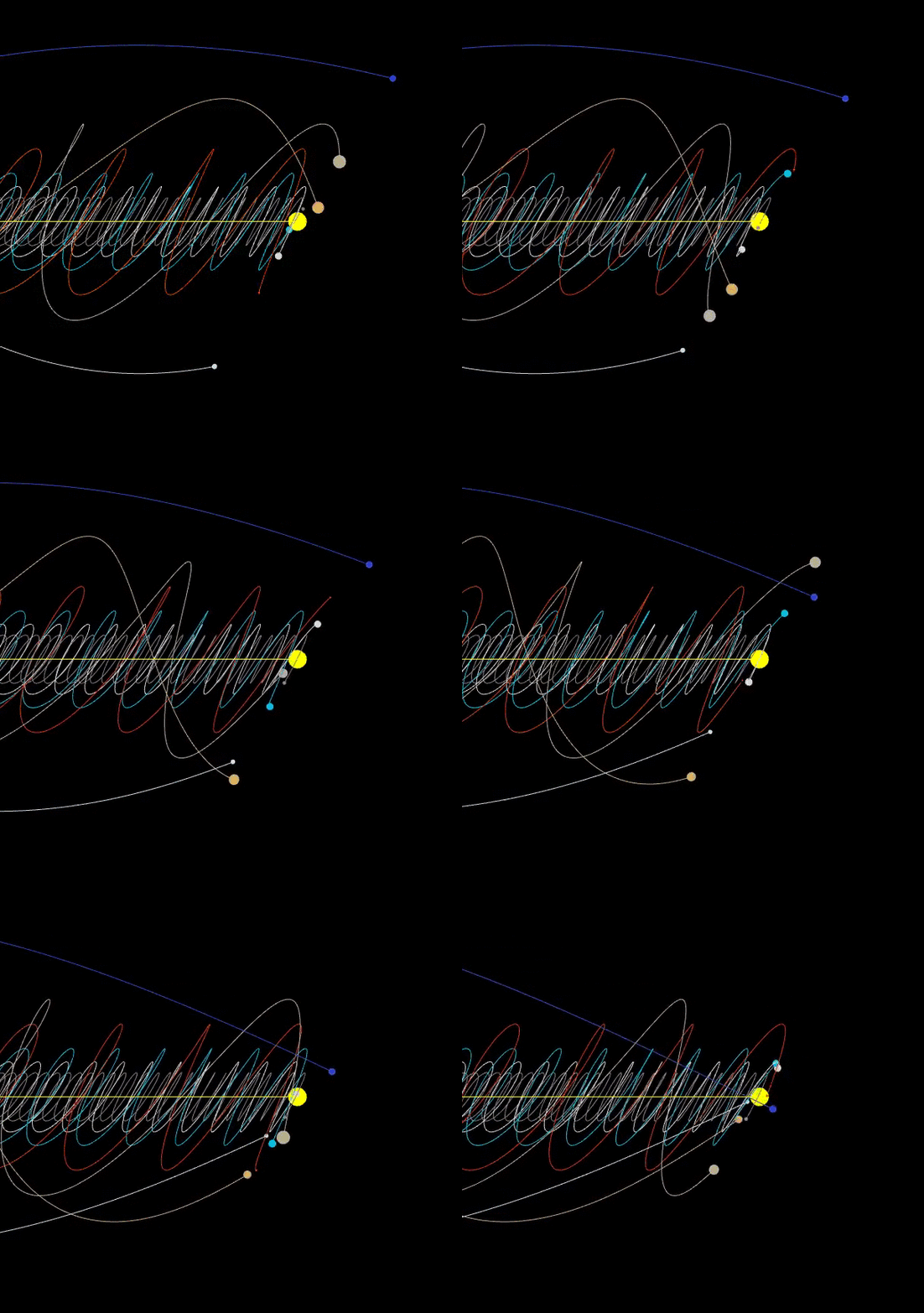
The mind-bending calculations required to predict how three heavenly bodies orbit each other have baffled physicists since the time of Sir Isaac Newton. Now artificial intelligence (A.I.) has shown that it can solve the problem in a fraction of the time required by previous approaches.

Newton was the first to formulate the problem in the 17th century, but finding a simple way to solve it has proved incredibly difficult. The gravitational interactions between three celestial objects like planets, stars and moons result in a chaotic system — one that is complex and highly sensitive to the starting positions of each body.

[…]

The algorithm they built provided accurate solutions up to 100 million times faster than the most advanced software program, known as Brutus.

[…]

Neural networks must be trained by being fed data before they can make predictions. So the researchers had to generate 9,900 simplified three-body scenarios using Brutus, the current leader when it comes to solving three-body problems.

They then tested how well the neural net could predict the evolution of 5,000 unseen scenarios, and found its results closely matched those of Brutus. However, the A.I.-based program solved the problems in an average of just a fraction of a second, compared with nearly 2 minutes.

The reason programs like Brutus are so slow is that they solve the problem by brute force, said Foley, carrying out calculations for each tiny step of the celestial bodies’ trajectories. The neural net, on the other hand, simply looks at the movements those calculations produce and deduces a pattern that can help predict how future scenarios will play out.

That presents a problem for scaling the system up, though, Foley said. The current algorithm is a proof-of-concept and learned from simplified scenarios, but training on more complex ones or even increasing the number of bodies involved to four of five first requires you to generate the data on Brutus, which can be extremely time-consuming and expensive.

Source: The ‘Three-Body Problem’ Has Perplexed Astronomers Since Newton Formulated It. A.I. Just Cracked It in Under a Second. | Live Science

Saturn surpasses Jupiter after the discovery of 20 new moons and you can help name them!

A team led by Carnegie’s Scott S. Sheppard has found 20 new moons orbiting Saturn.  This brings the ringed planet’s total number of moons to 82, surpassing Jupiter, which has 79. The discovery was announced Monday by the International Astronomical Union’s Minor Planet Center.

Each of the newly discovered moons is about five kilometers, or three miles, in diameter. Seventeen of them orbit the planet backwards, or in a retrograde direction, meaning their movement is opposite of the planet’s rotation around its axis. The other three moons orbit in the prograde—the same direction as Saturn rotates.

Two of the prograde moons are closer to the planet and take about two years to travel once around Saturn. The more-distant retrograde moons and one of the prograde moons each take more than three years to complete an orbit.

Source: Saturn surpasses Jupiter after the discovery of 20 new moons and you can help name them! | Carnegie Institution for Science

Scientists Uncover New Organic Molecules Coming Off Saturn’s Moon Enceladus

Scientists have discovered nitrogen- and oxygen- containing organic molecules in ice grains blown out by Saturn’s moon Enceladus, according to a new study.

Gas giants Saturn and Jupiter are orbited by some moons that almost seem more like planets themselves. One such moon is Saturn’s Enceladus, an icy orb thought to contain a very deep subsurface water ocean beneath a thick icy crust. Finding organic molecules on Enceladus is exciting, since water plus energy plus organic molecules might be the ingredients for life.

Enceladus blasted the material out in plumes from cracks in its south polar crust. The plumes carry a mixture of material from the moon’s rocky core and subsurface ocean. The Cassini mission flew through these plumes in 2004 and 2008, gathering data on the material with two of its instruments, the Ion and Neutral Mass Spectrometer (INMS) and the Cosmic Dust Analyser (CDA). For the new study, researchers based in Germany and the United States took a deeper look at the CDA’s data and found new organic compounds, according to the paper published in the Monthly Notices of the Royal Astronomical Society.

The molecules included amines, which are nitrogen- and oxygen-containing organic molecules similar to those on Earth that turn into amino acids. As a reminder, “organic” in this case simply means “containing carbon,” though these are the kind of compounds that can produce the complex molecules found in life on Earth.

[…]

Scientists have previously reported finding large organic molecules in Cassini data. This paper presents a new kind of molecule, one of interest to those hunting for life.

Source: Scientists Uncover New Organic Molecules Coming Off Saturn’s Moon Enceladus

A Moon Space Elevator Is Actually Feasible and Inexpensive: Study

In a paper published on the online research archive arXiv in August, Columbia astronomy students Zephyr Penoyre and Emily Sandford proposed the idea of a “lunar space elevator,” which is exactly what it sounds like—a very long elevator connecting the moon and our planet.

The concept of a moon elevator isn’t new. In the 1970s, similar ideas were floated in science fiction (Arthur C. Clarke’s The Fountains of Paradise, for example) and by academics like Jerome Pearson and Yuri Artsutanov.

But the Columbia study differs from previous proposal in an important way: instead of building the elevator from the Earth’s surface (which is impossible with today’s technology), it would be anchored on the moon and stretch some 200,000 miles toward Earth until hitting the geostationary orbit height (about 22,236 miles above sea level), at which objects move around Earth in lockstep with the planet’s own rotation.

Dangling the space elevator at this height would eliminate the need to place a large counterweight near Earth’s orbit to balance out the planet’s massive gravitational pull if the elevator were to be built from ground up. This method would also prevent any relative motion between Earth’s surface and space below the geostationary orbit area from bending or twisting the elevator.

These won’t be problems for the moon because the lunar gravitational pull is significantly smaller and the moon’s orbit is tidally locked, meaning that the moon keeps the same face turned toward Earth during its orbit, therefore no relative motion of the anchor point.

After doing the math, the researchers estimated that the simplest version of the lunar elevator would be a cable thinner than a pencil and weigh about 88,000 pounds, which is within the payload capacity of the next-generation NASA or SpaceX rocket.

The whole project may cost a few billion dollars, which is “within the whim of one particularly motivated billionaire,” said Penoyre.

Future moon travelers will still have to ride a rocket, though, to fly up to the elevator’s dangling point, and then transfer to a robotic vehicle, which would climb up the cable all the way up to the moon.

Source: A Moon Space Elevator Is Actually Feasible and Inexpensive: Study | Observer

SpaceX Says a ‘Bug’ Prevented It From Receiving Warning of Possible ESA Satellite Collision. For the first time ESA had to unexpectedly avoid a satellite constellation.

The European Space Agency was forced to perform a “collision avoidance maneuver” to prevent its Aeolus spacecraft from potentially smashing into one of Elon Musk’s Starlink satellites, in what is quickly becoming an all-too-common occurrence. According to SpaceX, it never received the expected alert that a collision was possible.

ESA pumped out a series of tweets yesterday describing the incident, in which the Aeolus satellite “fired its thrusters, moving it off a collision course with a @SpaceX satellite in their #Starlink constellation” on Monday morning. Launched in August 2018, the Aeolus Earth science satellite monitors the planet’s wind from space, allowing for better weather predictions and climate modeling.

[…]

Experts in the ESA’s Space Debris Team “calculated the risk of collision between these two active satellites,” determining that the safest option for Aeolus was to increase its height and have it pass over the SpaceX satellite, according to an ESA tweet. It marked the first time the ESA had to perform “a collision avoidance manoeuvre’ to protect one of its satellites from colliding with a ‘mega constellation,’” noted the space agency.

[…]

But as the ESA tweeted yesterday, as “the number of satellites in orbit increases, due to ‘mega constellations’ such as #Starlink comprising hundreds or even thousands of satellites, today’s ‘manual’ collision avoidance process will become impossible…”

[…]

An ESA graphic identified the culprit as being Starlink 44. The maneuver was done a half-Earth-orbit before Aeolus’ closest approach to the Starlink satellite. Jeff Foust from SpaceNews provides more insight into the incident:

Holger Krag, director of ESA’s Space Safety Programme Office, said in a Sept. 3 email that the agency’s conjunction assessment team noticed the potential close approach about five days in advance, using data provided by the U.S. Air Force’s 18th Space Control Squadron. “We have informed SpaceX and they acknowledged,” he said. “Over the days the collision probability exceeded the decision threshold and we started the maneuver preparation and shared our plans with SpaceX. The decision to maneuver was then made the day before.”

The odds of a collision were calculated at 1 in 1,000, which was high enough to warrant the maneuver. ESA scientists assessed the threat using data gathered by the U.S. Air Force, along with the “operators’ own knowledge of spacecraft positions,” according to SpaceNews.

In a statement emailed to Gizmodo, a SpaceX spokesperson said the Starlink team “last exchanged an email with the Aeolus operations team on August 28, when the probability of collision was only in the [1 in 50,000 range], well below the [1 in 10,000] industry standard threshold and 75 times lower than the final estimate.”

Once the U.S. Air Force’s updates showed that the probability had increased to more than 1 in 10,000, “a bug in our on-call paging system prevented the Starlink operator from seeing the follow on correspondence on this probability increase,” according to the spokesperson, who said “SpaceX is still investigating the issue and will implement corrective actions…. had the Starlink operator seen the correspondence, we would have coordinated with ESA to determine best approach with their continuing with their maneuver or our performing a maneuver.”

Yikes. This incident reveals the flimsy and primitive state of space traffic management, in which a failed communication led to ESA having to act unilaterally on the issue.

Source: SpaceX Says a ‘Bug’ Prevented It From Receiving Warning of Possible Satellite Collision

Well done, Elon Musk, incompetence does it again.

ESA satellite dodges a “mega constellation” – Musks cluster satellites

The European Space Agency (ESA) accomplished a first today: moving one of its satellites away from a potential collision with a “mega constellation”.

The constellation in question was SpaceX’s Starlink, and the firing of the thrusters of the Aeolus Earth observation satellite was designed to raise the orbit of the spacecraft to allow SpaceX’s satellite to pass beneath without risking a space slam.

The ESA operations team confirmed that this morning’s manoeuvre took place approximately half an orbit before the potential pileup. It also warned that, with further Starlink satellites in the pipeline and other constellations from the likes of Amazon due to launch, performing such moves manually would soon become impossible.

If plans to orbit thousands more satellites (to bring broadband to remote areas, or inflict it on air-travellers, for example) come to fruition, the ESA team reckons that things will need to be a lot more automated. Acronyms such as AI have been bandied around to create debris and constellation avoidance systems that move faster than the current human-based approach.

We contacted SpaceX to get its take on ESA’s antics, but nothing has yet emerged from Musk’s media orifice. If it does, we will update this article accordingly.

While this is a first for a “mega constellation”, ESA is well practiced at dodging satellites, although mostly dead ones (or debris.) In 2018, the boffins keeping track of things had to perform 28 manoeuvres. A swerve to miss an active spacecraft is, however, unusual.

Aeolus itself was launched on 22 August 2018, and is designed to acquire profiles of the Earth’s winds, handy for understanding the dynamics of weather and improving forecasting.

You can make your own joke about nervous squeaks of flatulence as scientists realised that the spacecraft, designed to spend just over three years in orbit, was headed toward a possible mash-up with one of Musk’s finest.

The incident serves as a timely reminder of the risks of flinging up thousands of small satellites to blanket the Earth with all manner of services. Keeping the things out of the way of each other and those spacecraft with more scientific goals will be an ever increasing challenge if the plans of Musk et al become a reality.

Source: Everyone remembers their first time: ESA satellite dodges a “mega constellation” • The Register

Mysterious, Ancient Radio Signals Keep Pelting Earth. Astronomers Designed an AI to Hunt Them Down..

Sudden shrieks of radio waves from deep space keep slamming into radio telescopes on Earth, spattering those instruments’ detectors with confusing data. And now, astronomers are using artificial intelligence to pinpoint the source of the shrieks, in the hope of explaining what’s sending them to Earth from — researchers suspect — billions of light-years across space.

Usually, these weird, unexplained signals are detected only after the fact, when astronomers notice out-of-place spikes in their data — sometimes years after the incident. The signals have complex, mysterious structures, patterns of peaks and valleys in radio waves that play out in just milliseconds. That’s not the sort of signal astronomers expect to come from a simple explosion, or any other one of the standard events known to scatter spikes of electromagnetic energy across space. Astronomers call these strange signals fast radio bursts (FRBs). Ever since the first one was uncovered in 2007, using data recorded in 2001, there’s been an ongoing effort to pin down their source. But FRBs arrive at random times and places, and existing human technology and observation methods aren’t well-primed to spot these signals.

Now, in a paper published July 4 in the journal Monthly Notices of the Royal Astronomical Society, a team of astronomers wrote that they managed to detect five FRBs in real time using a single radio telescope. [The 12 Strangest Objects in the Universe]

Wael Farah, a doctoral student at Swinburne University of Technology in Melbourne, Australia, developed a machine-learning system that recognized the signatures of FRBs as they arrived at the University of Sydney’s Molonglo Radio Observatory, near Canberra. As Live Science has previously reported, many scientific instruments, including radio telescopes, produce more data per second than they can reasonably store. So they don’t record anything in the finest detail except their most interesting observations.

Farah’s system trained the Molonglo telescope to spot FRBs and switch over to its most detailed recording mode, producing the finest records of FRBs yet.

Based on their data, the researchers predicted that between 59 and 157 theoretically detectable FRBs splash across our skies every day. The scientists also used the immediate detections to hunt for related flares in data from X-ray, optical and other radio telescopes — in hopes of finding some visible event linked to the FRBs — but had no luck.

Their research showed, however, that one of the most peculiar (and frustrating, for research purposes) traits of FRBs appears to be real: The signals, once arriving, never repeat themselves. Each one appears to be a singular event in space that will never happen again.

Source: Mysterious, Ancient Radio Signals Keep Pelting Earth. Astronomers Designed an AI to Hunt Them Down. | Live Science