The Linkielist

Linking ideas with the world

The Linkielist

Swiss lab’s rooftop demo makes fuel from sunlight and air

[…]

the pilot system demonstrates an important possible source of carbon-neutral fuel for industries struggling to decarbonise, such as aviation and shipping, which currently contribute around 8 per cent of total carbon dioxide emissions attributed to human activity.

But, producing 32 millilitres of methanol in a typical seven-hour-day run, the current proof of concept will require investment and a policy shift to compete with fossil fuels.

The technique, described in a peer-reviewed early access version of the paper in science journal Nature earlier this month, captures carbon dioxide and water directly from ambient air. They are then fed into a solar redox unit which is heated to 1,500˚C using an umbrella-like parabolic sunlight collector. The inside of the reactor employs cerium oxide in a two-step thermochemical process. Firstly, cerium oxide is reduced, and oxygen is released. In the second step, CO2 and water are added to a mixture of hydrogen and carbon monoxide. The cerium oxide then absorbs oxygen, oxidizes and returns to its initial state, allowing the process to begin again.

The output mix – also known as syngas – is fed into a gas-to-liquid unit where it is converted to methanol, although such units can convert the gases into kerosene, gasoline, or other liquid fuels.

Given the high investment needed to scale such technology, the output would cost vastly more than commercial aviation fuel and would need policy support to be viable, according to the research group led by Professor Aldo Steinfeld of ETG Zurich.

[…]

With investment, the researchers estimate that the technique could produce 95,000 litres of kerosene a day – enough to fuel an Airbus A350 carrying 325 passengers for a London-New York roundtrip – from a 3.8km2 field.

Co-sourcing water and CO2 from the air means the system could operate without a fresh water supply, making it suitable for desert locations, thus avoiding impact on agriculture, human population or areas rich in wildlife.

[…]

Source: Swiss lab’s rooftop demo makes fuel from sunlight and air • The Register

Fifth Circuit Says Man Can’t Sue Federal Agencies For Allegedly Targeting and Tormenting Him After He Refused To Be An FBI Informant

The secrecy surrounding all things national security-related continues to thwart lawsuits alleging rights violations. The Fifth Circuit Court of Appeals has just dumped a complaint brought by Abdulaziz Ghedi, a naturalized American citizen who takes frequent trips to Somalia, the country he was born in. According to Ghedi’s complaint, rejecting the advances of one federal agency has subjected him to continuous hassling by a number of other federal agencies.

The Appeals Court decision [PDF] opens with a paragraph that telegraphs the futility of Ghedi’s effort, as well as the ongoing string of indignities the government has decided to inflict on people who just want to travel.

Abdulaziz Ghedi is an international businessman who regularly jets across the globe. Frequent travelers, however, are not always trusted travelers. In recent years, Ghedi has had repeated run-ins with one of America’s most beloved institutions: modern airport security.

The general indignities were replaced with seemingly more personal indignities when Ghedi decided he wasn’t interested in working part-time for the feds.

Ghedi complains that ever since he refused to be an informant for the Federal Bureau of Investigation a decade ago, he has been placed on a watchlist, leading to “extreme burdens and hardship while traveling.”

This isn’t a novel complaint. This has happened to plenty of immigrants and US citizens who visit countries the federal government finds interesting. Many, many Muslims have been approached by the FBI to work as informants. And many have reported their traveling experiences got noticeably worse when they refused to do so.

Without moving past a motion to dismiss, there can be no discovery. And national security concerns means there isn’t going to be much to discover, even if a plaintiff survives a first round of filings.

Unsurprisingly, the Government refuses to confirm or deny anything.

That put Ghedi in the crosshairs of “a byzantine structure featuring an alphabet soup of federal agencies,” as the court puts it. The DHS oversees everything. Day-to-day hassling is handled by the TSA (domestic travelers) and the CBP (international travelers). Ghedi saw more of one (CBP) than the other, but the TSA still handles screening of passengers and luggage, so he saw plenty of both.

The refusal to join the FBI as a paid informant apparently led to all of the following:

• an inability to print a boarding pass at home, requiring him to interact with ticketing agents “for an average of at least one hour, when government officials often appear and question” him;

• an SSSS designation on his boarding passes;

• TSA searches of his belongings, “with the searches usually lasting at least an hour”;

• TSA pat downs when departing the U.S. and CBP pat downs when returning to the U.S.;

• encounters with federal officers when boarding and deboarding planes;

• questioning and searches by CBP officers “for an average of two to three hours” after returning from international travel;

• CBP confiscation of his laptop and cellphone “for up to three weeks”;

• being taken off an airplane two times after boarding; and

• being detained for seven hours by DHS and CBP officials in Buffalo, New York in May 2012 and being detained in Dubai for two hours in March 2019.

Ghedi approached the DHS through its court-mandated redress program to inquire about his status twice — once in 2012 and again in 2019. In both cases, the DHS refused to confirm or deny anything about his travel status or his placement on any watchlists that might result in enhanced screening and extended conversations with federal agents every time he flew.

Ghedi sued the heads of all the agencies involved, alleging rights violations stemming from his refusal to become an informant and his apparent placement on some watchlist operated by these agencies.

Ghedi brings two Fourth Amendment claims. The first alleges that the heads of the DHS, TSA, and CBP violated his Fourth Amendment rights through “prolonged detentions,” and “numerous invasive, warrantless patdown searches” lacking probable cause. The second alleges that the heads of the DHS, TSA, and CBP also violated his Fourth Amendment rights through their agents conducting “warrantless searches of his cell phones without probable cause.” The Fourth Amendment protects “[t]he right of the people to be secure in their persons . . . and effects, against unreasonable searches and seizures.”

The district court said he had no standing to sue. The Fifth Circuit says he does. But standing to sue doesn’t matter if you sue the wrong people. The Appeals Court says there’s a plausible injury alleged here, but it wasn’t perpetrated by the named defendants.

Even though we hold that Ghedi has plausibly alleged an injury in fact, he still must satisfy standing’s second prong—that his injury is fairly traceable to these Defendants. Here Ghedi’s Fourth Amendment claims falter. That is because Ghedi bases his Fourth Amendment claims on TSA and CBP agents’ searching him and seizing his electronics. He argues these searches and seizures are atypical actions, even for people on the Selectee List. Yet instead of suing these agents directly, Ghedi has brought his Fourth Amendment claims against the heads of DHS, TSA, and CBP. Ghedi does not allege that any of these officials personally conducted or directed the searches or seizures he has experienced. And his allegations that his experiences are atypical cut against an inference that these agents are following official policy.

Not only that, but the court says Ghedi has never been prevented from traveling. At worst, traveling has become a constant hassle, marked by hours-long delays, unexplained device seizures, and plenty of unwanted conversations with federal agents. But ultimately Ghedi got where he was going and I guess that’s good enough.

Ghedi never alleges that he was prevented from ultimately getting to his final destination. At most, these allegations lead to a reasonable inference that the Government has inconvenienced Ghedi. But they do not plausibly allege a deprivation of Ghedi’s right to travel.

There are some rights the court will recognize but this isn’t one of them.

In short, Ghedi has no right to hassle-free travel. In the Supreme Court’s view, international travel is a “freedom” subject to “reasonable governmental regulation.” And when it comes to reasonable governmental regulation, our sister circuits have held that Government-caused inconveniences during international travel do not deprive a traveler’s right to travel.

And, putting the final nail in Ghedi’s litigation coffin, the Appeals Court says the government’s secrets may harm individuals but they can’t harm their reputation… because they’re secret.

As we noted at the outset, Ghedi’s status on the Selectee List is a Government secret. Simply put, secrets are not stigmas. The very harm that a stigma inflicts comes from its public nature. Ghedi pleaded no facts to support that the Government has ever published his status—one way or the other—on the Selectee List. His assertions that the Government has attached the “stigmatizing label of ‘suspected terrorist’” and “harm[ed] . . . his reputation” are legal conclusions, not factual allegations.

That’s how it goes for litigants trying to sue over rights violations perpetrated by agencies engaged in the business of national security. Allegations are tough to verify because the government refuses to confirm, deny, or even discuss a great deal of its national security work in court. Ghedi could always try this lawsuit again, perhaps armed with FOIA’ed documents pertaining to his travels and the many agencies that make it difficult for him. But that’s as unlikely to result in clarifying information for the same reason: national security.

[…]

Source: Fifth Circuit Says Man Can’t Sue Federal Agencies For Allegedly Targeting Him After He Refused To Be An FBI Informant | Techdirt

EU Plans to Ban Trading Practice That Helps Fuel GameStop Value Surge – or retail traders actually trade

The European Commission is planning to ban payment for order flow, paralleling potential U.S. moves to stem a practice that hit the headlines during the meme-stock mania.

A forthcoming review of the Markets in Financial Instruments Directive will include a ban amid other measures to increase transparency, such as a consolidated tape of information about transactions, people familiar with the matter said.

The U.S. Securities and Exchange Commission is separately weighing a ban on payment for order flow, in which trading firms pay retail brokerages to execute their trades. Regulators are concerned that video-game like prompts have encouraged excessive trading on app-based brokerages that fueled a explosive surge in value for GameStop Corp. and other stocks this year.

relates to EU Set to Ban Trading Practice Helping Power Meme-Stock Mania

While the day-trading frenzy is far more muted in Europe than the U.S., the practice of zero-commission trading is starting to cross the Atlantic. That prompted the bloc’s markets watchdog to warn firms and investors in July of the risks arising from payment for order flow.

EXPLAINER: How Payment for Order Flow Works 

A spokesperson for the European Commission declined to comment.

Mairead McGuinness, the EU’s financial services commissioner, said this month regulators were “closely monitoring” payment for order flow. It was difficult to assess how problematic the practice is “because there is no consolidated view of all liquidity and prices of financial instruments traded across execution venues in the European markets.”

McGuinness said the payment for order flow “may lead to retail orders not being executed on terms most favorable to the client but instead on the terms most profitable to brokers,” according to a written response to a question from a European Union lawmaker.

“This would not be in line with the second Markets in Financial Instruments Directive,” she said. It’s also why regulators are “considering proposing legislation to facilitate a consolidated tape that provides all brokers and their clients with such a holistic view” of all liquidity and prices of financial instruments traded across execution venues in the European markets.

Consolidated Tape

The EU is planning to set a separate tape for each asset class, according to the people familiar. Details on delivery, specifications and speed would be set out later. There may be a tender process to choose the provider of a consolidated tape for an asset class.

The current draft notes a 15-minute delay to consolidate the data will remain acceptable, echoing current rules where exchanges should provide their data for free after 15 minutes. Those contributing data to the tape would share its revenue if the tape consolidates data in less than 15 minutes.

Source: EU Plans to Ban Trading Practice That Helps Fuel GameStop Value Surge – Bloomberg

So trying to restrict people from trading is somehow good for “the market”?

Researchers develop program to read any genome sequence and decipher its genetic code – shows underlying evolutionary forces

Yekaterina “Kate” Shulgina was a first year student in the Graduate School of Arts and Sciences, looking for a short computational biology project so she could check the requirement off her program in systems biology. She wondered how genetic code, once thought to be universal, could evolve and change.

That was 2016 and today Shulgina has come out the other end of that short-term project with a way to decipher this genetic mystery. She describes it in a new paper in the journal eLife with Harvard biologist Sean Eddy.

The report details a new computer program that can read the of any organism and then determine its genetic code. The program, called Codetta, has the potential to help scientists expand their understanding of how the genetic code evolves and correctly interpret the genetic code of newly sequenced .

“This in it of itself is a very fundamental biology question,” said Shulgina, who does her graduate research in Eddy’s Lab.

The genetic code is the set of rules that tells the cells how to interpret the three-letter combinations of nucleotides into proteins, often referred to as the building blocks of life. Almost every organism, from E. coli to humans, uses the same genetic code. It’s why the code was once thought to be set in stone. But scientists have discovered a handful of outliers—organisms that use alternative genetic codes—exist where the set of instructions are different.

This is where Codetta can shine. The program can help to identify more organisms that use these alternative genetic codes, helping shed new light on how genetic codes can even change in the first place.

“Understanding how this happened would help us reconcile why we originally thought this was impossible… and how these really fundamental processes actually work,” Shulgina said.

Already, Codetta has analyzed the genome sequences of over 250,000 bacteria and other called archaea for alternative genetic codes, and has identified five that have never been seen. In all five cases, the code for the amino acid arginine was reassigned to a different amino acid. It’s believed to mark the first-time scientists have seen this swap in bacteria and could hint at evolutionary forces that go into altering the genetic code.

[…]

Source: Researchers develop program to read any genome sequence and decipher its genetic code

How to Stop Chrome From Sharing Your Motion Data on Android

[…] Mysk, a duo of app developers and security researchers, recently exposed Chrome’s shadiness on Twitter. In the tweet, Mysk brings to light that, by default, Chrome is sharing your phone’s motion data with the websites you visit. This is not cool.

Why you don’t want third parties accessing your motion data

To start with, this is—as I have pointed out—creepy af. The data comes from your phone’s accelerometer, the sensor responsible for tracking the device’s orientation and position. That sensor makes it possible to switch from portrait to landscape mode, as well as track you and your phone’s motion. For example, it empowers fitness apps to know how many steps you took, so long as you had your phone on you.

Since most of us keep our phones in our pocket or on our person, there is a lot of motion data generated on the device throughout the day. Google Chrome, by design, allows any website you click on to request that motion data, and hands it over with gusto. Researchers have found that these sites use accelerometer data to monitor ad interactions, check ad impressions, and to track your device (well, duh). Those first two, however, are infuriatingly sketchy; websites don’t just want to know if you’ll click on an ad or not, they want to know how you physically interact with these popups. Hey, why stop there? Why not tap into my camera and see what color shirt I’m wearing?

How to stop Chrome from sharing motion data with sites

Delete the app from your phone. Kidding. I know the vast majority of people on Android aren’t going to want to switch from Chrome to another mobile browser. That said, privacy-minded users might want to jump ship to something more reputable—like Firefox—and, if so, good for you.

But there are plenty of benefits to sticking with Chrome, especially on Android (considering the platform is also designed and operated by Google). If you don’t want to take the most drastic step, you can simply toggle a setting to block Google from sharing this data. As Mysk points out in their tweet, you can disable motion-data-sharing from Chrome’s settings.

Here’s how: Open the app, tap the three dots in the top-right corner, then choose “Settings.” Next, scroll down, tap “Site settings,” then “Motion sensors.” Turn off the toggle here to make sure no more third-party sites can ask for your motion data from here on out.

Source: How to Stop Chrome From Sharing Your Motion Data on Android

Got Anything To Talk About? These Dutch Hackers Want You To Say It To Them

As we head into another Northern Hemisphere pandemic winter and hope that things won’t be quite as bad this year, next summer seems an extremely long time away in the future. But it will be upon us sooner than we might think, and along with it will we hope come a resumption of full-scale hacker camps. One of the biggest will be in the Netherlands, where MCH 2022 will take lace at the end of July, and if you’re up to casting your minds ahead far enough for that then they’re inviting submissions to their Call for Participation. Their events are always a memorable and relaxed opportunity to spend a few days in the sun alongside several thousand other like-minded individuals, so we’d urge you to give it some consideration.

If you’ve never delivered a conference talk before then it can be a daunting prospect, but in fact a hacker camp can be an ideal place to give it a first try. Unlike a more traditional technology conference where most of the attendees file into the auditorium, at hacker camps there is so much else on offer that many talks are delivered to only that sub group of attendees for whom the subject is of real interest. So there is less of the huge auditorium of anonymous crowds about it, and more of the small and friendly crowd of fellow enthusiasts. The great thing about our community is that there are as many different interests within it as there are individuals, so whatever your product, specialism, or favourite hobby horse might be, you’ll find people at a hacker camp who’d like to hear what you have to say.

If you’re still seeking inspiration, of course you might find it by looking at the schedule from SHA, the last Dutch camp.

Source: Got Anything To Talk About? These Dutch Hackers Want You To Say It To Them | Hackaday

Microsoft will now snitch on you at work like never before

[…]

this news again comes courtesy of Microsoft’s roadmap service, where Redmond prepares you for the joys to come.

This time, there are a couple of joys.

The first is headlined: “Microsoft 365 compliance center: Insider risk management — Increased visibility on browsers.”

It all sounded wonderful until you those last four words, didn’t it? For this is the roadmap for administrators. And when you give a kindly administrator “increased visibility on browsers,” you can feel sure this means an elevated level of surveillance of what employees are typing into those browsers.

In this case, Microsoft is targeting “risky activity.” Which, presumably, has some sort of definition. It offers a link to its compliance center, where the very first sentence has whistleblower built in: “Web browsers are often used by users to access both sensitive and non-sensitive files within an organization.”

And what is the compliance center monitoring? Why, “files copied to personal cloud storage, files printed to local or network devices, files transferred or copied to a network share, files copied to USB devices.”

You always assumed this was the case? Perhaps. But now there will be mysteriously increased visibility.

“How might this visibility be increased?,” I hear you shudder. Well, there’s another little roadmap update that may, just may, offer a clue.

This one proclaims: “Microsoft 365 compliance center: Insider risk management — New ML detectors.”

Yes, your company will soon have extra-special robots to crawl along after you and observe your every “risky” action. It’s not enough to have increased visibility on browsers. You must also have Machine Learning constantly alert for someone revealing your lunch schedule.

Microsoft offers a link to its Insider Risk Management page. This enjoys some delicious phrasing: “Customers acknowledge insights related to the individual user’s behavior, character, or performance materially related to employment can be calculated by the administrator and made available to others in the organization.”

Yes, even your character is being examined here.

[…]

Source: Microsoft will now snitch on you at work like never before | ZDNet

Robinhood Hack Compromises Millions of Customer Email Addresses

Someone recently hacked and attempted to extort Robinhood, the popular investment and trading platform, gaining access to millions of customers’ email addresses and full names in the process.

The platform revealed the security incident in a blog post published Monday, assuring users that nobody had lost any money as a result of the incident.

“An unauthorized third party obtained access to a limited amount of personal information for a portion of our customers,” the company revealed, while emphasizing that the breach had since been contained and that there had been “no financial loss to any customers.”

The incident, which took place on Nov. 3, was apparently the result of a social engineering scheme that targeted a customer support employee. The hacker convinced the employee that they were cleared to access “certain customer support systems,” and subsequently gained access to the email addresses of approximately 5 million customers and the full names of approximately 2 million customers, the company said.

For a much smaller subset of customers, the data breach was substantially more invasive: “We also believe that for a more limited number of people—approximately 310 in total—additional personal information, including name, date of birth, and zip code, was exposed, with a subset of approximately 10 customers having more extensive account details revealed,” the company’s blog post says.

Afterward, the criminal attempted to extort the company with the information it had stolen.

[…]

Source: Robinhood Hack Compromises Millions of Customer Email Addresses

Star System With Right-Angled Planets Surprises Astronomers

this report from the New York Times about a “particularly unusual” star about 150 light-years away that’s orbited by three planets: What’s unusual is the inclinations of the outer two planets, HD 3167 c and d. Whereas in our solar system all the planets orbit in the same flat plane around the sun, these two are in polar orbits. That is, they go above and below their star’s poles, rather than around the equator as Earth and the other planets in our system do.

Now scientists have discovered the system is even weirder than they thought. Researchers measured the orbit of the innermost planet, HD 3167 b, for the first time — and it doesn’t match the other two. It instead orbits in the star’s flat plane, like planets in our solar system, and perpendicular to HD 3167 c and d. This star system is the first one known to act like this

The unusual configuration of HD 3167 highlights just how weird and wonderful other stars and their planets can be. “It puts in perspective again what we think we know about the formation of planetary systems,” said Vincent Bourrier from the University of Geneva in Switzerland, who led the discovery published last month in the journal Astronomy & Astrophysics.

“Planets can evolve in really, really different ways.”

Source: Star System With Right-Angled Planets Surprises Astronomers – Slashdot

DIY House Plants Watering System

Build watering system for house plants. In part one of this video series, we will create a sensor that measures soil moisture, ambient temperature and light.

Build watering system for house plants. In part two of this video series, we will create a central unit that takes sensor readings and also waters our plants on command.

Build watering system for house plants. In part two of this video series, we will create a central unit that takes sensor readings and also waters our plants on command.

Source: https://github.com/SasaKaranovic/HousePlantMonitoringSystem

No toilet for returning SpaceX crew, stuck using diapers – had just eaten chilli and tacos

The astronauts who will depart the International Space Station on Sunday will be stuck using diapers on the way home because of their capsule’s broken toilet.

NASA astronaut Megan McArthur described the situation Friday as “suboptimal” but manageable. She and her three crewmates will spend 20 hours in their SpaceX capsule, from the time the hatches are closed until Monday morning’s planned splashdown.

“Spaceflight is full of lots of little challenges,” she said during a news conference from orbit. “This is just one more that we’ll encounter and take care of in our mission. So we’re not too worried about it.”

After a series of meetings Friday, mission managers decided to bring McArthur and the rest of her crew home before launching their replacements. That SpaceX launch already had been delayed more than a week by and an undisclosed medical issue involving one of the crew.

SpaceX is now targeting liftoff for Wednesday night at the earliest.

French astronaut Thomas Pesquet, who will return with McArthur, told reporters that the past six months have been intense up there. The conducted a series of spacewalks to upgrade the station’s , endured inadvertent thruster firings by docked Russian vehicles that sent the station into brief spins, and hosted a private Russian film crew—a first.

They also had to deal with the toilet leak, pulling up panels in their SpaceX capsule and discovering pools of urine. The problem was first noted during SpaceX’s private flight in September, when a tube came unglued and spilled urine beneath the floorboards. SpaceX fixed the toilet on the capsule awaiting liftoff, but deemed the one in orbit unusable.

Engineers determined that the capsule had not been structurally compromised by the urine and was safe for the ride back. The astronauts will have to rely on what NASA describes as absorbent “undergarments.”

On the culinary side, the astronauts grew the first chile peppers in —”a nice moral boost,” according to McArthur. They got to sample their harvest in the past week, adding pieces of the green and red peppers to tacos.

“They have a nice spiciness to them, a little bit of a lingering burn,” she said. “Some found that more troublesome than others.”

Also returning with McArthur and Pesquet: NASA astronaut Shane Kimbrough and Japanese astronaut Akihiko Hoshide. SpaceX launched them to the space station on April 23. Their capsule is certified for a maximum 210 days in space, and with Friday marking their 196th day aloft, NASA is eager to get them back as soon as possible.

One American and two Russians will remain on the space following their departure. While it would be better if their replacements arrived first—in order to share tips on living in space—Kimbrough said the remaining NASA astronaut will fill in the newcomers.

Source: No toilet for returning SpaceX crew, stuck using diapers

Alfa Romeo will debut an all-electric Giulia sedan in 2024

Alfa Romeo Giulia
Alfa Romeo

Italian automaker Alfa Romeo is developing an all-electric version of its four-door Giulia sedan. In an interview with Auto Express, Jean-Philippe Imparato, the company’s CEO, said Alfa Romeo would debut the EV sometime in 2024. Additionally, he revealed the car will be built on the STLA Large platform from its parent company Stellantis.

The conglomerate announced the architecture this past summer. At the time, it said it would allow its cars to go from zero to 60 in as little as two seconds, and allow for a potential range of up to 500 miles. Dodge, one of the other automakers under the Stellantis umbrella, will use the platform in the all-electric muscle car it plans to debut in 2024. Alfa Romeo could also offer a Quadrifoglio variant of the Giulia, but Imparato said that will depend on whether it can get the kind of performance that’s associated with the moniker.

[….]

Source: Alfa Romeo will debut an all-electric Giulia sedan in 2024 | Engadget

Reg reader ditches Samsung smart TV after seeing huge UI ads everywhere

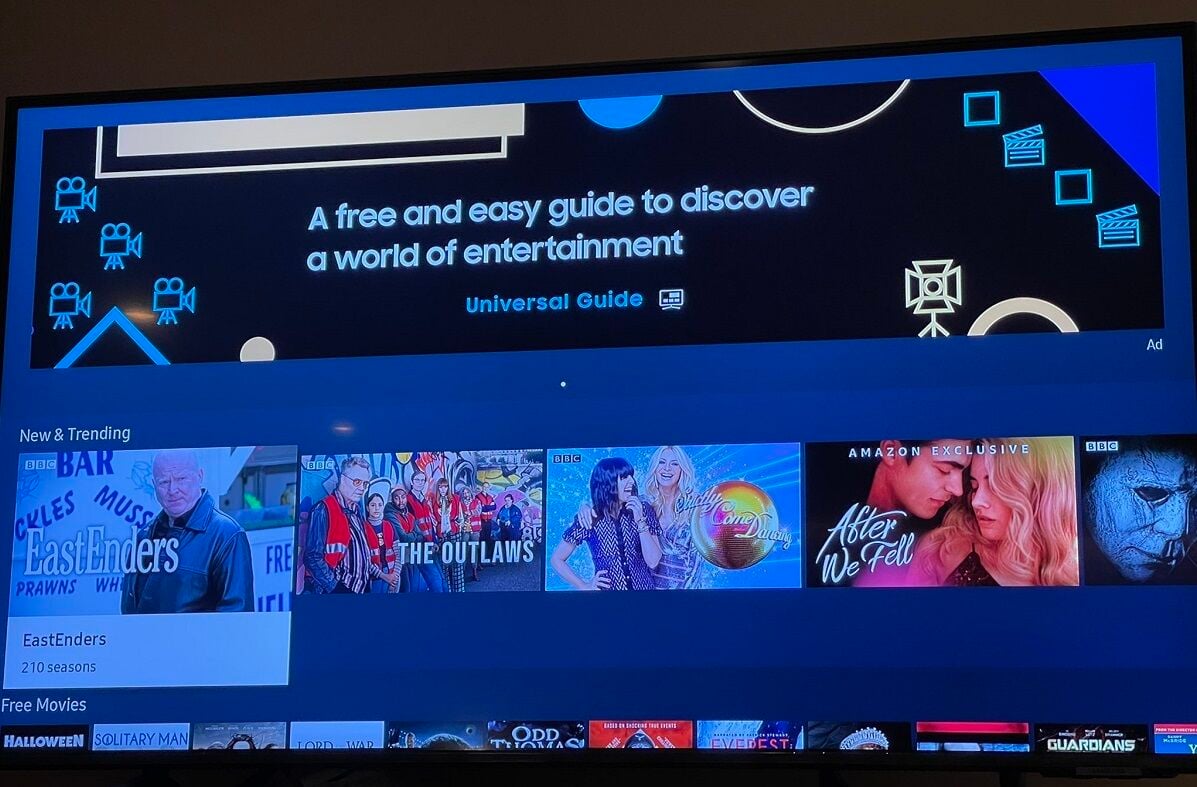
A Register reader triggered a kerfuffle for Samsung after asking the electronics biz if he could disable large and intrusive adverts splattered across his new smart TV’s programme guide.

Ross McKillop bought the telly from UK retailer John Lewis but felt distinctly undersold when he turned it on to find the internet-connected device displaying advertising on its electronic programme guide menu.

Reg reader Ross McKillop's Samsung TV displaying smart ads taking up half the screen space

Ross McKillop’s Samsung TV displaying smart ads taking up half the screen space

“If you press the menu button to change between like TV or Netflix or, or whatever, even different sources, there’s an advert panel,” lamented McKillop to The Reg. “It seems that people accept this.”

Irritated by the giant advert for Samsung’s own wares, McKillop took to Twitter to ask the obvious question. The answer was surprisingly blunt.

“The more annoying [advert],” McKillop told us, “is the one that appears on the application menu, on every menu [level].”

Such a problem is, sadly, not new, as we reported about a year ago when other Samsung TV customers began wondering where the giant adverts splattered all over their TVs’ user interfaces had come from.

“I expect Netflix to promote Netflix’s products or Netflix programming on a service I pay for because it’s a service,” stormed McKillop, adding that he didn’t expect to have his TV’s manufacturer insert unavoidable advertising into his new box.

Smart readers (like our man Ross) know that you can kill ads at home with innovations such as the Pi-Hole home network-level adblocker.

Our reader also pointed out that the adverts on his new internet-connected telly were not visible in Samsung’s marketing videos about the product.

We asked Samsung if it wished to comment. The manufacturer failed to respond. McKillop has since returned his TV to retailer John Lewis.

Samsung has been relatively open about what its smart TVs do. A quick look at the “Samsung privacy policy – smart TV supplement” on its UK website reveals that the company hoovers up information about “your TV viewing history” including “information about the networks, channels, websites visited, and programs viewed on your Samsung Smart TV and the amount of time spent viewing them”.

This kind of subtle-but-invasive monitoring was the subject of a warning by an American university professor in 2019 who described it as “a cesspit of surveillance”.

The devices can pose a security risk unless they’re treated like any other internet-connectable device, as the Korean giant itself reminded tellywatchers a couple of years ago (well, they deleted that Twitter missive but El Reg doesn’t forget).

All in all, if you’re buying a Samsung TV, just remember that you’re not only paying for a big panel so you can watch reruns of Friends; you’re also paying to be part of Samsung’s global TV advertising network.

Source: Reg reader ditches Samsung smart TV after seeing huge UI ads • The Register

Kleiman v. Wright: $65 Billion Bitcoin Case Has Started

The civil trial of Ira Kleiman vs. Craig Wright started on Monday in Miami. The estate of David Kleiman is suing Craig Wright, the self declared inventor of bitcoin, for 50% ownership of 1.1 million bitcoins. The estate claims Kleiman was in a partnership with Wright to mine the coins but after Kleiman died in April 2013, Wright denied any partnership. At over $60,000 each per bitcoin, this case is currently worth $65 billion.

Craig Wright has previously claimed he is the inventor of Bitcoin, Satoshi Nakamoto, which has been met with skepticism based on his inability to show any proof. In this case, Wright has made numerous dubious claims. After the case was filed in 2018, Wright claimed he did not have the keys to the coins but that they would be arriving in January 2020 through a “bonded courier.” After January 2020, Wright provided keys to the estate for verification which the estate claims the bitcoins were fake. Expressing skepticism that the courier even existed, the estate asked for more information about the courier. Wright then claimed the identity of the courier and all communications were protected under attorney-client privilege as the courier was an attorney.

Source: Kleiman v. Wright: $65 Billion Bitcoin Case Has Started – Slashdot

Code compiled to WASM may lack standard security defenses

[…]

In a paper titled, The Security Risk of Lacking Compiler Protection in WebAssembly, distributed via ArXiv, the technical trio say that when a C program is compiled to WASM, it may lack anti-exploit defenses that the programmer takes for granted on native architectures.

The reason for this, they explain, is that security protections available in compilers like Clang for x86 builds don’t show up when WASM output is produced.

“We compiled 4,469 C programs with known buffer overflow vulnerabilities to x86 code and to WebAssembly, and observed the outcome of the execution of the generated code to differ for 1,088 programs,” the paper states.

“Through manual inspection, we identified that the root cause for these is the lack of security measures such as stack canaries in the generated WebAssembly: while x86 code crashes upon a stack-based buffer overflow, the corresponding WebAssembly continues to be executed.”

[….]

For those not in the know, a stack is a structure in memory used by programs to store temporary variables and information controlling the operation of the application. A stack canary is a special value stored in the stack. When someone attempts to exploit, say, a buffer overflow vulnerability in an application, and overwrite data on the stack to hijack the program’s execution, they should end up overwriting the canary. Doing so will be detected by the program, allowing it to trap and end the exploitation attempt.

Without these canaries, an exploited WASM program could continue running, albeit at the bidding of whoever attacked it, whereas its x86 counterpart exits for its own protection, and that’s a potential security problem. Stack canaries aren’t a panacea, and they can be bypassed, though not having them at all makes exploitation a lot easier.

And these issues are not necessarily a deal-breaker: WASM bytecode still exists in a sandbox, and has further defenses against control-flow hijacking techniques such as return-oriented programming.

But as the researchers observe, WASM’s documentation insists that stack-smashing protection isn’t necessary for WASM code. The three boffins say their findings indicate security assumptions for x86 binaries should be questioned for WASM builds and should encourage others to explore the consequences of this divergent behavior, as it applies both to stack-based buffer overflows and other common security weaknesses.

[…]

Source: Code compiled to WASM may lack standard security defenses • The Register

Likely Drone Attack On U.S. Power Grid Revealed In New Intelligence Report

U.S. officials believe that a DJI Mavic 2, a small quadcopter-type drone, with a thick copper wire attached underneath it via nylon cords was likely at the center of an attempted attack on a power substation in Pennsylvania last year. An internal U.S. government report that was issued last month says that this is the first time such an incident has been officially assessed as a possible drone attack on energy infrastructure in the United States, but that this is likely to become more commonplace as time goes on. This is a reality The War Zone has sounded the alarm about in the past, including when we were first to report on a still unexplained series of drone flights near the Palo Verde nuclear powerplant in Arizona in 2019.

[…]

“This is the first known instance of a modified UAS [unmanned aerial system] likely being used in the United States to specifically target energy infrastructure,” the JIB states. “We assess that a UAS recovered near an electrical substation was likely intended to disrupt operations by creating a short circuit to cause damage to transformers or distribution lines, based on the design and recovery location.”

ABC and other outlets have reported that the JIB says that this assessment is based in part on other unspecified incidents involving drones dating back to 2017.

[…]

Beyond the copper wire strung up underneath it, the drone reportedly had its camera and internal memory card removed. Efforts were taken to remove any identifying markings, indicating efforts by the operator or operators to conceal the identifies and otherwise make it difficult to trace the drone’s origins.

[…]


Source: Likely Drone Attack On U.S. Power Grid Revealed In New Intelligence Report

US bans trade with security firm NSO Group over Pegasus spyware

Surveillance software developer NSO Group may have a very tough road ahead. The US Commerce Department has added NSO to its Entity List, effectively banning trade with the firm. The move bars American companies from doing business with NSO unless they receive explicit permission. That’s unlikely, too, when the rule doesn’t allow license exceptions for exports and the US will default to rejecting reviews.

NSO and fellow Israeli company Candiru (also on the Entity List) face accusations of enabling hostile spying by authoritarian governments. They’ve allegedly supplied spyware like NSO’s Pegasus to “authoritarian governments” that used the tools to track activists, journalists and other critics in a bid to crush political dissent. This is part of the Biden-Harris administration’s push to make human rights “the center” of American foreign policy, the Commerce Department said.

The latest round of trade bans also affects Russian company Positive Technologies and Singapore’s Computer Security Initiative Consultancy, bot of which were accused of peddling hacking tools.

[…]

Source: US bans trade with security firm NSO Group over Pegasus spyware (updated) | Engadget

UK Schools Normalizing Biometric Collection By Using Facial Recognition For Meal Payments

Subjecting students to surveillance tech is nothing new. Most schools have had cameras installed for years. Moving students from desks to laptops allows schools to monitor internet use, even when students aren’t on campus. Bringing police officers into schools to participate in disciplinary problems allows law enforcement agencies to utilize the same tech and analytics they deploy against the public at large. And if cameras are already in place, it’s often trivial to add facial recognition features.

The same tech that can keep kids from patronizing certain retailers is also being used to keep deadbeat kids from scoring free lunches. While some local governments in the United States are trying to limit the expansion of surveillance tech in their own jurisdictions, governments in the United Kingdom seem less concerned about the mission creep of surveillance technology.

Some students in the UK are now able to pay for their lunch in the school canteen using only their faces. Nine schools in North Ayrshire, Scotland, started taking payments using biometric information gleaned from facial recognition systems on Monday, according to the Financial Times. [alt link]

The technology is being provided by CRB Cunningham, which has installed a system that scans the faces of students and cross-checks them against encrypted faceprint templates stored locally on servers in the schools. It’s being brought in to replace fingerprint scanning and card payments, which have been deemed less safe since the advent of the COVID-19 pandemic.

According to the Financial Times report, 65 schools have already signed up to participate in this program, which has supposedly dropped transaction times at the lunchroom register to less than five seconds per student. I assume that’s an improvement, but it seems fingerprints/cards weren’t all that slow and there are plenty of options for touchless payment if schools need somewhere to spend their cafeteria tech money.

CRB says more than 97% of parents have consented to the collection and use of their children’s biometric info to… um… move kids through the lunch line faster. I guess the sooner you get kids used to having their faces scanned to do mundane things, the less likely they’ll be to complain when demands for info cross over into more private spaces.

The FAQ on the program makes it clear it’s a single-purpose collection governed by a number of laws and data collection policies. Parents can opt out at any time and all data is deleted after opt out or if the student leaves the school. It’s good this is being handled responsibly but, like all facial recognition tech, mistakes can (and will) be made. When these inevitably occur, hopefully the damage will be limited to a missed meal.

The FAQ handles questions specifically about this program. The other flyer published by the North Ayrshire Council explains nothing and implies facial recognition is harmless, accurate, and a positive addition to students’ lives.

We’re introducing Facial Recognition!

This new technology is now available for a contactless meal service!

Following this exciting announcement, the flyer moves on to discussing biometric collections and the tech that makes it all possible. It accomplishes this in seven short “land of contrasts” paragraphs that explain almost nothing and completely ignore the inherent flaws in these systems as well as the collateral damage misidentification can cause.

The section titled “The history of biometrics” contains no history. Instead, it says biometric collections are already omnipresent so why worry about paying for lunch with your face?

Whilst the use of biometric recognition has been steadily growing over the last decade or so, these past couple of years have seen an explosion in development, interest and vendor involvement, particularly in mobile devices where they are commonly used to verify the owner of the device before unlocking or making purchases.

If students want to learn more (or anything) about the history of biometrics, I guess they’ll need to do their own research. Because this is the next (and final) paragraph of the “history of biometrics” section:

We are delighted to offer this fast and secure identification technology to purchase our delicious and nutritious school meals

Time is a flattened circle, I guess. The history of biometrics is the present. And the present is the future of student payment options, of which there are several. But these schools have put their money on facial recognition, which will help them raise a generation of children who’ve never known a life where they weren’t expected to use their bodies to pay for stuff.

Source: UK Schools Normalizing Biometric Collection By Using Facial Recognition For Meal Payments | Techdirt

Nintendo Killed Emulation Sites Then Released Garbage N64 Games For The Switch

[…]

You will recall that a couple of years back, Nintendo opened up a new front on its constant IP wars by going after ROM and emulation sites. That caused plenty of sites to simply shut themselves down, but Nintendo also made a point of getting some scalps to hang on its belt, most famously in the form of RomUniverse. That site, which very clearly had infringing material not only on the site but promoted by the site’s ownership, got slapped around in the courts to the tune of a huge judgement against, which the site owners simply cannot pay.

But all of those are details and don’t answer the real question: why did Nintendo do this? Well, as many expected from the beginning, it did this because the company was planning to release a series of classic consoles, namely the NES mini and SNES mini. But, of course, what about later consoles? Such as the Nintendo 64?

Well, the answer to that is that Nintendo has offered a Nintendo Switch Online service uplift that includes some N64 games that you can play there instead.

After years of “N64 mini” rumors (which have yet to come to fruition), Nintendo announced plans to honor its first fully 3D gaming system late last month in the form of the Nintendo Switch Online Expansion Pack. Pay a bit extra, the company said, and you’d get a select library of N64 classics, emulated by the company that made them, on Switch consoles as part of an active NSO subscription.

One month later, however, Nintendo’s sales proposition grew more sour. That “bit extra” ballooned to $30 more per year, on top of the existing $20/year fee—a 150 percent jump in annual price. Never mind that the price also included an Animal Crossing expansion pack (which retro gaming fans may not want) and Sega Genesis games (which have been mostly released ad nauseam on every gaming system of the past decade). For many interested fans, that price jump was about the N64 collection.

So, a bit of a big price tag and a bunch of extras that are mostly besides the point from the perspective of the buyer. Buy, hey, at least Nintendo fans will finally get some N64 games to play on their Switch consoles, right?

Well, it turns out that Nintendo’s offering cannot come close to matching the quality of the very emulators and ROMs that Nintendo has worked so hard to disappear. The Ars Technica post linked above goes into excruciating details, some of which we’ll discuss for the purpose of giving examples, but here are the categories that Nintendo’s product does worse than an emulator on a PC.


  • Game options, such as visual settings for resolution to fit modern screens
  • Visuals, such as N64’s famous blur settings, and visual changes that expose outdated graphical sprites
  • Controller input lag
  • Controller configuration options
  • Multiplayer lag/stutter


If that seems like a lot of problems compared with emulators that have been around for quite a while, well, ding ding ding! We’ll get into some examples briefly below, but I’ll stipulate that none of the issues in the categories above are incredibly bad. But there are so many of them that they all add up to bad!

[….]

Source: Nintendo Killed Emulation Sites Then Released Garbage N64 Games For The Switch | Techdirt

NFI decrypts Tesla’s hidden driving data

[…] The Netherlands Forensic Institute (NFI) said it discovered a wealth of information about Tesla’s Autopilot, along with data around speed, accelerator pedal positions, steering wheel angle and more. The findings will allow the government to “request more targeted data” to help determine the cause of accidents, the investigators said.

The researchers already knew that Tesla vehicles encrypt and store accident related data, but not which data and how much. As such, they reverse-engineered the system and succeeded in “obtaining data from the models S, Y, X and 3,” which they described in a paper presented at an accident analysis conference.

[….]

With knowledge of how to decrypt the storage, the NFI carried out tests with a Tesla Model S so it could compare the logs with real-world data. It found that the vehicle logs were “very accurate,” with deviations less than 1 km/h (about 0.6 MPH).

[…]

It used to be possible to extract Autopilot data from Tesla EVs, but it’s now encrypted in recent models, the investigators said. Tesla encrypts data for good reason, they acknowledged, including protecting its own IP from other manufacturers and guarding a driver’s privacy. It also noted that the company does provide specific data to authorities and investigators if requested.

However, the team said that the extra data they extracted would allow for more detailed accident investigations, “especially into the role of driver assistance systems.” It added that it would be ideal to know if other manufacturers stored the same level of detail over long periods of time. “If we would know better which data car manufacturers all store, we can also make more targeted claims through the courts or the Public Prosecution Service,” said NFI investigator Frances Hoogendijk. “And ultimately that serves the interest of finding the truth after an accident.”

Source: The Dutch government claims it can decrypt Tesla’s hidden driving data | Engadget

Protecting your IP this way basically means things like not being able to use the data for legitimate reasons – such as investigating accidents – as well as halting advancements. This whole IP thing has gotten way out of hand to the detriment of the human race!

Also, this sounds like non-GDPR compliant data collection

Commercial and Military Applications and Timelines for Quantum Technology | RAND

This report provides an overview of the current state of quantum technology and its potential commercial and military applications. The author discusses each of the three major categories of quantum technology: quantum sensing, quantum communication, and quantum computing. He also considers the likely commercial outlook over the next few years, the major international players, and the potential national security implications of these emerging technologies. This report is based on a survey of the available academic literature, news reporting, and government-issued position papers.

Most of these technologies are still in the laboratory. Applications of quantum sensing could become commercially or militarily ready within the next few years. Although limited commercial deployment of quantum communication technology already exists, the most-useful military applications still lie many years away. Similarly, there may be niche applications of quantum computers in the future, but all known applications are likely at least ten years away. China currently leads the world in the development of quantum communication, while the United States leads in the development of quantum computing.

Key Findings

Quantum technology is grouped into three broad categories: quantum sensing, quantum communication, and quantum computing

  • Quantum sensing refers to the ability to use quantum mechanics to build extremely precise sensors. This is the application of quantum technology considered to have the nearest-term operational potential.
  • The primary near-term application of quantum communication technology is security against eavesdroppers, primarily through a method known as quantum key distribution (QKD). Longer-term applications include networking together quantum computers and sensors.
  • Quantum computing refers to computers that could, in principle, perform certain computations vastly more quickly than is fundamentally possible with a standard computer. Certain problems that are completely infeasible to solve on a standard computer could become feasible on a quantum computer.

Every subfield of quantum technology potentially has major implications for national security

  • Some of the primary applications for quantum sensing include position, navigation, and timing and possibly intelligence, surveillance, and reconnaissance.
  • Quantum communication technology could use QKD to protect sensitive encrypted communications against hostile interception, although some experts consider other security solutions to be more promising.
  • Quantum computing could eventually have the most severe impact on national security. A large-scale quantum computer capable of deploying Shor’s algorithm on current encryption would have a devastating impact on virtually all internet security.

There is no clear overall world leader in quantum technology

  • The United States, China, the European Union, the United Kingdom, and Canada all have specific national initiatives to encourage quantum-related research.
  • The United States and China dominate in overall spending and the most-important technology demonstrations, but Canada, the United Kingdom, and the European Union also lead in certain subfields.
  • China is the world leader in quantum communication, and the United States is the world leader in quantum computing.

The highest-impact quantum technologies are still many years away

  • Applications of quantum sensing could become commercially or militarily ready within the next few years.
  • Limited commercial deployment of quantum communication technology already exists, but the most-useful military and commercial applications still lie many years away.
  • There may be niche applications of quantum computers over the next few years, but all currently known applications are likely at least ten years away.

Source: Commercial and Military Applications and Timelines for Quantum Technology | RAND

Google pays fines to Russia over banned content – because fine is paltry

 U.S. tech giant Google has paid Russia more than 32 million roubles ($455,079) in fines for failing to delete content Moscow deems illegal, the company and a Russian lawmaker said after talks on Monday.

[…]

In 2020, Google’s compliance with requests to delete content was 96.2%, Pancini said, and in the first half of this year, it removed over 489,000 videos, but Russia said too much banned content still remained available.

Piskarev said last week that this included child pornography. Russia has ordered other foreign tech firms to delete posts promoting drug abuse and dangerous pastimes, information about homemade weapons and explosives, as well as ones by groups it designates as extremist or terrorist.

Around 2,650 pieces of illegal content on Google’s internet resources remained undeleted as of the start of October, the RIA news agency cited Piskarev as saying.

“Work has been carried out, as we see, however it is still very far from ideal,” he said.

Piskarev said Pancini had cited technical difficulties for Google’s failure to remove all the banned content.

Source: Google pays fines to Russia over banned content

As soon as you hear about child pornography alarm bells should be ringing – someone is trying to do something else which is totally unacceptable

5 notable Facebook fuckups in the recent relevations

The Facebook Papers are based on leaks from former Facebook staffer Frances Haugen and other inside sources. Haugen has appeared before US Congress, British Parliament, and given prominent television interviews. Among the allegations raised are that Facebook:

  • Knows that its algorithms lead users to extreme content and that it employs too few staff or contractors to curb such content, especially in languages other than English. Content glorifying violence and hate therefore spreads on Facebook – which really should know better by now after the The New York Times in 2018 reported that Myanmar’s military used Facebook to spread racist propaganda that led to mass violence against minority groups;
  • Enforces its rules selectively, allowing certain celebrities and websites to get away with behavior that would get others kicked off the platform. Inconsistent enforcement means users don’t get the protection from harmful content Facebook has so often promised, implying that it prioritises finding eyeballs for ads ahead of user safety;
  • Planned a special version of Instagram targeting teenagers, but cancelled it after Haugen revealed the site’s effects on some users – up to three per cent of teenage girls experience depression or anxiety, or self-harm, as a result of using the service;
  • Can’t accurately assess user numbers and may be missing users with multiple accounts. The Social Network™ may therefore have misrepresented its reach to advertisers, or made its advertising look more super-targeted than it really is – or both;
  • Just isn’t very good at spotting the kind of content it says has no place on its platform – like human trafficking – yes, that means selling human beings on Facebook. At one point Apple was so upset by the prevalence of Facebook posts of this sort it threatened to banish Zuckerberg’s software from the App Store.

Outlets including AP News and The Wall Street Journal have more original reporting on the leaks.

Source: Facebook labels recent revelations unfair • The Register