Our Solar System’s Magnetic Sheild (Heliosphere) is Shaped like a croissant

All the planets of our solar system are encased in a magnetic bubble, carved out in space by the Sun’s constantly outflowing material, the solar wind. Outside this bubble is the interstellar medium — the ionized gas and magnetic field that fills the space between stellar systems in our galaxy. One question scientists have tried to answer for years is on the shape of this bubble, which travels through space as our Sun orbits the center of our galaxy. Traditionally, scientists have thought of the heliosphere as a comet shape, with a rounded leading edge, called the nose, and a long tail trailing behind.

Research published in Nature Astronomy in March and featured on the journal’s cover for July provides an alternative shape that lacks this long tail: the deflated croissant.

Model showing the heliosphere appearing as a deflated croissant shape, wrapped in the interstellar magnetic field
An updated model suggests the shape of the Sun’s bubble of influence, the heliosphere (seen in yellow), may be a deflated croissant shape, rather than the long-tailed comet shape suggested by other research.
Credits: Opher, et al

The shape of the heliosphere is difficult to measure from within. The closest edge of the heliosphere is more than ten billion miles from Earth. Only the two Voyager spacecraft have directly measured this region, leaving us with just two points of ground-truth data on the shape of the heliosphere.

[…]

“There are two fluids mixed together. You have one component that is very cold and one component that is much hotter, the pick-up ions,” said Opher, a professor of astronomy at Boston University. “If you have some cold fluid and hot fluid, and you put them in space, they won’t mix — they will evolve mostly separately. What we did was separate these two components of the solar wind and model the resulting 3D shape of the heliosphere.”

Considering the solar wind’s components separately, combined with Opher’s earlier work using the solar magnetic field as a dominant force in shaping the heliosphere, created a deflated croissant shape, with two jets curling away from the central bulbous part of the heliosphere, and notably lacking the long tail predicted by many scientists.

“Because the pick-up ions dominate the thermodynamics, everything is very spherical. But because they leave the system very quickly beyond the termination shock, the whole heliosphere deflates,” said Opher.

The shape of our shield

The shape of the heliosphere is more than a question of academic curiosity: The heliosphere acts our solar system’s shield against the rest of the galaxy.

An illustration showing the heliosphere being pelted with cosmic rays from outside our solar system
Our heliosphere blocks many cosmic rays, shown as bright streaks in this animated image, from reaching the planets of our solar system.
Credits: NASA’s Goddard Space Flight Center/Conceptual Image Lab

Energetic events in other star systems, like supernova, can accelerate particles to nearly the speed of light. These particles rocket out in all directions, including into our solar system. But the heliosphere acts as a shield: It absorbs about three-quarters of these tremendously energetic particles, called galactic cosmic rays, that would make their way into our solar system.

Those that do make it through can wreak havoc. We’re protected on Earth by our planet’s magnetic field and atmosphere, but technology and astronauts in space or on other worlds are exposed. Both electronics and human cells can be damaged by the effects of galactic cosmic rays — and because galactic cosmic rays carry so much energy, they’re difficult to block in a way that’s practical for space travel. The heliosphere is spacefarers’ main defense against galactic cosmic rays, so understanding its shape and how that influences the rate of galactic cosmic rays pelting our solar system is a key consideration for planning robotic and human space exploration.

The heliosphere’s shape is also part of the puzzle for seeking out life on other worlds. The damaging radiation from galactic cosmic rays can render a world uninhabitable, a fate avoided in our solar system because of our strong celestial shield. As we learn more about how our heliosphere protects our solar system — and how that protection may have changed throughout the solar system’s history — we can look for other star systems that might have similar protection. And part of that is the shape: Are our heliospheric lookalikes long-tailed comet shapes, deflated croissants, or something else entirely?

Source: Uncovering Our Solar System’s Shape | NASA

Lawmakers Ask California DMV How It Makes $50 Million a Year Selling Drivers’ Data

A group of nearly a dozen lawmakers led by member of Congress Anna Eshoo wrote to the California Department of Motor Vehicles (DMV) on Wednesday looking for answers on how and why the organization sells the personal data of residents. The letter comes after Motherboard revealed last year that the DMV was making $50 million annually from selling drivers’ information.

The news highlights how selling personal data is not limited to private companies, but some government entities follow similar practices too.

“What information is being sold, to whom it is sold, and what guardrails are associated with the sale remain unclear,” the letter, signed by congress members including Ted Lieu, Barbara Lee, and Mike Thompson, as well as California Assembly members Kevin Mullin and Mark Stone, reads.

Specifically, the letter asks what types of organizations has the DMV disclosed drivers’ data to in the past three years. Motherboard has previously reported on how other DMVs around the country sold such information to private investigators, including those hired to spy on suspected cheating spouses. In an earlier email to Motherboard, the California DMV said data requesters may include insurance companies, vehicle manufacturers, and prospective employers.

The information sold in general by DMVs includes names, physical addresses, and car registration information. Multiple other DMVs previously confirmed they have cut-off access to some clients after they abused the data.

On Wednesday, the California DMV said in an emailed statement, “The DMV does not sell driver information for marketing purposes or to generate revenue outside of the cost of administering its requester program—which only provides certain driver and vehicle related information as statutorily required.”

“The DMV takes its obligation to protect personal information very seriously. Information is only released according to California law, and the DMV continues to review its release practices to ensure information is only released to authorized persons/entities and only for authorized purposes. For example, if a car manufacturer is required to send a recall notice to thousands of owners of a particular model of car, the DMV may provide the car manufacturer with information on California owners of this particular model through this program,” the statement added.

After Motherboard’s earlier investigation into the sale of DMV data to private investigators, senators criticized the practice. Bernie Sanders more specifically said that DMVs should not profit from selling such data.

“In today’s ever-increasing digital world, our private information is too often stolen, abused, used for profit or grossly mishandled,” the new letter from lawmakers reads. “It’s critical that the custodians of the personal information of Americans—from corporations to government agencies—be held to high standards of data protection in order to restore the right of privacy in our country.”

Source: Lawmakers Ask California DMV How It Makes $50 Million a Year Selling Drivers’ Data

Germany plans to dim lights at night to save insects

In a draft law seen by AFP, the country’s environment ministry has drawn up a number of new measures to protect insects, ranging from partially outlawing spotlights to increased protection of natural habitats.

“Insects play an important role in the ecosystem…but in Germany, their numbers and their diversity has severely declined in recent years,” reads the draft law, for which the ministry hopes to get cabinet approval by October.

a city at night: Sundown could mean bright lights must go out in future for German cities like capital Berlin. © David GANNON Sundown could mean bright lights must go out in future for German cities like capital Berlin.

The changes put forward in the law include stricter controls on both lighting and the use of insecticides.

Light traps for insects are to be banned outdoors, while searchlights and sky spotlights would be outlawed from dusk to dawn for ten months of the year.

The draft also demands that any new streetlights and other outdoor lights be installed in such a way as to minimise the effect on plants, insects and other animals.

The use of weed-killers and insecticides would also be banned in national parks and within five to ten metres of major bodies of water, while orchards and dry-stone walls are to be protected as natural habitats for insects.

The proposed reforms are part of the German government’s more general “insect protection action plan”, which was announced last September under growing pressure from environmental and conservation activists.

Source: Germany plans to dim lights at night to save insects

Hackers are defacing loads of high profile Reddit channels with pro-Trump messages

A massive hack has hit Reddit today after tens of Reddit channels have been hacked and defaced to show messages in support of Donald Trump’s reelection campaign.

The hacks are still ongoing at the time of writing, but we were told Reddit’s security team is aware of the issue and has already begun restoring defaced channels.

A partial list of impacted channels (subreddits) is available below. This includes Reddit channels for the NFL, many TV shows, The Pirate Bay, Disneyland, Disney’s Avengers, several city channels, and more. Combined, the channels have tens of millions of subscribers.

The Reddit security team said the hack took place after the intruder(s) took over subreddit moderator accounts. Several moderators have also come forward to admit that their accounts have been hacked and that they did not use two-factor authentication. Channel owners who are having problems have been asked to report problems in this Reddit ModSupport thread.

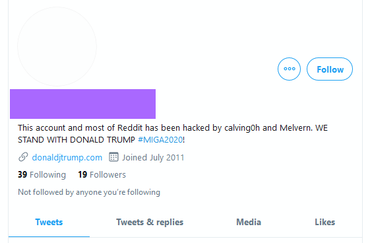
An account on Twitter took credit for the hack. However, the account’s owners did not respond to a request for comment so ZDNet can verify its claims. The account is now suspended.

reddit-hackers.png
Image: ZDNet

The Reddit hack also comes after Reddit banned r/The_Donald, a channel for Donald Trump supporters, in late June. Reddit said it took the decision to ban the channel for breaking its community rules after reports of harassment, bullying, and threats of violence.

Today’s stunt is reminiscent to a similar one that took place at the end of June and the start of July, when more than 1,800 Roblox accounts were hacked and defaced with a similar pro-Trump reelection message.

Source: Hackers are defacing Reddit with pro-Trump messages | ZDNet

Private equity wants to own your DNA – Blackstone buys Ancestry at $250,- per person

The nation’s largest private equity firm is interested in buying your DNA data. The going rate: $261 per person. That appears to be what Blackstone, the $63 billion private equity giant, is willing to pay for genetic data controlled by one of the major companies gathering it from millions of customers.

Earlier this week, Blackstone announced it was paying $4.7 billion to acquire Ancestry.com, a pioneer in pop genetics that was launched in the 1990s to help people find out more about their family heritage.

Ancestry’s customers get an at-home DNA kit that they send back to the company. Ancestry then adds that DNA information to its database and sends its users a report about their likely family history. The company will also match you to other family members in its system, including distant cousins you may or may not want to hear from. And for up to $400 a year, you can continue to search Ancestry’s database to add to your knowledge of your family tree.

Ancestry has some information, mostly collected from public databases, on hundreds of millions of individuals. But its most valuable information is that of the people who have taken its DNA tests, which totals 18 million. And at Blackstone’s $4.7 billion purchase price that translates to just over $250 each.

[…]

Source: Private equity wants to own your DNA – CBS News

Facebook Relaxed Fact-Checking Standards on Conservative Pages: Report

In an attempt to correct the perception of a small but very vocal minority that claims Facebook’s silencing conservative voices on its platforms, the company’s reportedly swung too far in the opposite direction and essentially gave a free pass to conservative pages to spew their bullshit online.

According to leaked documents reviewed by NBC, Facebook relaxed its fact-checking rules for conservative news outlets and personalities, including Breitbart and former Fox News stooges Diamond and Silk, so that they wouldn’t be penalized for spreading misinformation. This report comes just a day after a Buzzfeed exposé detailing how a Facebook employee was allegedly fired after collecting evidence of this preferential treatment of right-wing pages.

Per its standards, Facebook issues strikes to pages that have repeatedly spread inaccurate or misleading information as determined by the company’s millions of fact-checking partners (news outlets, politicians, influencers, etc.). If an account receives two strikes in a 90-day period, it receives a “repeat offender” status and can be shadowbanned or even temporarily lose advertising privileges. Facebook employees work with fact-checking partners to triage these misinformation flags, with high-priority issues receiving an “escalation” tag that then pushes them on to company higher-ups for review.

According to an archive of these escalations with the last six months that was leaked to NBC, Facebook employees in the misinformation escalations team waived strikes issued to some conservative pages under direct oversight from senior leadership. Roughly two-thirds of the cases listed concerned conservative pages, including those of Donald Trump Jr., Eric Trump, and Gateway Pundit.

[.,..]

Source: Facebook Relaxed Fact-Checking Standards on Conservative Pages: Report

An odd piece of news if not propoganda considering the big tech companies were slammed during their hearings buy the conspiracy seeing anti-vaxxer senators in the room

Whoops, our bad, we just may have ‘accidentally’ left Google Home devices recording your every word, sound, sorry

Your Google Home speaker may have been quietly recording sounds around your house without your permission or authorization, it was revealed this week.

The Chocolate Factory admitted it had accidentally turned on a feature that allowed its voice-controlled AI-based assistant to activate and snoop on its surroundings. Normally, the device only starts actively listening in and making a note of what it hears after it has heard wake words, such as “Ok, Google” or “Hey, Google,” for privacy reasons. Prior to waking, it’s constantly listening out for those words, but is not supposed to keep a record of what it hears.

Yet punters noticed their Google Homes had been recording random sounds, without any wake word uttered, when they started receiving notifications on their phone that showed the device had heard things like a smoke alarm beeping, or glass breaking in their homes – all without giving their approval.

Google said the feature had been accidentally turned on during a recent software update, and it has now been switched off, Protocol reported. It may be that this feature is or was intended to be used for home security at some point: imagine the assistant waking up whenever it hears a break in, for instance. Google just bought a $450m, or 6.6 per cent, stake in anti-burglary giant ADT.

Source: Whoops, our bad, we just may have ‘accidentally’ left Google Home devices recording your every word, sound, sorry • The Register

NRA riddled with Fraud. Investigation Moves NY AG To Seek Group’s Dissolution

The attorney general of New York took action Thursday to dissolve the National Rifle Association following an 18-month investigation that found evidence the powerful gun rights group is “fraught with fraud and abuse.”

Attorney General Letitia James claims in a lawsuit filed Thursday that she found financial misconduct in the millions of dollars and that it contributed to a loss of more than $64 million over a three-year period.

The suit alleges that top NRA executives misused charitable funds for personal gain, awarded contracts to friends and family members, and provided contracts to former employees to ensure loyalty.

Seeking to dissolve the NRA is the most aggressive sanction James could have sought against the not-for-profit organization, which James has jurisdiction over because it is registered in New York. James has a wide range of authorities relating to nonprofits in the state, including the authority to force organizations to cease operations or dissolve. The NRA is all but certain to contest it.

The NRA said in a statement that the legal action was political, calling it a “baseless premeditated attack on our organization and the Second Amendment freedoms it fights to defend… we not only will not shrink from this fight – we will confront it and prevail.”

“The NRA’s influence has been so powerful that the organization went unchecked for decades while top executives funneled millions into their own pockets,” James said in a statement. “The NRA is fraught with fraud and abuse, which is why, today, we seek to dissolve the NRA, because no organization is above the law.”

James’ complaint names the National Rifle Association as a whole but also names four current and former NRA executives: Executive Vice President Wayne LaPierre, general counsel John Frazer, former Chief Financial Officer Woody Phillips and former chief of staff Joshua Powell.

Source: NRA Lawsuit: Fraud Investigation Moves New York AG To Seek Group’s Dissolution : NPR

Well, my thoughts and prayers go out to you, NRA and all your gun nut psycho killer friends.

Spotify CEO Daniel Ek says working musicians may no longer be able to release music only “once every three to four years” – they will have to work just like the rest of us

Spotify CEO Daniel Ek discussed streaming and sustainability in a recent interview with Music Ally published on Thursday. Ek denied criticisms that Spotify pays insufficient royalties to artists, and insisted that the role of the musician had changed in today’s “future landscape.”

Ek claimed that a “narrative fallacy” had been created and caused music fans to believe that Spotify doesn’t pay musicians enough for streams of their music. “Some artists that used to do well in the past may not do well in this future landscape,” Ek said, “where you can’t record music once every three to four years and think that’s going to be enough.”

What is required from successful musicians, Ek insisted, is a deeper, more consistent, and prolonged commitment than in the past. “The artists today that are making it realize that it’s about creating a continuous engagement with their fans. It is about putting the work in, about the storytelling around the album, and about keeping a continuous dialogue with your fans.”

Source: Spotify CEO Daniel Ek says working musicians may no longer be able to release music only “once every three to four years” | The FADER

A business model where you work a few weeks a year untill you can just coast along on royalties is wrong on so many levels.

Google victory in German top court over right to be forgotten means you can’t just delete the evil stuff you did

A German court has sided with Google and rejected requests to wipe entries from search results. The cases hinged on whether the right to be forgotten outweighed the public’s right to know.

Germany’s highest court agreed on Monday with lower courts and rejected the two plaintiffs’ appeals over privacy concerns.

In the first case, a former managing director of a charity had demanded Google remove links to certain news articles that appeared in searches of his name. The articles from 2011 reported that the charity was in financial trouble and that the manager had called in sick. He later argued in court that information on his personal health issues should not be divulged to the public years later.

The court ruled that whether links to critical articles have to be removed from the search list always depends on a comprehensive consideration of fundamental rights in the individual case.

A second case was referred to the European Court of Justice. It concerned two leaders of a financial services company that sought to have links to negative reports about their investment model removed. The couple had argued that the US-based websites, which came up in the searches for their names, were full of fake news and sought to market other financial services providers.

[…]

Links are only be deleted from searches in Europe but would appear as normal in other regions. Any data “forgotten” by Google, which mostly provides links to material published by others, is only removed from its search results, not from the internet.

The cases stem from a 2014 ruling in the European Court of Justice (ECJ), which found that EU citizens had the right to request search engines, such as Alphabet’s Google and Microsoft’s Bing, remove “inaccurate, inadequate, irrelevant or excessive” search results linked to their name. The case centered on a Spaniard who found that when his name was Googled, it returned links to an advertisement for a property auction related to an unpaid social welfare debt. He argued the debt had long since been settled.

Source: Google victory in German top court over right to be forgotten | Germany| News and in-depth reporting from Berlin and beyond | DW | 27.07.2020

YouTube threatens to remove music videos in Denmark over songwriter royalty fallout

YouTube is embroiled in a very public spat with songwriters and music publishers in Denmark, via local collection society Koda.

According to Koda – Denmark’s equivalent of ASCAP/BMI (US) or PRS For Music (UK) – YouTube has threatened to remove “Danish music content” (ie. music written by Danish songwriters) from its service.

The cause of this threat is a disagreement between the two parties over the remuneration of songwriters and publishers in the market.

YouTube and Koda’s last multi-year licensing deal expired in April. Since then, the two parties have been operating under a temporary license agreement.

At the same time, Polaris, the umbrella body for collection societies in the Nordics, has been negotiating with YouTube over a new Scandinavia-wide licensing agreement.

But in a statement to media today (July 31), Koda claims YouTube is insisting that – in order to extend its temporary deal in Denmark – Koda must now agree to a near-70% reduction in payments to composers and songwriters.

YouTube has fired back at this claim, suggesting that under its existing temporary deal with Koda (which expires today), the body “earned back less than half of the guarantee payments” handed over by the service.

[…] wait – how on earth does a guarantee payment relate to the amount you renumerate people?

In response to Koda’s refusal to agree to YouTube’s proposed deal, Koda claims that “on the evening of Thursday 30 July, Google announced that they will soon remove all Danish music content on YouTube”.

Reports out of Denmark suggest YouTube may pull the plug on this content as soon as this Saturday.

[…]

“While we’ve had productive conversations we have been unable to secure a fair and equitable agreement before our existing one expired. They are asking for substantially more than what we pay our other partners. This is not only unfair to our other YouTube partners and creators, it is unhealthy for the wider economics of our industry.

“Without a new license, we’re unable to make their content available in Denmark.  Our doors remain open to Koda to bring their content back to YouTube.”

YouTube added in a statement to MBW: “We take copyright law very seriously. As our license expires today and since we have been unable to secure an agreement we will remove identified Koda content from the platform.”

Koda says it “cannot accept” YouTube’s terms, and that as a result “Google have now unilaterally decided that Koda’s members cannot have their content shown on YouTube”.

[…]

Koda’s media director, Kaare Struve, said: “Google have always taken an ‘our way or the highway’ approach, but even for Google, this is a low point.

“Of course, Google know that they can create enormous frustration among our members by denying them access to YouTube – and among the many Danes who use YouTube every day.

“We can only suppose that by doing so, YouTube hope to be able to push through an agreement, one where they alone dictate all terms.”

Koda says that ever since its first agreement with YouTube was signed in 2013, “the level of payments received from YouTube has been significantly lower than the level of payment [distributed] by subscription-based services”.

Koda’s CEO, Gorm Arildsen, said: “It is no secret that our members have been very dissatisfied with the level of payment received for the use of their music on YouTube for many years now. And it’s no secret that we at Koda have actively advocated putting an end to the tech giants’ free-ride approach and underpayment for artistic content in connection with the EU’s new Copyright Directive.

“The fact that Google now demands that the payments due from them should be reduced by almost 70% in connection with a temporary contract extension seems quite bizarre.”

[…]

Source: YouTube threatens to remove music videos in Denmark over songwriter royalty fallout – Music Business Worldwide

Well guys, I reccommend you move over to Vimeo. At least that way you’re helping to break the monopoly. Not that I believe in the slightest that Koda is working in the best interests of artists as much as it’s filling its’ own pockets, but there you go.

AI tracks drone pilot’s location through the small movements the drone makes

The minute details of rogue drone’s movements in the air may unwittingly reveal the drone pilot’s location—possibly enabling authorities to bring the drone down before, say, it has the opportunity to disrupt air traffic or cause an accident. And it’s possible without requiring expensive arrays of radio triangulation and signal-location antennas.

So says a team of Israeli researchers who have trained an AI drone-tracking algorithm to reveal the drone operator’s whereabouts, with a better than 80 per cent accuracy level. They are now investigating whether the algorithm can also uncover the pilot’s level of expertise and even possibly their identity.

[…]

Depending on the specific terrain at any given airport, a pilot operating a drone near a camouflaging patch of forest, for instance, might have an unobstructed view of the runway. But that location might also be a long distance away, possibly making the operator more prone to errors in precise tracking of the drone. Whereas a pilot operating nearer to the runway may not make those same tracking errors but may also have to contend with big blind spots because of their proximity to, say, a parking garage or control tower.

And in every case, he said, simple geometry could begin to reveal important clues about a pilot’s location, too. When a drone is far enough away, motion along a pilot’s line of sight can be harder for the pilot to detect than motion perpendicular to their line of sight. This also could become a significant factor in an AI algorithm working to discover pilot location from a particular drone flight pattern.

The sum total of these various terrain-specific and terrain-agnostic effects, then, could be a giant finger pointing to the operator. This AI application would also be unaffected by any relay towers or other signal spoofing mechanisms the pilot may have put in place.

Weiss said his group tested their drone tracking algorithm using Microsoft Research’s open source drone and autonomous vehicle simulator AirSim. The group presented their work-in-progress at the Fourth International Symposium on Cyber Security, Cryptology and Machine Learning at Ben-Gurion University earlier this month.

Their paper boasts a 73 per cent accuracy rate in discovering drone pilots’ locations. Weiss said that in the few weeks since publishing that result, they’ve now improved the accuracy rate to 83 per cent.

Now that the researchers have proved the algorithm’s concept, Weiss said, they’re hoping next to test it in real-world airport settings. “I’ve already been approached by people who have the flight permissions,” he said. “I am a university professor. I’m not a trained pilot. Now people that do have the facility to fly drones [can] run this physical experiment.”

Source: Attention Rogue Drone Pilots: AI Can See You! – IEEE Spectrum