The US is following through on promises of retaliation against Russia for its alleged involvement in the SolarWinds cyberattack. The APreports that President Biden has expelled 10 Russian diplomats from Washington, DC, including members of intelligence services, in response to actions that include the SolarWinds hack. The White House also imposed sanctions on 32 “entities and individuals” as an answer to reported 2020 election interference attempts.
Biden formally blamed the Russia-backed cyberattack group Cozy Bear (aka APT29) as the culprit behind the SolarWinds breach. The FBI, NSA and CISA also issued a joint cybersecurity advisory warning of vulnerabilities Russian intelligence used to compromise networks. The Treasury Department, meanwhile, declared that six Russian technology companies were involved in creating the tools to enable “malicious cyber activities.”
[…]
The actions also encompass a number of non-technology concerns, such as bounties on US soldiers in Afghanistan, Russia’s ongoing actions in Crimea and the attempts to silence Russian opposition leader Alexei Navalny.
Blue Origin has successfully completed a test launch and landing of its reuseable New Shepard rocket with an advanced capsule design, bringing the outfit one step closer to eventually sending up paying passengers.
The test flight, codenamed NS-15 as it’s the 15th to date, was conducted at 1651 UTC (1151 CDT) at a Blue Origin site near Van Horn, Texas, on Wednesday. Two Blue Origin employees climbed up the launch tower, entered the capsule, and were strapped into their seats, and followed final procedures to prepare for a fake take off. Just before the New Shepard was due to fly, however, they left the capsule, with just Mannequin Skywalker, the instrument-stuffed dummy Blue Origin uses, to make the short journey.
The flight was the first test of the new capsule design that’ll be more comfortable for people paying six-figure sums to go into space. New acoustic and temperature controls were tested, as well an improved radio and control systems. NASA wants to see all is right before putting humans on it.
You can watch the whole thing again here. Skip to 1:53:39 to get to the countdown.
NS-15 was completed in just over ten minutes, according to the mission’s broadcast. First, the capsule separated from the booster at about three minutes into the flight. After the booster reached its highest point – about 350,000 feet or 106.7 kilometres – it slowed down and reentered the atmosphere.
It was guided back onto is landing pad and performed a rocket burn to slow its speed down to five miles per hour at seven minutes into the flight for a soft landing. The capsule touched down around three minutes later.
Webshop Allekabels has leaked private data and passwords of millions of Dutch people. It may be the largest password data breach in the Netherlands ever.
Allekabels’ stolen database, containing the private data of some 3.6 million people, was put up for sale on a hacker forum at the end of January for a sum of 15,000 euros. Audio and computer cables are available for purchase via Allekabels, as well as suspension brackets and antennas.
RTL Nieuws has viewed and verified the stolen data.
This totals some 2.6 million unique email addresses linked to names, home addresses, telephone numbers, dates of birth and encrypted passwords.
At least 109,000 IBAN numbers of Allekabels customers were also stolen and traded.
Russia’s infamous APT 29, aka Cozy Bear, was behind the SolarWinds Orion attack, the US and UK governments said today as America slapped sanctions on Russian infosec companies as well as expelling diplomats from that country’s US embassy.
One of the sanctioned companies is Positive Technologies, familiar in the West for, among other things, in-depth research exposing vulnerabilities in Intel’s hardware security architecture.
The compromise saw Russian state intelligence operatives carefully compromise the build systems of SolarWinds’ network monitoring software Orion to distribute a backdoor into its 18,000 customers. Those customers included the UK and US governments, among many others
“The Russian Intelligence Services’ third arm, the SVR, is responsible for the 2020 exploit of the SolarWinds Orion platform and other information technology infrastructures. This intrusion compromised thousands of US government and private sector networks,” said the US Treasury.
The American attribution was echoed by the British government with Foreign Secretary Dominic Raab saying in a statement: “We see what Russia is doing to undermine our democracies. The UK and US are calling out Russia’s malicious behaviour, to enable our international partners and businesses at home to better defend and prepare themselves against this kind of action.”
The US Defence Department added: “Recent Russian SVR activities include compromising SolarWinds Orion software updates, targeting COVID-19 research facilities through deploying WellMess malware, and leveraging a VMware vulnerability that was a zero-day at the time for follow-on Security Assertion Markup Language (SAML) authentication abuse.”
The NCSC also said in a public statement that “the overall impact on the UK of the SVR’s exploitation of this software is low.” Government departments have refused to even talk about the impact of the Orion compromise despite it being in widespread use around Whitehall and further afield, lending credibility to the notion that UK.gov was more widely hit by the breach than it wants to admit.
[…]
Other sanctioned outfits included ERA Technopolis, aka Pasit; Neobit, an infosec firm which was also the alma mater for a Russian spy who sneaked into Microsoft back in 2010; the Russian state compsci research institution; and a Russian business called Advanced System Technology AO.
US persons are banned from doing business with any of the above.
Google Earth has partnered with NASA, the U.S. Geological Survey, the EU’s Copernicus Climate Change Service, and Carnegie Mellon University’s CREATE Lab to bring users time-lapse images of the planet’s surface—24 million satellite photos taken over 37 years. Together they offer photographic evidence of a planet changing faster than at any time in millennia. Shorelines creep in. Cities blossom. Trees fall. Water reservoirs shrink. Glaciers melt and fracture.
“We can objectively see global warming with our own eyes,” said Rebecca Moore, director of Google Earth. “We hope that this can ground everyone in an objective, common understanding of what’s actually happening on the planet, and inspire action.”
Timelapse, the name of the new Google Earth feature, is the largest video on the planet, according to a statement from the company, requiring 2 million hours to process in cloud computers, and the equivalent of 530,000 high-resolution videos. The tool stitches together nearly 50 years of imagery from the U.S.’s Landsat program, which is run by NASA and the USGS. When combined with images from complementary European Sentinel-2 satellites, Landsat provides the equivalent of complete coverage of the Earth’s surface every two days. Google Earth is expected to update Timelapse about once a year.
The Timelapse images are stark. In Southwestern Greenland, warmer Atlantic waters and air temperatures are accelerating ice melt.
Claushavn, Greenland
Source: Google
Tree loss in Brazil in 2020 surged by a quarter over the prior year.
Longyangxia Solar Park, located in Gonghe County, Qinghai Province.
Source: Google
This image, below, illustrates what it took to make a viewable experience. The 24 million images had to be processed to remove clouds or other obstructions and then stitched together into the final product.
Twenty-four million satellite images from 1984 to 2020 were analyzed to identify and remove artifacts, like clouds.
Source: Google
“Now, our one, static snapshot of the planet”—Google Earth—“has become dynamic, providing ongoing visual evidence of Earth’s changes from climate and human behavior occurring across space and time, over four decades,” Moore said. “And this was made possible because of the U.S. government and European Union’s commitments to open and accessible data.”
A new experimental treatment could someday give people a way to grow missing teeth, if early research on lab animals holds up.
Scientists at Japan’s Kyoto University and the University of Fukui developed a monoclonal antibody treatment that seems to trigger the body to grow new teeth, according to research published last month in the journal Science Advances. If upcoming experiments continue to work, it could eventually give us a way to regrow teeth lost in adulthood or those that were missing since childhood due to congenital conditions.
[…]
eventually the team found that blocking a gene called USAG-1 led to increased activity of Bone Morphogenic Protein (BMP), a molecule that determines how many teeth will grow in the first place, and allowed adult mice to regrow any that they were missing.
The experiment also worked on ferrets, which the researchers say is important because their teeth are far more humanlike than mouse teeth are.
“Ferrets are diphyodont animals with similar dental patterns to humans,” Kyoto researcher and lead study author Katsu Takahashi said in the press release. “Our next plan is to test the antibodies on other animals such as pigs and dogs.”
There’s still a long way to go before they reach human trials, but continued success in those upcoming trials would be a promising sign for the future of a clinical treatment that lets us naturally regrow our missing teeth.
Intelsat’s IS-10-02 communications satellite was running low on fuel — it’s been in orbit since 2004, after all, and has already exceeded its original mission lifespan by five years. Thanks to Northrop Grumman’s Mission Extension Vehicle-2 (MEV-2), however, it gained another five years of life and will stay operational instead of being decommissioned. MEV-2 launched in August and has been making its way to the satellite in geosynchronous orbit since then. On Monday, it caught up to its target and clamped onto it to provide the IS-10-02 with more fuel.
According to TechCrunch, a representative described the robotic spacecraft as a “jetpack for the 10-02 satellite.” The spokesperson explained the docking process as follows:
“The MEV-2 docking system consists of a probe that we insert into the liquid apogee engine on the aft end of a satellite. Nearly 80% of satellites in orbit have this featuring, allowing the MEV service a variety of customers. The liquid apogee engine acts as a “cone to capture” to help guide the probe which once it passes through the throat of the engine, expands to capture the client satellite. The probe is then retracted pulling three stanchions, or feet, up against the launch adaptor ring, securely clamping the two vehicles together.”
This marks the first time a life-extension services vehicle was able to dock with an active satellite in its operational GEO orbital location. MEV-2’s predecessor, the MEV-1, clamped onto Intelsat’s IS-901 last year. That satellite was already out of fuel and was docked out of its original orbit at the time, though. As TechCrunch notes, Northrop Grumman had to ensure that MEV-2’s approach wouldn’t disrupt its target’s operation and orbit. By successfully doing so, the aerospace corporation proved that it’s possible to service active satellites, which means companies can potentially save millions by extending the life of their older space objects.
MEV-2 will stay with IS-10-02 before moving on to extend the life of another satellite. In addition to the MEV, the company is working on robotic vehicles that can do in-orbit repair, augmentation, assembly and inspection. Those vehicles will also be used to deliver life-extending pods to satellites to extend their mission lifespan without the need to remain docked with their targets. Northrop Grumman is hoping to launch both those technologies by 2024.
WhatsApp representatives told Forbes that the easiest way to protect yourself against this kind of an attack is to make sure you’ve associated an email address with your two-step verification process so the attacker won’t be able to spoof your identity. You can do that right now by pulling up WhatsApp, loading its Settings, tapping on Two-Step Verification, and inputting your email address (or checking to make sure you’ve already done so).
This isn’t going to block the attack per se, but it’ll make it a lot easier for WhatsApp’s customer service team to help you out should you find yourself in a “prevented from authenticating my account” feedback loop—which is what will happen if an attacker reaches out to WhatsApp posing as you, claiming that your account has been hacked and that WhatsApp should deactivate it. (You’ll then “receive” codes to revert the mistaken de-registration, only you won’t be able to input them because of the previous trick, which will have temporarily banned you for entering too many incorrect 2FA codes.)
The FBI deleted web shells installed by criminals on hundreds of Microsoft Exchange servers across the United States, it was revealed on Tuesday.
The Feds were given approval by the courts to carry out the deletions, which occurred without first warning the servers’ owners, following the discovery and exploitation of critical vulnerabilities in the enterprise software.
Shortly after Microsoft raised the alarm early last month over the security holes in Exchange and provided fixes for the vulnerabilities, miscreants swarmed to exploit the programming blunders and hijack unpatched installations. (Certain groups were even breaking in Exchange servers via the holes before their existence was public knowledge.)
The FBI found hundreds of such compromised deployments with backdoors installed by one cyber-gang in particular, leading to agents asking the courts to allow them to go in and delete the malicious code. The court approved the action and the document was unsealed this week, 30 days later.
“Although many infected system owners successfully removed the web shells from thousands of computers, others appeared unable to do so, and hundreds of such web shells persisted unmitigated,” the Justice Department noted in an announcement. “Today’s operation removed one early hacking group’s remaining web shells, which could have been used to maintain and escalate persistent, unauthorized access to US networks.”
The FBI deleted the shells by issuing a command through the web shell to the server “which was designed to cause the server to delete only the web shell (identified by its unique file path),” it said. Critically, however, the Feds did not touch the servers themselves and so they remain unpatched and open to infiltration.
A $291 Adobe cancelation fee has provoked fierce criticism of the creative software company.
A post from a customer has gone viral on Twitter, after he discovered that he would have to pay nearly $300 to bring his Creative Cloud subscription to an end.
It has sparked a discussion about Adobe’s practices, with many others coming forward to say that they too have faced extremely steep cancelation fees when they’ve tried to cut ties with the company.
A screenshot uploaded to the micro-blogging site by Twitter user @Mrdaddguy showed that they faced a $291.45 fee to cancel their Adobe Creative Cloud plan.
At the time of publication the tweet has attracted more than 13,000 retweets, more than 4,000 quote tweets, and more than 70,000 likes.
Twitter users have been almost universally in agreement in their criticism of the company, with some describing the cancelation fee as “absurd”, “disgusting,” and likening it to being held hostage by the company.
“Adobe has been holding me hostage for the better part of a year on a free trial that magically converted to a yearlong subscription with a wild cancellation fee,” wrote Twitter user Laura Hudson. “Blink twice if they have you too.”
Some have weighed into the conversation by suggesting alternatives to Adobe’s suite of products, such as Clip Studio Paint, Procreate, Blender, Krita, Paint tool Sai, many of which are either free to use or available as one-time purchases.
Others, meanwhile, are arguing that Adobe’s penalty fees are so severe that it should be considered “morally correct” to pirate the company’s software in revenge.
“Adobe on their hands and knees begging us to pirate their software,” wrote Twitter user JoshDeLearner.
“This thread is a great reminder of why it’s morally correct to pirate Adobe products,” wrote Dozing Starlight. A multitude of similar tweets can be found here.
Days after scraped data from more than a billion Facebook and LinkedIn profiles, collectively speaking, was put for sale online, it looks like now it’s Clubhouse’s turn. The upstart platform seems to have experienced the same fate, with an SQL database containing 1.3 million scraped Clubhouse user records leaked for free on a popular hacker forum.
To see if any of your online accounts were exposed in previous security breaches, use our personal data leak checker with a library of 15+ billion breached records.
What was leaked?
The leaked database contains a variety of user-related information from Clubhouse profiles, including:
The Free Software Foundation (FSF) on Monday apologized for mishandling the announcement last month that founder Richard Stallman, or RMS, had been reelected to its board of directors – and published a statement from RMS both justifying his behavior and apologizing for it.
“FSF staff should have been informed and consulted first,” the FSF said. “The announcement by RMS at LibrePlanet was a complete surprise to staff, all those who worked so hard to organize a great event, to LibrePlanet speakers and to the exhibitors. We had hoped for a more inclusive and thoughtful process and we apologize that this did not occur.”
It’s possible for an attacker to completely suspend your WhatsApp account, without any recourse for the individual user, and all they need is your phone number. At the time of writing there’s no solution for this issue.
This newly-discovered flaw uses two separate vectors. The attacker installs WhatsApp on a new device and enters your number to activate the chat service. They can’t verify it, because of course, the two-factor authentication system is sending the login prompts to your phone instead. After multiple repeated and failed attempts, your login is locked for 12 hours.
Here’s where the tricky part comes in: with your account locked, the attacker sends a support message to WhatsApp from their email address, claiming that their (your) phone has been lost or stolen, and that the account associated with your number needs to be deactivated. WhatsApp “verifies” this with a reply email, and suspends your account without any input on your end. The attacker can repeat the process several times in succession to create a semi-permanent lock on your account.
[…]
The attack is a proof-of-concept from a pair of security researchers, Luis Márquez Carpintero and Ernesto Canales Pereña, and was first reported by Forbes. The results are disturbing, but at the very least, this method can’t be used to actually gain access to an account, merely to block access by its legitimate owner. Confidential text messages and contacts are not exposed.
About two weeks ago, millions of Google Chrome users were signed up for an experiment they never agreed to be a part of. Google had just launched a test run for Federated Learning of Cohorts—or FLoC–a new kind of ad-targeting tech meant to be less invasive than the average cookie. In a blog post announcing the trial, the company noted that it would only impact a “small percentage” of random users across ten different countries, including the US, Mexico, and Canada, with plans to expand globally as the trials run on.
These users probably won’t notice anything different when they click around on Chrome, but behind the scenes, that browser is quietly keeping a close eye on every site they visit and ad they click on. These users will have their browsing habits profiled and packaged up, and shared with countless advertisers for profit. Sometime this month, Chrome will give users an option to opt-out of this experiment, according to Google’s blog post—but as of right now, their only option is to block all third-party cookies in the browser.
That is if they even know that these tests are happening in the first place. While I’ve written my fairshare about FLoC up until this point, the loudest voices I’ve seen pipe up on the topic are either marketing nerds, policy nerds, or policy nerds that work in marketing. This might be due to the fact that—aside from a few blog posts here or there—the only breadcrumbs Google’s given to people looking to learn more about FLoC are inscrutable pages of code, an inscrutable GitHub repo, and inscrutable mailing lists. Even if Google bothered asking for consent before enrolling a random sample of its Chrome user base into this trial, there’s a good chance they wouldn’t know what they were consenting to.
(For the record, you can check whether you’ve been opted into this initial test using this handy tool from the Electronic Frontier Foundation.)
[…]
The trackers that FLoC is meant to replace are known as “third-party cookies.” We have a pretty in-depth guide to the way this sort of tech works, but in a nutshell: these are snippets of code from adtech companies that websites can bake into the code underpinning their pages. Those bits of code monitor your on-site behavior—and sometimes other personal details—before the adtech org behind that cookie beams that data back to its own servers.
[…]
The catch is that Google still has all that juicy user-level data because it controls Chrome. They’re also still free to keep doing what they’ve always been doing with that data: sharing it with federal agencies, accidentally leaking it, and, y’know, just being Google.
[…]
“Isn’t that kind of… anti-competitive?”
It depends on who you ask. Competition authorities in the UK certainly think so, as do trade groups here in the US. It’s also been wrapped up into a Congressional probe, at least one class action, and a massive multi-state antitrust case spearheaded by Texas Attorney General Ken Paxton. Their qualms with FLoC are pretty easy to understand. Google already controls about 30% of the digital ad market in the US, just slightly more than Facebook—the other half of the so-called Duopoly—that controls 25% (for context, Microsoft controls about 4%).
While that dominance has netted Google billions upon billions of dollars per year, it’s recently netted multiple mounting antitrust investigations against the company, too. And those investigations have pretty universally painted a picture of Google as a blatant autocrat of the ad-based economy, and one that largely got away with abhorrent behavior because smaller rivals were too afraid—or unable—to speak up. This is why many of them are speaking up about FLoC now.
“But at least it’s good for privacy, right?”
Again, it depends who you ask! Google thinks so, but the EFF sure doesn’t. In March, the EFF put out a detailed piece breaking down some of the biggest gaps in FLoC’s privacy promises. If a particular website prompts you to give up some sort of first-party data—by having you sign up with your email or phone number, for example—your FLoC identifier isn’t really anonymous anymore.
Aside from that hiccup, the EFF points out that your FLoC cohort follows you everywhere you go across the web. This isn’t a big deal if my cohort is just “people who like to reupholster furniture,” but it gets really dicey if that cohort happens to inadvertently mold itself around a person’s mental health disorder or their sexuality based on the sites that person browses. While Google’s pledged to keep FloC’s from creating cohorts based on these sorts of “sensitive categories,” the EFF again pointed out that Google’s approach was riddled with holes.
Scientists working on the psychology of problem solving may have hit upon why things always seem to get more complicated.
A newly uncovered heuristic – a mental shortcut or rule of thumb – shows bias towards adding features to find a solution, rather than subtracting existing features.
A simple experiment in Lego has provided some insight into the phenomenon.
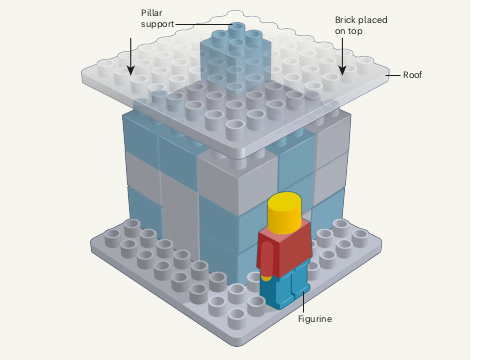
A team led by Gabrielle Adams, assistant professor of public policy and psychology at the University of Virginia, presented 197 participants with a Lego tower, four Duplo blocks high, six-by-six nodules on the horizontal plane. Above the tower was an 8×8 flat roof supported in the corner by a single 2×2 block.
The objective was to stabilise the roof so it would not fall onto a figure below when a brick was placed on top of it.
All the participants were told they could alter the structure however they wanted to. A control group was told “each piece that you add costs ten cents” while a “subtraction-cue condition” group was told “each piece that you add costs 10 cents but removing pieces is free.”
The simplest and cheapest solution was to remove the single block supporting the roof and attach it directly to the tower. But only 41 per cent of participants went with this solution. The remainder decided to add three bricks to support the roof. However, for the group given the subtraction-cue condition, 61 per cent of participants took the first option.
Adams and team also studied how participants make a 10×10 grid of green and white boxes symmetrical on a computer screen. They found people tend to add green boxes to the emptier half of the grid rather than removing them from the fuller half, even when doing the latter would have been more efficient.
The researcher also studied how people completed this task under “cognitive load.” While working on the task, they were asked to press the “F” key whenever they saw a 5 in a string of numerals passing across the top of the screen. The result was that people systematically default to searching for additive transformations, and consequently overlook subtractive transformations.
[P]eople are biased towards creating solutions by adding features rather than taking them away…. A study also observed the tendency at an organisational level
The researchers seem to have discovered a heuristic that people are biased towards creating solutions by adding features rather than taking them away. A study also observed the tendency at an organisational level.
For example, looking at university archives, they found that an incoming president had requested suggestions for changes that would allow the institution to better serve its students and community. Only 11 per cent of the responses involved removing an existing regulation, practice or programme.
Click to enlarge
The research, published in Nature, argued that the discovery could have far-reaching ramifications.
“As with many heuristics, it is possible that defaulting to a search for additive ideas often serves its users well,” the paper said. “However, the tendency to overlook subtraction may be implicated in a variety of costly modern trends, including overburdened minds and schedules, increasing red tape in institutions and humanity’s encroachment on the safe operating conditions for life on Earth.
“If people default to adequate additive transformations – without considering comparable (and sometimes superior) subtractive alternatives – they may be missing opportunities to make their lives more fulfilling, their institutions more effective and their planet more liveable.” ®
Here we show that individuals who are asleep and in the midst of a lucid dream (aware of the fact that they are currently dreaming) can perceive questions from an experimenter and provide answers using electrophysiological signals. We implemented our procedures for two-way communication during polysomnographically verified rapid-eye-movement (REM) sleep in 36 individuals. Some had minimal prior experience with lucid dreaming, others were frequent lucid dreamers, and one was a patient with narcolepsy who had frequent lucid dreams. During REM sleep, these individuals exhibited various capabilities, including performing veridical perceptual analysis of novel information, maintaining information in working memory, computing simple answers, and expressing volitional replies. Their responses included distinctive eye movements and selective facial muscle contractions, constituting correctly answered questions on 29 occasions across 6 of the individuals tested. These repeated observations of interactive dreaming, documented by four independent laboratory groups, demonstrate that phenomenological and cognitive characteristics of dreaming can be interrogated in real time.
Zachary Horwitz never made it big on the Sunset Strip — there was the uncredited part in Brad Pitt’s “Fury” and a host of roles in low-budget thrillers and horror flicks. But federal charges suggest he had acting talent, duping several financial firms out of hundreds of millions of dollars and enabling him to live the Hollywood dream after all.
That meant chartered flights and a $6 million mansion — replete with wine cellar and home gym. Horwitz even included a bottle of Johnnie Walker Blue Label, which retails for more than $200, as a gift to investors along with his company’s “annual report.”
The claims are outlined in legal documents that U.S. prosecutors and the Securities and Exchange Commission released this week alleging Horwitz, 34, was running a massive Ponzi scheme. His scam: a made-up story that he had exclusive deals to sell films to Netflix Inc. and HBO. Dating back to 2014, the SEC said he raised a shocking $690 million in fraudulent funds. On Tuesday, Horwitz was arrested.
Horwitz, who went by the screen name “Zach Avery,” used fabricated contracts and fake emails to swindle at least five firms, according to the government. Investors were issued promissory notes through his firm 1inMM Capital to acquire the rights to movies that would be sold to Netflix and HBO for distribution in Latin America, Australia, New Zealand and other locations.
The claims of business relationships with the media companies were bogus, according to prosecutors, with a Netflix executive going so far as to send a cease-and-desist order to Horwitz and his attorney in February.
While Horwitz promised returns in excess of 35%, he was actually relying on new investors to pay off old ones, according to the SEC, which won a court order to freeze his assets. Ryan Hedges, Horwitz’s attorney, didn’t respond to requests for comment.
As part of the ongoing legal battle between Fortnite maker Epic and Apple, some new information has come to light confirming the most annoying thing about Apple’s iMessage app: that Apple could make a cross-platform version of iMessage for Android phones, but it won’t because it would be bad for business.
This info comes from testimony that appears in Epic’s brief against Apple, which was posted recently on Reddit. In the document, there are several statements from well-known Apple execs describing the reasons why Apple never made a cross-platform version of iMessage for Android devices.
In one quote dating back to 2013, Eddy Cue—who is now Apple’s senior vice president for internet software and services—said that Apple “could have made a version [of iMessage] on Android that worked with iOS,” providing the possibility that “users of both platforms would have been able to exchange messages with one another seamlessly.”
Sadly, it seems multiple Apple execs were concerned that doing so would make it too easy for iPhone owners to leave the Apple ecosystem, with Apple’s senior vice president of software engineering, Craig Federighi, having said, “iMessage on Android would simply serve to remove [an] obstacle to iPhone families giving their kids Android phones”—a sentiment Epic’s brief says was also shared by Phil Schiller, who back then was in charge of overseeing Apple’s App Store.
It seems these sentiments have been known within Apple for quite some time. The brief describes a 2016 comment from a former Apple employee who said “the #1 most difficult [reason] to leave the Apple universe app is iMessage … iMessage amounts to serious lock-in,” with Schiller having affirmed the comment by saying, “moving iMessage to Android will hurt us more than help us, this email illustrates why.”
China’s antitrust regulators slapped a record fine on one of the country’s largest technology conglomerates, closing a months-long investigation that began
and setting the precedent for the government to use anti-monopoly rules to regulate the country’s Big Tech.
Alibaba Group Holding, the world’s largest e-commerce company and owner of this newspaper, was fined 18.2 billion yuan (US$2.8 billion) by the State Administration for Market Regulation (SAMR).
The Hangzhou-based company “abused its dominant market position in China’s online retail platform service market since 2015 by forcing online merchants to open stores or take part in promotions on its platforms,” compelling the market to “
, the world’s largest supplier of mobile chips, in 2015.
[…]
The antitrust investigation of Alibaba was part of the Chinese government’s effort to tame the unfettered growth of the country’s tech behemoths, and to ringfence financial security and prevent risk amid a period of slowing economic growth during the coronavirus pandemic. It has been widely watched, for ramifications that could potentially affect the entire ecosystem of businesses and economy centred around the internet.
The hefty fine was aimed at promoting the “healthy and continuous development of the country’s internet industry” and was by no means a denigration of the “important role of internet platforms in economic and social development,” and shows no change in the state’s “attitude of supporting internet platforms,” according to a commentary by the People’s Daily, the mouthpiece newspaper of the ruling Communist Party.
The production of glass—one of humanity’s oldest materials—is getting a 21st century makeover. A new approach to glassmaking treats the material like plastic, allowing scientists to injection mold vaccine vials, sinuous channels for carrying out lab chemistry, and other complex shapes.
“It’s a really exciting paper,” says André Studart, a materials scientist at ETH Zürich. “This is a great way to form glass into complicated and interesting geometries.”
[…]
In 2017, researchers led by Frederik Kotz, a microsystems engineer at the Albert Ludwig University of Freiburg, set out to change that. They reworked a 3D printer to forge glass rather than printing plastics or metals.
The scientists created a printable powder by mixing silica nanoparticles with a polymer that could be cured with ultraviolet (UV) light. After printing the shapes they wanted, they cured the polymer with UV light so it would hold its shape. They then fired the mix in an oven to burn off the polymer and fuse the silica particles into a continuous glass structure.
The approach worked, making it possible to craft shapes such as tiny pretzels and replica castle gates. The work garnered interest from companies wanting to build minute lenses and other complex transparent optical components for telecommunications equipment. But the procedure was slow, turning out components one by one, rather than a fully industrial approach that could produce parts en masse, as is done with plastic.
To speed things up, Kotz and his colleagues have now extended their nanocomposite approach to work with injection molding, a process used to mass produce plastic parts like toys and car bumpers by the ton. The researchers again started with tiny silica particles. The team then mixed the silica with two polymers, polyethylene glycol (PEG) and polyvinyl butyral (PVB). The mixture created a dry powder with the consistency of toothpaste. The team fed the paste into an extruder that pressed it into a preformed mold with shapes such as a disc or tiny gear.
Outside of the mold, the parts hold their shape because myriad weak attractive bonds, called van der Waals interactions, form between neighboring silica particles. But the parts are still fragile.
To harden them, the researchers used water to wash away the PEG. They then fired the remaining material in two stages: First at 600°C to burn out the PVB, and second at 1300°C to fuse the silica particles into the final piece.
“What you get in the end is high purity silica glass” in any shape you want, Kotz says. The glass parts also end up with the optical and chemical characteristics needed for commercial telecommunications devices and chemical reactors, he and his colleagues report today in Science.
[…]
However, Studart says this new approach to mass producing glass parts still faces a bottleneck: Washing away the PEG must be done slowly, over days, to ensure the glass parts don’t crack. Speed that up, he says, and injection molding of glass could become as popular as it is with plastic.
Signal announced on Tuesday that as a part of its latest beta, it’s adding support for a new Signal Payments feature that allows Signal users to send “privacy focused payments as easily as sending or receiving a message.”
These payments are only going to be available to Android and iOS Signal users in the UK during this beta, and will use one specific payment network: MobileCoin, an open-source cryptocurrency that is itself still a prototype, according to the MobileCoin GitHub repo. The same page notes that the MobileCoin Wallet that someone would need in order to send these payments back and forth isn’t yet available for download by anyone in the U.S. As Wired notes, however, this is a new feature that the company wants to expand globally once it’s out of its infancy.
Unlike other popular texting apps that also offer a payment component—like, say, Facebook Messenger—MobileCoin doesn’t rely on funneling money from a user’s bank account in order to function. Instead, it’s a currency that lives on the blockchain, allowing payments made over MobileCoin to bypass the banking systems that routinely work with major data brokers in order to pawn off people’s transaction data.
Many technologists viscerally felt yesterday’s announcement as a punch to the gut when we heard that the Signal messaging app was bundling an embedded cryptocurrency. This news really cut to heart of what many technologists have felt before when we as loyal users have been exploited and betrayed by corporations, but this time it felt much deeper because it introduced a conflict of interest from our fellow technologists that we truly believed were advancing a cause many of us also believed in. So many of us have spent significant time and social capital moving our friends and family away from the exploitative data siphon platforms that Facebook et al offer, and on to Signal in the hopes of breaking the cycle of commercial exploitation of our online relationships. And some of us feel used.
Signal users are overwhelmingly tech savvy consumers and we’re not idiots. Do they think we don’t see through the thinly veiled pump and dump scheme that’s proposed? It’s an old scam with a new face.
Allegedly the controlling entity prints 250 million units of some artificially scarce trashcoin called MOB (coincidence?) of which the issuing organization controls 85% of the supply. This token then floats on a shady offshore cryptocurrency exchange hiding in the Cayman Islands or the Bahamas, where users can buy and exchange the token. The token is wash traded back and forth by insiders and the exchange itself to artificially pump up the price before it’s dumped on users in the UK to buy to allegedly use as “payments”. All of this while insiders are free to silently use information asymmetry to cash out on the influx of pumped hype-driven buys before the token crashes in value. Did I mention that the exchange that floats the token is the primary investor in the company itself, does anyone else see a major conflict of interest here?
Let it be said that everything here is probably entirely legal or there simply is no precedent yet. The question everyone is asking before these projects launch now though is: should it be?
Some people on Reddit are throwing about that they donated so they feel they should be able to tell the developers what they should and should not be doing as well.
IMHO an open source developer is free to work on whatever projects they choose and combine them as much as they want. They are not “paid” by the couple of dollars someone donates every month. This is a completely optional extra setting which is off by default. Signal is not mining crypto with the app. People are free to fork Signal into another project without the payment option. Is it a pump and dump? I hope not. What is for sure though is that money is tight in the Free Open Source (FOSS) arena and it’s not surprising that people are jumping in strange directions to find a way to monetise a hugely popular product which is only causing them stress due to rude, know it all users who refuse to actually contribute, an idealistic fanatic mindset by the FOSS group who have salaries and hardly any income at all.
Before he lost it all—all $20 billion—Bill Hwang was the greatest trader you’d never heard of.
Starting in 2013, he parlayed more than $200 million left over from his shuttered hedge fund into a mind-boggling fortune by betting on stocks. Had he folded his hand in early March and cashed in, Hwang, 57, would have stood out among the world’s billionaires. There are richer men and women, of course, but their money is mostly tied up in businesses, real estate, complex investments, sports teams, and artwork. Hwang’s $20 billion net worth was almost as liquid as a government stimulus check. And then, in two short days, it was gone.
[…]
Modest on the outside, Hwang had all the swagger he needed inside the Wall Street prime-brokerage departments that finance big investors. He was a “Tiger cub,” an alumnus of Tiger Management, the hedge fund powerhouse that Julian Robertson founded. In the 2000s, Hwang ran his own fund, Tiger Asia Management, which peaked at about $10 billion in assets.
It didn’t matter that he’d been accused of insider trading by U.S. securities regulators or that he pleaded guilty to wire fraud on behalf of Tiger Asia in 2012. Archegos, the family office he founded to manage his personal wealth, was a lucrative client for the banks, and they were eager to lend Hwang enormous sums.
On March 25, when Hwang’s financiers were finally able to compare notes, it became clear that his trading strategy was strikingly simple. Archegos appears to have plowed most of the money it borrowed into a handful of stocks—ViacomCBS, GSX Techedu, and Shopify among them.
[…]
At least once, Hwang stepped over the line between aggressive and illegal. In 2012, after years of investigations, the U.S. Securities and Exchange Commission accused Tiger Asia of insider trading and manipulation in two Chinese bank stocks. The agency said Hwang “crossed the wall,” receiving confidential information about pending share offerings from the underwriting banks and then using it to reap illicit profits.
Hwang settled that case without admitting or denying wrongdoing, and Tiger Asia pleaded guilty to a U.S. Department of Justice charge of wire fraud.
[…]
U.S. rules prevent individual investors from buying securities with more than 50% of the money borrowed on margin. No such limits apply to hedge funds and family offices. People familiar with Archegos say the firm steadily ramped up its leverage. Initially that meant about “2x,” or $1 million borrowed for every $1 million of capital. By late March the leverage was 5x or more.
Hwang also kept his banks in the dark by trading via swap agreements. In a typical swap, a bank gives its client exposure to an underlying asset, such as a stock. While the client gains—or loses—from any changes in price, the bank shows up in filings as the registered holder of the shares.
That’s how Hwang was able to amass huge positions so quietly. And because lenders had details only of their own dealings with him, they, too, couldn’t know he was piling on leverage in the same stocks via swaps with other banks. ViacomCBS Inc. is one example. By late March, Archegos had exposure to tens of millions of shares of the media conglomerate through Morgan Stanley, Goldman Sachs Group Inc., Credit Suisse, and Wells Fargo & Co. The largest holder of record, indexing giant Vanguard Group Inc., had 59 million shares.
[…]
At some point in the past few years, Hwang’s investments shifted from mainly tech companies to a more eclectic mix. Media conglomerates ViacomCBS and Discovery Inc. became huge holdings. So did at least four Chinese stocks: GSX Techedu, Baidu, Iqiyi, and Vipshop.
Although it’s impossible to know exactly when Archegos did those swap trades, there are clues in the regulatory filings by his banks. Starting in the second quarter of 2020, all Hwang’s banks became big holders of stocks he bet on. Morgan Stanley went from 5.22 million shares of Vipshop Holdings Ltd. as of June 30, to 44.6 million by Dec. 31.
Leverage was playing a growing role, and Hwang was looking for more. Credit Suisse and Morgan Stanley had been doing business with Archegos for years, unperturbed by Hwang’s brush with regulators. Goldman, however, had blacklisted him. Compliance officials who frowned on his checkered past blocked repeated efforts internally to open an account for Archegos, according to people with direct knowledge of the matter.
[…]
The fourth quarter of 2020 was a fruitful one for Hwang. While the S&P 500 rose almost 12%, seven of the 10 stocks Archegos was known to hold gained more than 30%, with Baidu, Vipshop, and Farfetch jumping at least 70%.
All that activity made Archegos one of Wall Street’s most coveted clients. People familiar with the situation say it was paying prime brokers tens of millions of dollars a year in fees, possibly more than $100 million in total. As his swap accounts churned out cash, Hwang kept accumulating extra capital to invest—and to lever up. Goldman finally relented and signed on Archegos as a client in late 2020. Weeks later it all would end in a flash.
Damage to Hwang’s Investments
Share price
Data: Compiled by Bloomberg
The first in a cascade of events during the week of March 22 came shortly after the 4 p.m. close of trading that Monday in New York. ViacomCBS, struggling to keep up with Apple TV, Disney+, Home Box Office, and Netflix, announced a $3 billion sale of stock and convertible debt. The company’s shares, propelled by Hwang’s buying, had tripled in four months. Raising money to invest in streaming made sense. Or so it seemed in the ViacomCBS C-suite.
Instead, the stock tanked 9% on Tuesday and 23% on Wednesday. Hwang’s bets suddenly went haywire, jeopardizing his swap agreements. A few bankers pleaded with him to sell shares; he would take losses and survive, they reasoned, avoiding a default. Hwang refused, according to people with knowledge of those discussions, the long-ago lesson from Robertson evidently forgotten.
That Thursday his prime brokers held a series of emergency meetings. Hwang, say people with swaps experience, likely had borrowed roughly $85 million for every $20 million, investing $100 and setting aside $5 to post margin as needed. But the massive portfolio had cratered so quickly that its losses blew through that small buffer as well as his capital.
The dilemma for Hwang’s lenders was obvious. If the stocks in his swap accounts rebounded, everyone would be fine. But if even one bank flinched and started selling, they’d all be exposed to plummeting prices. Credit Suisse wanted to wait.
Late that afternoon, without a word to its fellow lenders, Morgan Stanley made a preemptive move. The firm quietly unloaded $5 billion of its Archegos holdings at a discount, mainly to a group of hedge funds. On Friday morning, well before the 9:30 a.m. New York open, Goldman started liquidating $6.6 billion in blocks of Baidu, Tencent Music Entertainment Group, and Vipshop. It soon followed with $3.9 billion of ViacomCBS, Discovery, Farfetch, Iqiyi, and GSX Techedu.
When the smoke finally cleared, Goldman, Deutsche Bank AG, Morgan Stanley, and Wells Fargo had escaped the Archegos fire sale unscathed. There’s no question they moved faster to sell. It’s also possible they had extended less leverage or demanded more margin. As of now, Credit Suisse and Nomura appear to have sustained the greatest damage. Mitsubishi UFJ Financial Group Inc., another prime broker, has disclosed $300 million in likely losses.
It’s all eerily reminiscent of the subprime-mortgage crisis 14 years ago. Then, as now, the trouble was a series of increasingly irresponsible loans. As long as housing prices kept rising, lenders ignored the growing risks. Only when homeowners stopped paying did reality bite: The banks all had financed so much borrowing that the fallout couldn’t be contained.
[…]
The best thing anyone can say about the Archegos collapse is that it didn’t spark a market meltdown. The worst thing is that it was an entirely preventable disaster made possible by Hwang’s lenders. Had they limited his leverage or insisted on more visibility into the business he did across Wall Street, Archegos would have been playing with fire instead of dynamite. It might not have defaulted. Regulators are to blame, too. As Congress was told at hearings following the GameStop Corp. debacle in January, there’s not enough transparency in the stock market. European rules require the party bearing the economic risk of an investment to disclose its interest. In the U.S., whales such as Hwang can stay invisible.
We updated our personal data leak checker database with more than 780,000 email addresses associated with this leak. Use it to find out if your LinkedIn profile has been scraped by the threat actors.
Days after a massive Facebook data leak made the headlines, it seems like we’re in for another one, this time involving LinkedIn.
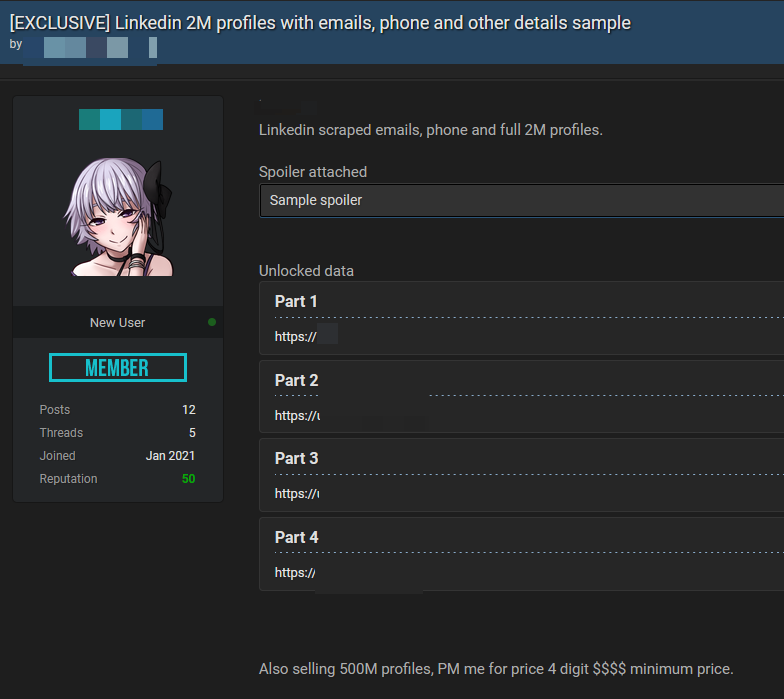
An archive containing data purportedly scraped from 500 million LinkedIn profiles has been put for sale on a popular hacker forum, with another 2 million records leaked as a proof-of-concept sample by the post author.
The four leaked files contain information about the LinkedIn users whose data has been allegedly scraped by the threat actor, including their full names, email addresses, phone numbers, workplace information, and more.
To see if your email address has been exposed in this data leak or other security breaches, use our personal data leak checker with a library of 15+ billion breached records.
While users on the hacker forum can view the leaked samples for about $2 worth of forum credits, the threat actor appears to be auctioning the much-larger 500 million user database for at least a 4-digit sum, presumably in bitcoin.
The author of the post claims that the data was scraped from LinkedIn. Our investigation team was able to confirm this by looking at the samples provided on the hacker forum. However, it’s unclear whether the threat actor is selling up-to-date LinkedIn profiles, or if the data has been taken or aggregated from a previous breach suffered by LinkedIn or other companies.
We asked LinkedIn if they could confirm that the leak was genuine, and whether they have alerted their users and clients, but we have received no reply from the company at the time of writing this report.
What was leaked?
Based on the samples we saw from the leaked files, they appear to contain a variety of mostly professional information from LinkedIn profiles, including:
A database containing the phone numbers of more than half a billion Facebook users is being freely traded online, and Facebook is trying to pin the blame on everyone but themselves.
A blog post titled “The Facts on News Reports About Facebook Data,” published Tuesday evening, is designed to silence the growing criticism the company is facing for failing to protect the phone numbers and other personal information of 533 million users after a database containing that information was shared for free in low level hacking forums over the weekend, as first reported by Business Insider.
Facebook initially dismissed the reports as irrelevant, claiming the data was leaked years ago and so the fact it had all been collected into one uber database containing one in every 15 people on the planet—and was now being given away for free—didn’t really matter.
[…]
But, instead of owning up to its latest failure to protect user data, Facebook is pulling from a familiar playbook: just like it did during the Cambridge Analytica scandal in 2018, it’s attempting to reframe the security failure as merely a breach of its terms of service.
So instead of apologizing for failing to keep users’ data secure, Facebook’s product management director Mike Clark began his blog post by making a semantic point about how the data was leaked.
“It is important to understand that malicious actors obtained this data not through hacking our systems but by scraping it from our platform prior to September 2019,” Clark wrote.
This is the identical excuse given in 2018, when it was revealed that Facebook had given Cambridge Analytica the data of 87 million users without their permission, for use in political ads.
Clark goes on to explain that the people who collected this data—sorry, “scraped” this data—did so by using a feature designed to help new users find their friends on the platform.
“This feature was designed to help people easily find their friends to connect with on our services using their contact lists,” Clark explains.
The contact importer feature allowed new users to upload their contact lists and match those numbers against the numbers stored on people’s profiles. But like most of Facebook’s best features, the company left it wide open to abuse by hackers.
“Effectively, the attacker created an address book with every phone number on the planet and then asked Facebook if his ’friends’ are on Facebook,” security expert Mikko Hypponen explained in a tweet.
Clark’s blog post doesn’t say when the “scraping” took place or how many times the vulnerability was exploited, just that Facebook fixed the issue in August 2019. Clark also failed to mention that Facebook was informed of this vulnerability way back in 2017, when Inti De Ceukelaire, an ethical hacker from Belgium, disclosed the problem to the company.
And, the company hasn’t explained why a number of users who have deleted their accounts long before 2018 have seen their phone numbers turn up in this database.
[…]
“While we addressed the issue identified in 2019, it’s always good for everyone to make sure that their settings align with what they want to be sharing publicly,” Clark wrote.
“In this case, updating the ‘How People Find and Contact You’ control could be helpful. We also recommend people do regular privacy checkups to make sure that their settings are in the right place, including who can see certain information on their profile and enabling two-factor authentication.”
It’s an audacious move for a company worth over $300 billion, with $61 billion cash on hand, to ask its users to secure their own information, especially considering how byzantine and complex the company’s settings menus can be.
Thankfully for the half a billion Facebook users who’ve been impacted by the breach, there’s a more practical way to get help. Troy Hunt, a cyber security consultant and founder of Have I Been Pwned has uploaded the entire leaked database to his website that allows anyone to check whether their phone number is listed in the leaked database.
Austrian privacy activist Max Schrems has filed a complaint against Google in France alleging that the US tech giant is illegally tracking users on Android phones without their consent.
Android phones generate unique advertising codes, similar to Apple’s Identifier for Advertisers (IDFA), that allow Google and third parties to track users’ browsing behavior in order to better target them with advertising.
In a complaint filed on Wednesday, Schrems’ campaign group Noyb argued that in creating and storing these codes without first obtaining explicit permission from users, Google was engaging in “illegal operations” that violate EU privacy laws.
Noyb urged France’s data privacy regulator to launch a probe into Google’s tracking practices and to force the company to comply with privacy rules. It argued that fines should be imposed on the tech giant if the watchdog finds evidence of wrongdoing.
“Through these hidden identifiers on your phone, Google and third parties can track users without their consent,” said Stefano Rossetti, privacy lawyer at Noyb. “It is like having powder on your hands and feet, leaving a trace of everything you do on your phone—from whether you swiped right or left to the song you downloaded.”
[…]
Last year, Schrems won a landmark case at Europe’s highest court that ruled a transatlantic agreement on transferring data between the bloc and the US used by thousands of corporations did not protect EU citizens’ privacy.