How to Download Everything Amazon Knows About You (It’s a Lot)

[…]To be clear, data collection is far from an Amazon-specific problem; it’s pretty much par for the course when it comes to tech companies. Even Apple, a company vocal about user privacy, has faced criticism in the past for recording Siri interactions and sharing them with third-party contractors.

The issue with Amazon, however, is the extent to which they collect and archive your data. Just about everything you do on, with, and around an Amazon product or service is logged and recorded. Sure, you might not be surprised to learn that when you visit Amazon’s website, the company logs your browsing history and shopping data. But it goes far beyond that. Since Amazon owns Whole Foods, it also saves your shopping history there. When you watch video content through its platforms, it records all of that information, too.

Things get even creepier with other Amazon products. If you read books on a Kindle, Amazon records your reading activity, including the speed of your page turns (I wonder if Bezos prefers a slow or fast page flip); if you peered into your Amazon data, you might find something similar to what a Reuter’s reporter found: On Aug. 8 2020, someone on that account read The Mitchell Sisters: A Complete Romance Series from 4:52 p.m. through 7:36 p.m., completing 428 pages. (Nice sprint.)

If you have one of Amazon’s smart speakers, you’re on the record with everything you’ve ever uttered to the device: When you ask Alexa a question or give it a command, Amazon saves the audio files for the entire interaction. If you know how to access you data, you can listen to every one of those audio files, and relive moments you may or may not have realized were recorded.

Another Reuters reporter found Amazon saved over 90,000 recordings over a three-and-a-half-year period, which included the reporter’s children asking Alexa questions, recordings of those same children apologizing to their parents, and, in some cases, extended conversations that were outside the scope of a reasonable Alexa query.

Unfortunately, while you can access this data, Amazon doesn’t make it possible to delete much of it. You can tweak your privacy settings you stop your devices from recording quite as much information. However, once logged, the main strategy to delete it is to delete the entire account it is associated with. But even if you can’t delete the data while sticking with your account, you do have a right to see what data Amazon has on you, and it’s simple to request.

How to download all of your Amazon data

To start, , or go to Amazon’s Help page. You’ll find the link under Security and Privacy > More in Security & Privacy > Privacy > How Do I Request My Data? Once there, click the “Request My Data” link.

From the dropdown menu, choose the data you want from Amazon. If you want everything, choose “Request All Your Data.” Hit “Submit Request,” then click the validation link in your email. That’s it. Amazon makes it easy to see what the have on you, probably because they know you can’t do anything about it.

[Reuters]

Source: How to Download Everything Amazon Knows About You (It’s a Lot)

The IEA wants to make their data available to the public – now it is on governments of the world’s rich countries to make this happen

To tackle climate change we need good data. This data exists; it is published by the International Energy Agency (IEA). But despite being an institution that is largely publicly funded, most IEA data is locked behind paywalls.

[…]

In 2020 we launched a campaign to unlock this data; we started on Twitter (one example), last year we wrote a detailed article about the problem here on OWID, and our letter in Nature.

[…]

The IEA has just announced that it aims to make all of its data and analysis freely available and open-access. This was put forward by the IEA’s executive director, Fatih Birol, and has been approved by its governing board already.

There is one step left. Next month – on February 2nd and 3rd – the IEA will ask for approval from its member countries. That means it is on the governments of the world’s rich countries to make this happen. If they do not approve it, it would be a missed opportunity to accelerate our action on addressing climate change.

This would be a massive achievement. The benefits of closing the small funding gap that remains greatly outweigh the costs.

There is now large support for the IEA data to be freely available – from researchers to journalists; policymakers to innovators. Many have called for the IEA data to be public.  Many thanks to everyone who has joined in pushing this forwards – below we share the links to several articles, petitions, and open letters that have made this possible.

Open letter to the International Energy Agency and its member countries: please remove paywalls from global energy data and add appropriate open licenses – by Robbie Morrison, Malte Schaefer and the OpenMod community

Energy watchdog urged to give free access to government data – Jillian Ambrose, in The Guardian

Opening up energy data is critical to battling climate change – Christa Hasenkopf, in Devex

Researchers are excited by ‘tantalising’ prospect of open IEA energy data – Joe Lo, in Climate Home

Open petition letter: Free IEA Data – A site by Skander Garroum and Christoph Proeschel on which you can write a letter to your country’s government.

[…]

Source: The IEA wants to make their data available to the public – now it is on governments of the world’s rich countries to make this happen – Our World in Data

Totally Bogus DMCA Takedowns From Giant Publishers Completely Nuke Book Review Blog Off The Internet

Just as we’re in the midst of a Greenhouse series all about SOPA, copyright industry lobbyists, and former copyright industry lawyers now running the Copyright Office are conspiring to make copyright law worse and to favor Hollywood and give the big giant legacy copyright companies more control and power over the internet.

And, yet, we pay almost no attention to how they massively abuse the power they already have under copyright law to silence people. The latest example is the book review blog, Fantasy Book Critic. I’d link to it, but as I’m writing this all you now see is a message that says “Sorry, the blog at fantasybookcritic.blogspot.com has been removed.”

Why? Because two of the largest publishing companies in the world, Penguin Random House and HarperCollins, hired a ridiculously incompetent service provider called “Link-Busters” which specializes in bullshit automated DMCA takedowns for the publishing industry. Link-Busters’ website looks like basically all of these sketchy, unreliable services, promising to “protect IP” and (even more ridiculously) “turn piracy into profits.”

[…]

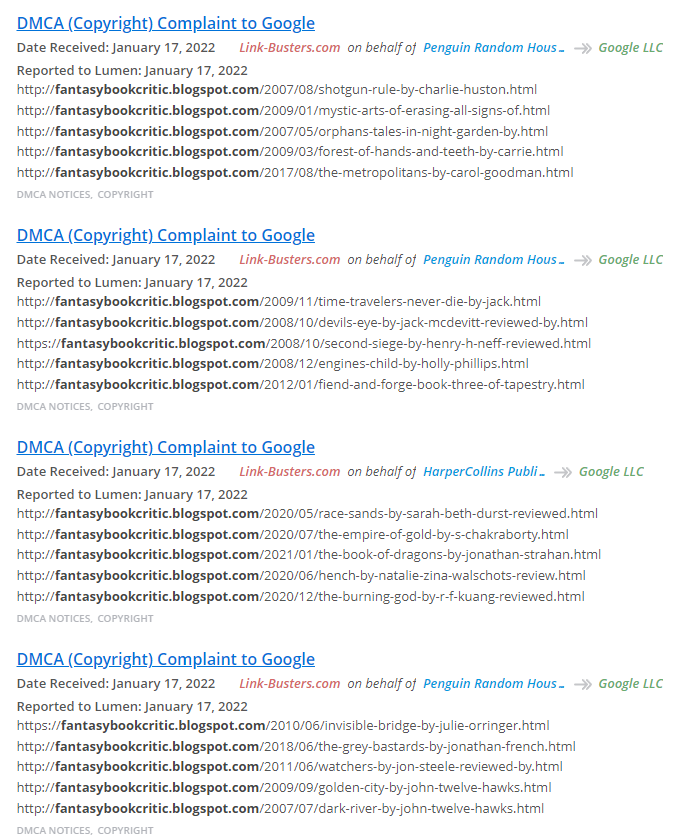
On Monday, Link-Busters, on behalf of Penguin Random House and HarperCollins sent over 50 bullshit takedown notices to Google, claiming that various reviews on Fantasy Book Critic were actually infringing copies of the books they were reviewing. Each notice listed many, many blog posts on the site. This is just a small sample of four such notices.

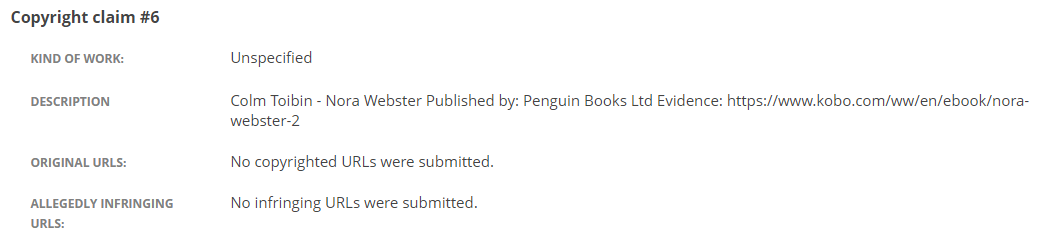
The actual notices do contain some links to websites that appear to have pirated copies of some books available, but also lots of links to Fantasy Book Critic’s reviews. The whole thing just seems incredibly sloppy by Link-Busters. Some of the “allegedly infringing” books in some of these notices didn’t even include links to allegedly infringing pages.

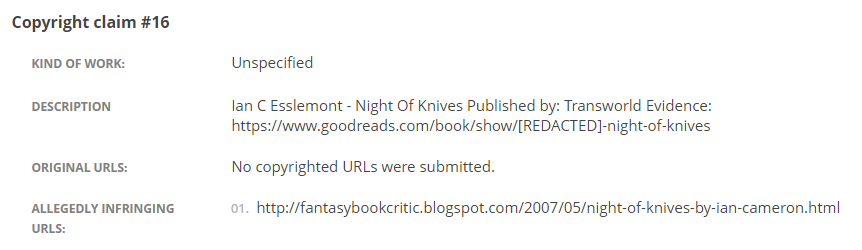
And then some show the only allegedly “infringing” links being… Fantasy Book Critic’s reviews:

That link, which again, does not exist any more, can be seen on the Internet Archive where you see that not only is it clearly a review, and not piracy, but it directly links visitors to places where they can buy the book.

[…]

the real problem here is that there are no consequences whatsoever for Link-Busters or Penguin Random House or HarperCollins. While the DMCA has Section 512(f), which is supposed to punish false notifiers, in practice it is a dead letter. This means, Link-Busters can spam Google with wild abandon with blatantly false DMCA notices and face zero consequences. But, more importantly, publishing giants like Penguin Random House and HarperCollins (which are currently suing libraries for offering lendable ebooks), can get away with this abuse of the law over and over again.

Fantasy Book Critic was reduced to begging on Twitter for Google to look more closely at Link-Busters bogus notifications and to restore their blog. They even contacted Link-Busters which admitted that they fucked up (though, perhaps they should have checked before sending these bogus notices?)

[…]

Source: Totally Bogus DMCA Takedowns From Giant Publishers Completely Nuke Book Review Blog Off The Internet | Techdirt

WhatsApp Ordered To Help US Agents Spy On Chinese Phones using 1986 pen register act

U.S. federal agencies have been using a 35-year-old American surveillance law to secretly track WhatsApp users with no explanation as to why and without knowing whom they are targeting. In Ohio, a just-unsealed government surveillance application reveals that in November 2021, DEA investigators demanded the Facebook-owned messaging company track seven users based in China and Macau. The application reveals the DEA didn’t know the identities of any of the targets, but told WhatsApp to monitor the IP addresses and numbers with which the targeted users were communicating, as well as when and how they were using the app. Such surveillance is done using a technology known as a pen register and under the 1986 Pen Register Act, and doesn’t seek any message content, which WhatsApp couldn’t provide anyway, as it is end-to-end encrypted.

As Forbes previously reported, over at least the last two years, law enforcement in the U.S. has repeatedly ordered WhatsApp and other tech companies to install these pen registers without showing any probable cause. As in those previous cases, the government order to trace Chinese users came with the statement that the Justice Department only needed to provide three “elements” to justify tracking of WhatsApp users. They include: the identity of the attorney or the law enforcement officer making the application; the identity of the agency making the application; and a certification from the applicant that “the information likely to be obtained is relevant to an ongoing criminal investigation being conducted by that agency.” “Other than the three elements described above, federal law does not require that an application for an order authorizing the installation and use of a pen register and a trap and trace device specify any facts,” the government wrote in the latest application.

Source: WhatsApp Ordered To Help US Agents Spy On Chinese Phones – Slashdot

Canon can’t get enough toner chips, so it’s telling customers how to defeat its DRM

[.,..]To enforce the use of first-party cartridges, manufacturers typically embed chips inside the consumables for the printers to “authenticate.” But when chips are in short supply, like today, manufacturers can find themselves in a bind. So Canon is now telling German customers how to defeat its printers’ warnings about third-party cartridges.

“Due to the worldwide continuing shortage of semiconductor components, Canon is currently facing challenges in procuring certain electronic components that are used in our consumables for our multifunction printers (MFP),” a Canon support website says in German. “In order to ensure a continuous and reliable supply of consumables, we have decided to supply consumables without a semiconductor component until the normal supply takes place again.”

[…]

The software on these printers comes with a relatively simple way to defeat the chip checks. Depending on the model, when an error message occurs after inserting toner, users can press either “I Agree,” “Close,” or “OK.” When users press that button, the world does not end. Rather, Canon says users may find that their toner cartridge doesn’t give them a low-toner warning before running empty.

“Although there are no negative effects on print quality when consumables are used without electronic components, certain additional functions, such as the detection of the toner level, may be impaired,” Canon’s support site says.

Source: Canon can’t get enough toner chips, so it’s telling customers how to defeat its DRM | Ars Technica

Facebook Pixel Hunt – Mozilla Rally want to track the trackers

In a collaboration between journalists at The Markup and Mozilla researchers, this study seeks to map Facebook’s pixel tracking network and understand the kinds of information it collects on sites across the web. The Markup will use the data collected in this study to create investigative journalism around the kinds of information Facebook collects about you, and where.

The study will run until July 13, 2022.

Goals of the Study

According to its own privacy policy, Facebook may collect information about you across the web even if you don’t have a Facebook account. One way Facebook performs this tracking is through a network of “pixels” that may be installed on many of the sites you visit. By joining this study, you will help Rally and The Markup investigate and report on where Facebook is tracking you and what kind of information they are collecting.

This Study Will Collect:

This Study will Collect:

  • The data sent to Facebook pixels as you browse
  • The URLs of the web pages you browse
  • The time you spend browsing pages
  • The presence of Facebook login cookies in your browser
  • A study survey that the user completes
  • Metadata on the URLs your visit:
    • The full URL of each webpage that you are on
    • Time spent browsing and playing media on each webpage
    • How far down the webpage you scrolled

In addition, your Rally demographics survey responses will be combined with study data for the analysis.

Note: Only deidentified metrics and models will be exported from our secure environment. For additional information about our data collection, view our metrics definition file in our open source codebase.

Source: Facebook Pixel Hunt

John Deere Hit With Class Action Lawsuit for Alleged Tractor Repair Monopoly

A class action lawsuit filed in Chicago has accused John Deere of running an illegal repair monopoly. The lawsuit alleged that John Deere has used software locks and restricted access to repair documentation and tools, making it very difficult for farmers to fix their own agricultural equipment, a problem that Motherboard has documented for years and that lawmakers, the FTC, and even the Biden administration have acknowledged.

[…]

The situation is so bad that it’s created a boom in the secondary market. Used tractors are selling for hundreds of thousands of dollars, in part, because they’re easier to repair than modern machines.

Forest River Farms, a farming corporation in North Dakota, filed the recent antitrust lawsuit against John Deere, alleging that “Deere’s network of highly-consolidated independent dealerships is not permitted through their agreements with Deere to provide farmers or repair shops with access to the same software and repair tools the Dealerships have.”

[…]

Last year, President Biden signed an executive order aimed at making it easier for everyone to fix their own stuff. He also directed the FTC to formally adopt a pro right-to-repair platform. Legislation has been introduced in congress that would enshrine the right-to-repair and similar laws are working their way through various statehouses across the country. Microsoft’s shareholders have pressed the company to do more for repair and even Apple is backing away from its monopolistic repair practices.

[…]

Source: John Deere Hit With Class Action Lawsuit for Alleged Tractor Repair Monopoly

German IT security watchdog: No evidence of censorship function in Xiaomi phones

Germany’s federal cybersecurity watchdog, the BSI, did not find any evidence of censorship functions in mobile phones manufactured by China’s Xiaomi Corp (1810.HK), a spokesperson said on Thursday.

Lithuania’s state cybersecurity body had said in September that Xiaomi phones had a built-in ability to detect and censor terms such as “Free Tibet”, “Long live Taiwan independence” or “democracy movement”. The BSI started an examination following these accusations, which lasted several months. read more

“As a result, the BSI was unable to identify any anomalies that would require further investigation or other measures,” the BSI spokesperson said.

Source: German IT security watchdog: No evidence of censorship function in Xiaomi phones | Reuters

Google’s and Facebook’s top execs accused of fixing ads

The alleged 2017 deal between Google and Facebook to kill header bidding, a way for multiple ad exchanges to compete fairly in automated ad auctions, was negotiated by Facebook COO Sheryl Sandberg, and endorsed by both Facebook CEO Mark Zuckerberg (now with Meta) and Google CEO Sundar Pichai, according to an updated complaint filed in the Texas-led antitrust lawsuit against Google.

Texas, 14 other US states, and the Commonwealths of Kentucky and Puerto Rico accused Google of unlawfully monopolizing the online ad market and rigging ad auctions in a December, 2020, lawsuit. The plaintiffs subsequently filed an amendment complaint in October, 2021, that includes details previously redacted.

On Friday, Texas et al. filed a third amended complaint [PDF] that fills in more blanks and expands the allegations by 69 more pages.

The fortified filing adds additional information about previous revelations and extends the scope of concern to cover in-app advertising in greater detail.

Presently, there are three other US government-backed unfair competition claims against Google ongoing: a federal antitrust lawsuit from the US Justice Department, a challenge from Colorado and 38 other State Attorneys General (filed around the same time as the Texas-led complaint), as well as a competition claim focused on Android and the Google Play Store filed last July.

The third amendment complaint delves into more detail about how Google allegedly worked “to kill header bidding,”

[]…]

The deal, referred to as “Jedi Blue” internally and eventually as “Open Bidding” when discussed publicly, allegedly allowed Facebook to win ad auctions even when outbid by competitors.

The third amended complaint explains, “Facebook’s Chief Operating Officer [REDACTED] was explicit that ‘[t]his is a big deal strategically’ in an email thread that included Facebook CEO [REDACTED].

[…]

The expanded filing includes new allegations about how Google used Accelerated Mobile Pages to hinder header bidding.

Google first created Accelerated Mobile Pages (“AMP”), a framework for developing mobile webpages, and made AMP compatible with Google’s ad server but substantially hindered compatibility with header bidding. Specifically, Google made AMP unable to execute JavaScript in the header, which frustrated publishers’ use of header bidding.

[…]

What’s more, the revised filing adds support for the claim that a Google ad program called Dynamic Revenue Share or DRS cheated to help Google win more valuable ad impressions.

“DRS manipulated Google’s exchange fee after soliciting bids in the auction and after peeking at rival exchanges’ bids to win impressions it would have otherwise lost,” the revised complaint says.

And the complaint now contends that Google personnel admitted the unfairness of the DRS system: “Google internally acknowledged that DRS made its auction untruthful: ‘One known issue with the current DRS is that it makes the auction untruthful as we determine the AdX revshare after seeing buyers’ bids and use winner’s bid to price itself (first-pricing)….'”

[…]

Source: Google’s and Facebook’s top execs accused of fixing ads • The Register

Google and Facebook Fined Big in Russia for Failing to Remove Banned Content – imprisonment threats follow forcing local data storage

A Russian court fined Alphabet Inc.’s Google 7.2 billion rubles ($98 million) and Meta Platforms Inc. 2 billion rubles Friday for failing to remove banned content, the largest such penalties yet, as the authorities escalate a crackdown on foreign technology companies.

The fines were due to the companies’ repeated failure to comply with orders to take down content and based on a percentage of their annual earnings in Russia, the federal communications watchdog said in a statement. Google and Meta could face more fines if they don’t remove the material, it said.

[…]

The government is also pushing tech companies to comply with its increasingly strict laws on localizing data storage. This year, Google and Apple Inc. removed a protest-voting app from their Russian stores during parliamentary elections after the authorities threatened to imprison their local staff.

Until the latest rulings, however, fines for failure to remove content were generally insignificant. In September, Russia’s federal communications watchdog said companies that did not delete content could face fines of 5% to 20% of their annual local revenue.

Google earned revenues in Russia of about 85 billion rubles in 2020, according to the Spark-Interfax database.

“For some reason, the company fulfills decisions of American and European courts unquestioningly,” Anton Gorelkin, a ruling party deputy in the lower house of parliament who sits on the Information Policy committee, wrote on Telegram after the Google ruling was announced Friday. “If the turnover fine doesn’t bring Google to its senses, I’m afraid that some very unpleasant measures will be taken.”

[…]

Source: Google in Russia Fined $98 Million for Failing to Remove Banned Content – Bloomberg

Snap suing to trademark the word “spectacles” for its smart glasses that no one has ever used or knows much about

Snap is suing the US Patent and Trademark Office (USPTO) for rejecting its application to trademark the word “spectacles” for its digital eyewear camera device. But the USPTO has maintained that “spectacles” is a generic term for smart glasses and that Snap’s version “has not acquired distinctiveness,” as required for a trademark.

In its complaint filed Wednesday in US District Court in California, Snap claims that the Spectacles name “evokes an incongruity between an 18th century term for corrective eyewear and Snap’s high-tech 21st century smart glasses. SPECTACLES also is suggestive of the camera’s purpose, to capture and share unusual, notable, or entertaining scenes (i.e., “spectacles”) and while also encouraging users to make ‘spectacles’ of themselves.”

Snap first introduced its camera-equipped Spectacles in 2016 (“a wearable digital video camera housed in a pair of fashionable sunglasses,” according to its complaint), which can take photos and videos while the user wears them and connects with the Snap smartphone app. Despite selling them both online and in pop-up vending machines around the world, the first iteration of Spectacles mostly flopped with consumers. In its 2017 third-quarter earnings report, Snap said it had lost nearly $40 million on some 300,000 unsold Spectacles.

In May 2021, Snap CEO Evan Spiegel showed off an augmented reality version of the Spectacles, which so far are available only to a small group of creators and reviewers chosen by the company. The AR Spectacles aren’t yet available for purchase by the general public.

Snap’s new complaint posits that there’s been enough media coverage of Spectacles, bolstered by some industry awards and its own marketing including social media, to support its claim that consumers associate the word “spectacles” with the Snap brand. Snap first filed a trademark application for Spectacles in September 2016, “for use in connection with wearable computer hardware” and other related uses “among consumer electronics devices and displays.”

During several rounds of back-and-forth with the company since then, the USPTO has maintained that the word “spectacles” appeared to be “generic in connection with the identified goods,” i.e. the camera glasses. Snap continued to appeal the agency’s decision.

In a November 2021 opinion, the USPTO’s Trademark Trial and Appeal Board (pdf) upheld the decision, reiterating that the word “spectacles” was a generic term that applied to all smart glasses, not just Snap’s version. Despite the publicity Snap claimed its Spectacles had received from its marketing and social media, the board noted in its opinion that Spectacles’ “social media accounts have an underwhelming number of followers, and the number of followers is surprisingly small,” which didn’t support the company’s argument that there had been a high enough level of consumer exposure to Snap’s Spectacles to claim that consumers associated the word with Snap’s brand.

[…]

Source: Snap suing to trademark the word “spectacles” for its smart glasses

This App Will Tell Android Users If an AirTag Is Tracking Them

Apple’s AirTags and Find My service can be helpful for finding things you lose—but they also introduce a big privacy problem. While those of us on iOS have had some tools for fighting those issues, Apple left those of us on Android without much to work with. A new Android AirTag finder app finally addresses some of those concerns.

How AirTags work

[…]

The Find My network employs the passive use of hundreds of millions of Apple devices to help expand your search. That way, you can locate your lost items even if they’re too far away for traditional wireless tracking. Your lost AirTag may be out of your own phone’s Bluetooth range, but it may not be far from another Apple device.

[…]

The Tracker Detect app comes out of a need for better security in the Find My network. Having such a wide network to track a tiny, easy-to-miss device could make it easy for someone to use AirTags to track someone.

People pointed out this vulnerability pretty soon after Apple announced the AirTags. With more than 113 million iPhones in the U.S., not to mention other Apple devices, the Find My network could be one of the widest tracking systems available. A device as small and easy-to-use as an AirTag on that network could make stalking easier than ever.

That said, Apple has a built-in feature designed to prevent tracking. If your iPhone senses that a strange AirTag, separated from its owner, is following you, it will send you an alert. If that AirTag is not found, it will start to make a sound anywhere from 8 to 24 hours after being separated from its owner.

However, Android users haven’t had these protections. That’s where Tracker Detect comes in; with this new Android AirTag app, you can scan the area to see if anyone may be tracking your location with an AirTag or other Find My-enabled accessory.

How to use Tracker Detect

If you’re concerned about people tracking you, download the Tracker Detect app from the Google Play Store. You don’t need an Apple account or any Apple devices to use it.

The app won’t scan automatically, so you’ll have to look for devices manually. To do that, open the app and tap Scan. Apple says it may take up to 15 minutes to find an AirTag that’s separated from its owner. You can tap Stop Scanning to end the search if you feel safe, and if the app detects something, it will mark it as Unknown AirTag.

Once the app has detected an AirTag, you can have it play a sound through the tag for up to ten minutes to help you find it. When you find the AirTag, you can scan it with an NFC reader to learn more about it.

[…]


Source: This App Will Tell Android Users If an AirTag Is Tracking Them

Malaysia in pocket of big business: Passes Bill to Imprison Illegal Streaming (even devices!) for 20 years

Laws that forbid the illegal uploading and downloading of copyrighted content are common around the world but the rise of streaming has sometimes exposed gaps in legislation.

Piracy-equipped Kodi devices, illegal streaming apps, and similar tools have led legal specialists to attempt to apply laws that didn’t envision the technology. In Malaysia, for example, it took a decision by the High Court last May to determine that the sale and distribution of streaming devices configured for piracy purposes does indeed constitute infringement under the Copyright Act.

But Malaysia was far from done. After previously informing the United States Patent and Trademark Office (USPTO) that the economic harm being caused to broadcasters and rightsholders in the country was a “serious problem”, Malaysia said it had amendments on the table to more directly tackle the illegal uploading, provision, and sharing of access to copyright works.

House of Representatives Passes Copyright Amendment Bill

This week Malaysia’s Dewan Rakyat (House of Representatives) passed the Copyright (Amendment) Bill 2021 which, among other things, will more directly address the challenges of illegal streaming.

“Act 332 is amended to ensure copyright laws implemented will provide more efficient and effective protection in line with current demands and to fulfill the needs of the business community and stakeholders,” said Domestic Trade and Consumer Affairs Minister Datuk Seri Alexander Nanta Linggi.

The amendments are focused on those involved in the provision or facilitation of illegal streams. The term “streaming technology” is repeatedly referenced and for the purposes of the act this includes computer programs (apps and other software tools), devices (streaming hardware of all kinds) that, in whole or in part, are used to infringe copyright in a protected work.

How the amendments will be used in practice remains to be seen but the scope appears to be intentionally broad and could result in significant punishments for those found to be in breach of the law.

Punishments for Illegal Streaming Facilitators

The first section of the amendment deals with those who “commit or facilitate infringement” of copyright by manufacturing a streaming technology for sale or hire, importing a streaming technology, selling or letting for hire (including offering, exposing or advertising for sale or hire), and/or possessing or distributing a streaming technology in the course of a business.

It expands to include distributing or offering to the public an infringing streaming technology or service other than in the course of a business, to such an extent “as to affect prejudicially the owner of the copyright.”

Anyone who contravenes these amendments will be guilty of an offense and upon conviction shall be liable to a fine of not less than 10 thousand ringgit (US$2,377) but not more than two hundred thousand ringgit (US$47,545). In addition to the possibility of fines, there are also custodial sentences that could reach a staggering 20 years imprisonment in the most serious of cases.

Those hoping to use a corporate structure as a shield are also put on notice. When any offenses are committed by a corporate body or by a person who is a partner in a firm, everyone from directors to managers will be deemed guilty of the offense and may be charged severally or jointly, unless they can show they had no knowledge and conducted due diligence to prevent the offense.

The details of the amendments can be found here (pdf)

Source: Malaysia Passes Bill to Imprison Illegal Streaming Pirates For Up To 20 Years * TorrentFreak

Considering the broadness of this law, it looks like selling a mobile phone, PC or laptop – which are all capable of streaming illegal content – could become punishable.

How China Uses Western Influencers As Pawns In Its Propaganda War

According to the New York Times, China is recruiting YouTubers to report on the country in a positive light and counter the West’s increasingly negative perceptions. “The videos have a casual, homespun feel. But on the other side of the camera often stands a large apparatus of government organizers, state-controlled news media and other official amplifiers — all part of the Chinese government’s widening attempts to spread pro-Beijing messages around the planet,” the report says. “State-run news outlets and local governments have organized and funded pro-Beijing influencers’ travel, according to government documents and the creators themselves. They have paid or offered to pay the creators. They have generated lucrative traffic for the influencers by sharing videos with millions of followers on YouTube, Twitter and Facebook.” An anonymous reader shares an excerpt from Techdirt, which summarizes the Times’ findings: Typically, the Chinese government support comes in the form of free organized trips around China, particularly in Xinjiang. By showing the influencers a carefully sanitized image of life in the country, the authorities don’t need to worry about negative stories. They simply make it easy for the YouTubers to present images of jolly peasants and happy city-dwellers, because that’s all they are allowed to see. One of the authors of the New York Times piece, Paul Mozur, noted on Twitter another important way that the authorities are able to help their influencer guests. Once produced, the China-friendly videos are boosted massively by state media and diplomatic Facebook and Twitter accounts: “One video by Israeli influencer Raz Gal-Or portraying Xinjiang as ‘totally normal’ was shared by 35 government connected accounts with a total of 400 million followers. Many were Chinese embassy Facebook accounts, which posted about the video in numerous languages.”

A new report from the Australian Strategic Policy Institute, “Borrowing mouths to speak on Xinjiang,” has some more statistics on this practice: “Our data collection has found that, between January 2020 and August 2021, 156 Chinese state-controlled accounts on US-based social media platforms have published at least 546 Facebook posts, Twitter posts and shared articles from [China Global Television Network], Global Times, Xinhua or China Daily websites that have amplified Xinjiang-related social media content from 13 influencer accounts. More than 50% of that activity occurred on Facebook.” Mozur says that the use of Western influencers in this way also allows employees of Beijing-controlled media, like the journalist Li Jingjing, to present themselves as independent YouTubers. On Twitter, however, she is labeled as “China state-affiliated media.” The Australian Strategic Policy Institute sees this as part of a larger problem (pdf): “labelling schemes adopted by some video-sharing and social media platforms to identify state-affiliated accounts are inconsistently applied to media outlets and journalists working for those outlets. In addition, few platforms appear to have clear policies on content from online influencers or vloggers whose content may be facilitated by state-affiliated media, through sponsored trips, for example.”

According to Mozur, China’s state broadcaster is actively looking for more influencers, offering bonuses and publicity for those who sign up. In the US, China’s consulate general is paying $300,000 to a firm to recruit influencers for the Winter Olympics, ranging from Celebrity Influencers with millions of Instagram or TikTok followers, to Nano Influencers, with merely a few thousand. The ultimate goal of deploying these alternative voices is not to disprove negative stories appearing in Western media, but something arguably worse, as the New York Times report explains: “China is the new super-abuser that has arrived in global social media,” said Eric Liu, a former content moderator for Chinese social media. “The goal is not to win, but to cause chaos and suspicion until there is no real truth.”

Source: How China Uses Western Influencers As Pawns In Its Propaganda War – Slashdot

Banks, ISPs Increasingly Embrace ‘Voice Print’ Authentication Despite Growing Security Risk

While it’s certainly possible to sometimes do biometrics well, a long line of companies frequently… don’t. Voice print authentication is particularly shaky, especially given the rise of inexpensive voice deepfake technology. But, much like the continued use of text-message two-factor authentication (which is increasingly shown to not be secure), it apparently doesn’t matter to a long list of companies.

Banks and telecom giants alike have started embracing voice authentication tech at significant scale despite the added threat to user privacy and security. And they’re increasingly collecting user “voice print” data without any way to opt out:

“despite multiple high-profile cases of scammers successfully stealing money by impersonating people via deepfake audio, big banks and ISPs are rolling out voice-based authentication at scale. The worst offender that I could find is Chase. There is no “opt in”. There doesn’t even appear to be a formal way to “opt out”! There is literally no way for me to call my bank without my voice being “fingerprinted” without my consent.”

[…]

Source: Banks, ISPs Increasingly Embrace ‘Voice Print’ Authentication Despite Growing Security Risk | Techdirt

Why our electronics break: what we can learn from nearly 10 years of repairs over 50k broken items

We now have data on over 21,000 broken items and what was done to fix them. This information comes from volunteers at our own events and others who use our community repair platform, restarters.net.

Thanks to our partners in the Open Repair Alliance who also collect this kind of data, we were able to include extra data from other networks around the world.

Together, this brought the total to nearly 50,000 broken items.

Want to see this data for yourself? Download the full dataset here
(Note: Links to the datasets that contain fault types are further down this page)

That’s a lot of data. So to analyse it, we focused on three types of products that the European Commission would be investigating:

  • Printers
  • Tablets
  • The batteries that power many of our gadgets.

[…]

Thanks to this collective effort, we were able to identify the most common reasons printers, tablets and batteries become unusable.

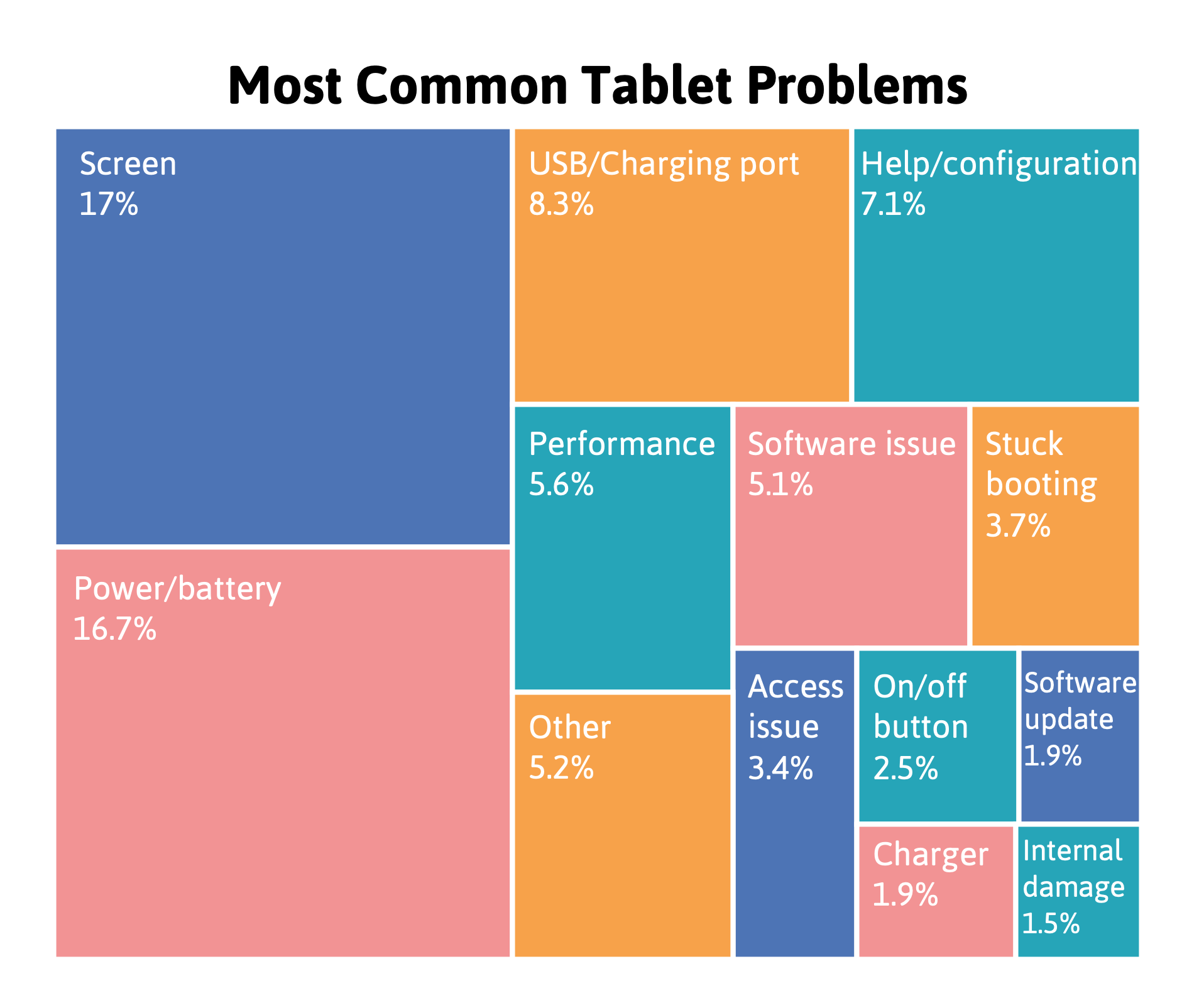
A diagram showing the most common tablet problems
These findings are based on the analysis of problems in 647 tablets brought to community repair events, but don’t include 131 tablets with poor data quality, making it impossible to confirm the main fault.

In addition, many of the items we looked at were fairly old, demonstrating that people really want to keep using their devices for longer.

But we also found that there are lots of barriers to repair that make this tricky. Some of the biggest are the lack of spare parts and repair documentation as well as designs that make opening the product difficult without causing extra damage.

You can see our full results and download the data for yourself here:

[…]

We want rules that make products easier to fix. And we’re already using data to push for a real Right to Repair. Just recently, we used previous findings to undermine an industry lobbyist’s anti-repair arguments in an EU policy meeting about upcoming regulations for smartphone and tablet repairability.

As a follow up, we also contributed our findings on common fault types in tablets, making the case for the need for better access to spare parts and repair information for this product category as well.

Next, we hope to increase the pressure on European policymakers for regulating printer repairability and battery-related issues in consumer products. For printers, the European Commission is considering rejecting a “voluntary agreement” proposed by industry, which ignores repairability for consumer printers.

And as for batteries, European institutions are working towards a Batteries Regulation, which must prioritise user-replaceability as well as the availability of spare parts.

[…]

Source: Why our electronics break: what we can learn from nearly 10 years of repairs – The Restart Project

Apple Removes All References to Controversial CSAM Scanning Feature – where they would scan all the pictures you took

Apple has quietly nixed all mentions of CSAM from its Child Safety webpage, suggesting its controversial plan to detect child sexual abuse images on iPhones and iPads may hang in the balance following significant criticism of its methods.

Apple in August announced a planned suite of new child safety features, including scanning users’ iCloud Photos libraries for Child Sexual Abuse Material (CSAM), Communication Safety to warn children and their parents when receiving or sending sexually explicit photos, and expanded CSAM guidance in Siri and Search.

Following their announcement, the features were criticized by a wide range of individuals and organizations, including security researchers, the privacy whistleblower Edward Snowden, the Electronic Frontier Foundation (EFF), Facebook’s former security chief, politicians, policy groups, university researchers, and even some Apple employees.

The majority of criticism was leveled at Apple’s planned on-device CSAM detection, which was lambasted by researchers for relying on dangerous technology that bordered on surveillance, and derided for being ineffective at identifying images of child sexual abuse.

[…]

Source: Apple Removes All References to Controversial CSAM Scanning Feature From Its Child Safety Webpage [Updated] – MacRumors

Scott Morrison urged to end ‘lunacy’ and push UK and US for Julian Assange’s release by Australian PMs

Australian parliamentarians have demanded the prime minister, Scott Morrison, intervene in the case of Julian Assange, an Australian citizen, after the United States won a crucial appeal in its fight to extradite the WikiLeaks founder on espionage charges.

“The prime minister must get Assange home,” the Australian Greens leader, Adam Bandt, told Guardian Australia on Saturday.

“An Australian citizen is being prosecuted for publishing details of war crimes, yet our government sits on its hands and does nothing.”

WikiLeaks founder Julian Assange.
WikiLeaks founder Julian Assange. Photograph: Daniel Leal-Olivas/AFP/Getty Images

The independent MP Andrew Wilkie called on Morrison to “end this lunacy” and demand the US and UK release Assange.

[…]

Source: Scott Morrison urged to end ‘lunacy’ and push UK and US for Julian Assange’s release | Australian politics | The Guardian

The European Commission is making its software open source to benefit society – considering it was paid for by the tax payers it’s the least they could do and should have done this years ago

The European Commission has announced that it’s adopting new rules around open source software which will see it release software under open source licenses. The decision follows a Commission study that found investment in open source software leads on average to four times higher returns. There has also been a push for this type of action from the Public Money, Public Code campaign.

If you’re wondering what sort of code the EC could offer to the world, it gave two examples. First, there’s its eSignature, a set of free standards, tools, and services that can speed up the creation and verification of electronic signatures that are legally valid inside the EU. Another example is LEOS (Legislation Editing Open Software) which is used to draft legal texts.

[…]

Source: The European Commission is making its software open source to benefit society – Neowin

Julian Assange can be extradited to the US, court rules, changes mind because US tells judge to.

Wikileaks founder Julian Assange can be extradited from the UK to the US, the High Court has ruled.

The US won its appeal against a January UK court ruling that he could not be extradited due to concerns over his mental health.

Judges were reassured by US promises to reduce the risk of suicide. His fiancee said they intended to appeal.

Mr Assange is wanted in the US over the publication of thousands of classified documents in 2010 and 2011.

Senior judges found the lower judge had based her decision in January on the risk of Mr Assange being held in highly restrictive prison conditions if extradited.

However, the US authorities later gave assurances that he would not face those strictest measures unless he committed an act in the future that merited them.

Giving the judgement, Lord Chief Justice Lord Burnett said: “That risk is in our judgement excluded by the assurances which are offered.

“It follows that we are satisfied that, if the assurances had been before the judge, she would have answered the relevant question differently.”

Mr Assange’s fiancee Stella Moris called the ruling “dangerous and misguided”, adding that the US assurances were “inherently unreliable”.

[…]

Wikileaks editor-in-chief Kristinn Hrafnsson said in a statement: “Julian’s life is once more under grave threat, and so is the right of journalists to publish material that governments and corporations find inconvenient.

“This is about the right of a free press to publish without being threatened by a bullying superpower.”

Amnesty International described the ruling as a “travesty of justice” and the US assurances as “deeply flawed”.

Nils Muiznieks, the human rights organisation’s Europe director, said it “poses a grave threat to press freedom both in the Unites States and abroad”.

Judges ordered the case must return to Westminster Magistrates’ Court for a district judge to send it formally to Home Secretary Priti Patel.

Mr Assange’s legal team – Birnberg Peirce Solicitors – said any appeal to the Supreme Court would relate to the question of assurances, rather than on issues such as free speech or “the political motivation of the US extradition request”.

Source: Julian Assange can be extradited to the US, court rules – BBC News

Report: VPNs Are Often a Mixed Bag for Privacy

[…] Consumer Reports, which recently published a 48-page white paper on VPNs that looks into the privacy and security policies of 16 prominent VPN providers. Researchers initially looked into some 51 different companies but ultimately honed in on the most prominent, high-quality providers. The results are decidedly mixed, with the report highlighting a lot of the long offered criticisms of the industry—namely, it’s lack of transparency, its PR bullshit, and its not always stellar security practices. On the flip side, a small coterie of VPNs actually seem pretty good.

[…]

. Consumers may often believe that by using a VPN they are able to become completely invisible online, as companies promise stuff like “unrivaled internet anonymity,” and the ability to “keep your browsing private and protect yourself from hackers and online tracking,” and so on and so forth.

In reality, there are still a whole variety of ways that companies and advertisers can track you across the internet—even if your IP address is hidden behind a virtual veil.

[…]

via a tool developed by a group of University of Michigan researchers, dubbed the “VPNalyzer” test suite, which was able to look at various security issues with VPN connections. The research team found that “malicious and deceptive behaviors by VPN providers such as traffic interception and manipulation are not widespread but are not nonexistent. In total, the VPNalyzer team filed more than 29 responsible disclosures, 19 of which were for VPNs also studied in this report, and is awaiting responses regarding its findings.”

The CR’s own analysis found “little evidence” of VPNs “manipulating users’ networking traffic when testing for evidence of TLS interception,” though they did occasionally run into examples of data leakage.

And, as should hopefully go without saying, any VPN with the word “free” near it should be avoided at all costs, lest you accidentally download some sort of Trojan onto your device and casually commit digital hari-kari.

[…]

According to CR’s review, four VPN providers rose to the top of the list in terms of their privacy and security practices. They were:

Apparently in that order.

These companies stood out mostly by not over-promising what they could deliver, while also scoring high on scales of transparency and security

[…]

Source: Report: VPNs Are Often a Mixed Bag for Privacy

Prisons snoop on inmates’ phone calls with speech-to-text AI

Prisons around the US are installing AI speech-to-text models to automatically transcribe conversations with inmates during their phone calls.

A series of contracts and emails from eight different states revealed how Verus, an AI application developed by LEO Technologies and based on a speech-to-text system offered by Amazon, was used to eavesdrop on prisoners’ phone calls.

In a sales pitch, LEO’s CEO James Sexton told officials working for a jail in Cook County, Illinois, that one of its customers in Calhoun County, Alabama, uses the software to protect prisons from getting sued, according to an investigation by the Thomson Reuters Foundation.

“(The) sheriff believes (the calls) will help him fend off pending liability via civil action from inmates and activists,” Sexton said. Verus transcribes phone calls and finds certain keywords discussing issues like COVID-19 outbreaks or other complaints about jail conditions.

Prisoners, however, said the tool was used to catch crime. In one case, it allegedly found one inmate illegally collecting unemployment benefits. But privacy advocates aren’t impressed. “T​​he ability to surveil and listen at scale in this rapid way – it is incredibly scary and chilling,” said Julie Mao, deputy director at Just Futures Law, an immigration legal group.

[…]

Source: Prisons snoop on inmates’ phone calls with speech-to-text AI • The Register

Executive at Swiss Tech Company Said to Operate Secret Surveillance Operation

The co-founder of a company that has been trusted by technology giants including Google and Twitter to deliver sensitive passwords to millions of their customers also operated a service that ultimately helped governments secretly surveil and track mobile phones, Bloomberg reported Monday, citing former employees and clients. From the report: Since it started in 2013, Mitto AG has established itself as a provider of automated text messages for such things as sales promotions, appointment reminders and security codes needed to log in to online accounts, telling customers that text messages are more likely to be read and engaged with than emails as part of their marketing efforts. Mitto, a closely held company with headquarters in Zug, Switzerland, has grown its business by establishing relationships with telecom operators in more than 100 countries. It has brokered deals that gave it the ability to deliver text messages to billions of phones in most corners of the world, including countries that are otherwise difficult for Western companies to penetrate, such as Iran and Afghanistan. Mitto has attracted major technology giants as customers, including Google, Twitter, WhatsApp, Microsoft’s LinkedIn and messaging app Telegram, in addition to China’s TikTok, Tencent and Alibaba, according to Mitto documents and former employees.

But a Bloomberg News investigation, carried out in collaboration with the London-based Bureau of Investigative Journalism, indicates that the company’s co-founder and chief operating officer, Ilja Gorelik, was also providing another service: selling access to Mitto’s networks to secretly locate people via their mobile phones. That Mitto’s networks were also being used for surveillance work wasn’t shared with the company’s technology clients or the mobile operators Mitto works with to spread its text messages and other communications, according to four former Mitto employees. The existence of the alternate service was known only to a small number of people within the company, these people said. Gorelik sold the service to surveillance-technology companies which in turn contracted with government agencies, according to the employees.

Source: Executive at Swiss Tech Company Said to Operate Secret Surveillance Operation – Slashdot

Life360 Reportedly Sells Location Data of Families and Kids

Life360, a popular tracking app that bills itself as “the world’s leading family safety service,” is purportedly selling location data on the 31 million families and kids that use it to data brokers. The chilling revelation may make users of the Tile Bluetooth tracker, which is being bought by Life360, think twice before continuing to use the device.

Life360’s data selling practices were revealed in a damning report published by the Markup on Monday. The report claims that Life360 sells location data on its users to roughly a dozen data brokers, some of which have sold data to U.S. government contractors. The data brokers then proceed to sell the location data to “virtually anyone who wants to buy it.” Life360 is purportedly one of the largest sources of data for the industry, the outlet found.

While selling location data on families and kids is already alarming, what’s even more frightening is that Life360 is purportedly failing to take steps to protect the privacy of the data it sells. This could potentially allow the location data, which the company says is anonymized, to be linked back to the people it belongs to.

[…]

Source: Life360 Reportedly Sells Location Data of Families and Kids

Documents Shows Just How Much The FBI Can Obtain From Encrypted Communication Services

There is no “going dark.” Consecutive FBI heads may insist there is, but a document created by their own agency contradicts their dire claims that end-to-end encryption lets the criminals and terrorists win.

Andy Kroll has the document and the details for Rolling Stone:

[I]n a previously unreported FBI document obtained by Rolling Stone, the bureau claims that it’s particularly easy to harvest data from Facebook’s WhatsApp and Apple’s iMessage services, as long as the FBI has a warrant or subpoena. Judging by this document, “the most popular encrypted messaging apps iMessage and WhatsApp are also the most permissive,” according to Mallory Knodel, the chief technology officer at the Center for Democracy and Technology.

The document [PDF] shows what can be obtained from which messaging service, with the FBI noting WhatsApp has plenty of information investigators can obtain, including almost real time collection of communications metadata.

WhatsApp will produce certain user metadata, though not actual message content, every 15 minutes in response to a pen register, the FBI says. The FBI guide explains that most messaging services do not or cannot do this and instead provide data with a lag and not in anything close to real time: “Return data provided by the companies listed below, with the exception of WhatsApp, are actually logs of latent data that are provided to law enforcement in a non-real-time manner and may impact investigations due to delivery delays.”

The FBI can obtain this info with a pen register order — the legal request used for years to obtain ongoing call data on targeted numbers, including numbers called and length of conversations. With a warrant, the FBI can get even more information. A surprising amount, actually. According to the document, WhatsApp turns over address book contacts for targeted users as well as other WhatsApp users who happen to have the targeted person in their address books.

Combine this form of contact chaining with a few pen register orders, and the FBI can basically eavesdrop on hundreds of conversations in near-real time. The caveat, of course, is that the FBI has no access to the content of the conversations. That remains locked up by WhatsApp’s encryption. Communications remain “warrant-proof,” to use a phrase bandied about by FBI directors. But is it really?

If investigators are able to access the contents of a phone (by seizing the phone or receiving permission from someone to view their end of conversations), encryption is no longer a problem. That’s one way to get past the going darkness. Then there’s stuff stored in the cloud, which can give law enforcement access to communications despite the presence of end-to-end encryption. Backups of messages might not be encrypted and — as the document points out — a warrant will put those in the hands of law enforcement.

If target is using an iPhone and iCloud backups enabled, iCloud returns may contain WhatsApp data, to include message content.

[…]

Source: Documents Shows Just How Much The FBI Can Obtain From Encrypted Communication Services | Techdirt