According to an investigation by Checkmarx security researchers, some Android devices may have an unpatched security flaw that an app could use to record you without your knowledge using your device’s camera and mic.
No attacks that exploit the bug have been reported so far, thankfully. Still, the Checkmarx researchers were able to successfully create and execute commands that could remotely record phone calls; capture photos, video, and audio; access GPS metadata from photos; and even check whether the phone was facing down—meaning hackers may one day create their own clever attacks for devices running an unpatched version of a device’s default camera apps.
Google and Samsung released patches for impacted smartphones earlier this year, but Checkmarx’s report suggests that many other Android smartphones may still be affected. Fortunately, there are ways you can check if your device has been patched.
Check for the bug on Pixel phones
Pay attention to the “Last Updated” date
Screenshot: Brendan Hesse
Pixel users can check for the patch easily: simply open your device’s settings then go to Apps & Notifications > See All Apps > Camera > Advanced > App details to open the app’s Google Play Store page. If the app has been updated since July 2019, you’re in the clear.
Check for the bug on other Android devices (manually)
If you’re not sure whether your smartphone’s manufacturer has issued an update for your phone’s camera app that fixes this bug, one way to find out is to try exploiting the bug yourself (which comes care of Ars Technica).
You’ll need:
A PC (this will work on Windows, Mac, and Linux).
Your Android device.
A USB cable to connect them.
Once you have those materials, here’s what you need to do:
First, you’ll need to install and configure ADB tools on your PC. All the necessary files and instructions for installing ADB for your PC’s OS can be found on the XDA Developer Forums.
After ADB is installed and configured, plug your Android phone into your PC with the USB cable. Next, we’re going to try to use codes to force the phone to take videos and photos without accessing the phone’s camera app.
Open your PC’s command terminal. On Windows: Press “Windows Key+R,” then type “cmd” and hit “run.” On Mac: Press “Command+Space” to open the Finder, then type “Terminal” and double click the Terminal icon to run.
In the command prompt window, run the following commands one at a time:
adb

 shell am start-activity

-ncom.google.android.GoogleCamera/com.android.camera.CameraActivity

—ezextra_turn_screen_on true -a android.media.action.VIDEO_CAMERA

—ezandroid.intent.extra.USE_FRONT_CAMERA true
Then:
adb

 shell am start-activity

-ncom.google.android.GoogleCamera/com.android.camera.CameraActivity

—ezextra_turn_screen_on true -a android.media.action.STILL_IMAGE_CAMERA

—ez android.intent.extra.USE_FRONT_CAMERA true

—eiandroid.intent.extra.TIMER_DURATION_SECONDS 3
Open your phone’s camera app and go to your photo/video library to check if the commands worked. If you find a new photo or video, then the bug is present on your device.
If you haven’t updated your device’s camera app in awhile, try checking for updates via the Google Play Store. Once you’ve installed anything that’s available for your phone’s default camera app, try the above ADB commands again. If they still work, you should report the issue to your device’s manufacturer as soon as possible. In addition, stay away from unknown camera, video, or audio recording apps, since this is the most likely method for hackers to slip malicious code onto your device and take a few photos.
A notice (PDF) posted by the long-operating department store chain said that, between October 7 and October 15 of this year, a Magecart script was running on the checkout page of its retail website.
The script was able to capture payment card details in two different ways: as it was being entered through the checkout page when placing an order, or if it was stored in the “wallet” page on the Macy’s website and then used to place an order.
“On October 15, 2019, we were alerted to a suspicious connection between macys.com and another website,” the retailer told exposed punters.
“Our security teams immediately began an investigation. Based on our investigation, we believe that on October 7, 2019 an unauthorized third party added unauthorized computer code to two pages on macys.com.”
Unfortunately for Macy’s customers, the script got pretty much everything needed for card fraud: card number, security code, and expiration date. Additionally, the malware was able to collect customer names as well as email and mailing addresses and phone numbers.
Macy’s notes that only the webpage was compromised: users who made purchases with the mobile app were not exposed. Experts say that the attack appears to be a rather bog-standard Magecart operation, albeit an extremely successful one.
Security company Onapsis estimates that roughly half of all companies using the Oracle EBS software have not yet patched CVE-2019-2648 and CVE-2019-2633, despite Big Red having pushed out fixes for both bugs back in April.
The two vulnerabilities are found in the Thin Client Framework API and are described as reflected SQL injections. An attacker who could remotely access the EBS server via HTTPS would be able to exploit the bug and send arbitrary commands to the vulnerable machine.
While this flaw is dangerous to EBS as a whole, it is particularly bad for servers that use the Payments module included with the suite. The Payments tool allows companies to set up and schedule direct deposits and automatic money transfers to suppliers or partners as well as handle invoices and orders. The bank routing and account numbers for transfer orders are kept on the server as text files and automatically loaded when needed.
You can guess where this is going.
An attacker who exploited either of the SQL injection flaws would be able to remotely modify those transfer order files to include instructions to move cash to an account of their choosing. Instant bank fraud.
Indian officials acknowledged on October 30th that a cyberattack occurred at the country’s Kudankulam nuclear power plant. An Indian private cybersecurity researcher had tweeted about the breach three days earlier, prompting Indian authorities to initially deny that it had occurred before admitting that the intrusion had been discovered in early September and that efforts were underway to respond to it.
According to last Monday’s Washington Post, Kudankulam is India’s biggest nuclear power plant, “equipped with two Russian-designed and supplied VVER pressurized water reactors with a capacity of 1,000 megawatts each. Both reactor units feed India’s southern power grid. The plant is adding four more reactor units of the same capacity, making the Kudankulam Nuclear Power Plant one of the largest collaborations between India and Russia.”
While reactor operations at Kudankulam were reportedly unaffected, this incident should serve as yet another wake-up call that the nuclear power industry needs to take cybersecurity more seriously. There are worrying indications that it currently does not: A 2015 report by the British think tank Chatham House found pervasive shortcomings in the nuclear power industry’s approach to cybersecurity, from regulation to training to user behavior. In general, nuclear power plant operators have failed to broaden their cultures of safety and security to include an awareness of cyberthreats. (And by cultures of safety and security, those in the field—such as the Fissile Materials Working Group—refer to a broad, all-embracing approach towards nuclear security, that takes into account the human factor and encompasses programs on personnel reliability and training, illicit trafficking interception, customs and border security, export control, and IT security, to name just a few items. The Hague Communiqué of 2014 listed nuclear security culture as the first of its three pillars of nuclear security, the other two being physical protection and materials accounting.)
This laxness might be understandable if last week’s incident were the first of its kind. Instead, there have been over 20 known cyber incidents at nuclear facilities since 1990.
Trusted Platform Module (TPM) serves as a root of trust for the operating system. TPM is supposed to protect our security keys from malicious adversaries like malware and rootkits.
Most laptop and desktop computers nowadays come with a dedicated TPM chip, or they use the Intel firmware-based TPM (fTPM) which runs on a separate microprocessor inside the CPU. Intel CPUs support fTPM since the Haswell generation (2013). TPM chips are also used in other computing devices such as cellphones and embedded devices.
We discovered timing leakage on Intel firmware-based TPM (fTPM) as well as in STMicroelectronics’ TPM chip. Both exhibit secret-dependent execution times during cryptographic signature generation. While the key should remain safely inside the TPM hardware, we show how this information allows an attacker to recover 256-bit private keys from digital signature schemes based on elliptic curves.
[…]
here is a high chance that you are affected. This depends if any of your computing devices (laptop, tablet, desktop, etc.) use Intel fTPM or STMicroelectronics TPM chips.
IT guru Bob Gendler took to Medium last week to share a startling discovery about Apple Mail. If you have the application configured to send and receive encrypted email—messages that should be unreadable for anyone without the right decryption keys—Apple’s digital assistant goes ahead and stores your emails in plain text on your Mac’s drive.
More frustrating, you can have Siri completely disabled on your Mac, and your messages will still appear within a Mac database known as snippets.db. A process known as suggested will still comb through your emails and dump them into this plaintext database. This issue, according to Gendler, is present on multiple iterations of macOS, including the most recent Catalina and Mojave builds.
“I discovered this database and what’s stored there on July 25th and began extensively testing on multiple computers with Apple Mail set up and fully confirming this on July 29th. Later that week, I confirmed this database exists on 10.12 machines up to 10.15 and behaves the same way, storing encrypted messages unencrypted. If you have iCloud enabled and Siri enabled, I know there is some data sent to Apple to help with improving Siri, but I don’t know if that includes information from this database.”
Consider keeping Siri out of your email
While Apple is currently working on a fix for the issues Gendler raised, there are two easy ways you can ensure that your encrypted emails aren’t stored unencrypted on your Mac. First, you can disable Siri Suggestions for Mail within the “Siri” section of System Preferences.
Screenshot: David Murphy
Second, you can fire up Terminal and enter this command:
Regardless of which option you pick, you’ll want to delete the snippets.db file, as disabling Siri’s collection capabilities doesn’t automatically remove what’s already been collected (obviously). You’ll be able to find this by pulling up your Mac’s drive (Go > Computer) and doing a quick search for “snippets.db.”
Screenshot: David Murphy
Apple also told The Verge that you can also limit which apps are allowed to have Full Disk Access on your Mac—via System Preferences > Security & Privacy > Privacy tab—to ensure that they can’t access your snippets.db file. You can also turn on FileVault, which will prevent your emails from appearing as plaintext within snippets.db.
Ubiquiti Networks is fending off customer complaints after emitting a firmware update that caused its UniFi wireless routers to quietly phone HQ with telemetry.
It all kicked off when the US-based manufacturer confirmed that a software update released this month programmed the devices to establish secure connections back to Ubiquiti servers and report information on Wi-Fi router performance and crashes.
Ubiquiti told customers all of the information is being handled securely, and has been cleared to comply with GDPR, Europe’s data privacy rules. Punters are upset they weren’t warned of the change.
“We have started to gather crashes and other critical events strictly for the purpose of improving our products,” the hardware maker said. “Any data collected is completely anonymized, GDPR compliant, transmitted using end-to-end encryption and encrypted at rest. The collection of this data does not and should not ever impact performance of devices.”
The assurance was of little consolation to UniFi owners who bristled at the idea of any of their data being collected, particularly without any notification nor permission. In particular, enterprise customers were less than thrilled to learn diagnostic data was being exfiltrated off their network.
“Undisclosed backdooring of my network is completely unacceptable and will result in no longer recommending, using, or selling of Ubiquiti gear,” remarked one netizen using the alias Private_.
“I realize that UBNT is too big to care about the few tens of $K per year that I generate for them, but I want to formally and clearly disclose my privacy policy/EULA, so that we understand each other. This is a stealth network intrusion and I don’t/won’t accept it.”
Security researchers have discovered a vulnerability in Ring doorbells that exposed the passwords for the Wi-Fi networks to which they were connected.
Bitdefender said the Amazon-owned doorbell was sending owners’ Wi-Fi passwords in cleartext as the doorbell joins the local network, allowing nearby hackers to intercept the Wi-Fi password and gain access to the network to launch larger attacks or conduct surveillance.
“When first configuring the device, the smartphone app must send the wireless network credentials. This takes place in an unsecure manner, through an unprotected access point,” said Bitdefender. “Once this network is up, the app connects to it automatically, queries the device, then sends the credentials to the local network.”
But all of this is carried out over an unencrypted connection, exposing the Wi-Fi password that is sent over the air.
Amazon fixed the vulnerability in all Ring devices in September, but the vulnerability was only disclosed today.
A number of popular “camgirl” sites have exposed millions of sex workers and users after the company running the sites left the back-end database unprotected.
The sites, run by Barcelona-based VTS Media, include amateur.tv, webcampornoxxx.net, and placercams.com. Most of the sites’ users are based in Spain and Europe, but we found evidence of users across the world, including the United States.
The database, containing months-worth of daily logs of the site activities, was left without a password for weeks. Those logs included detailed records of when users logged in — including usernames and sometimes their user-agents and IP addresses, which can be used to identify users. The logs also included users’ private chat messages with other users, as well as promotional emails they were receiving from the various sites. The logs even included failed login attempts, storing usernames and passwords in plaintext. We did not test the credentials as doing so would be unlawful.
None of the data was encrypted.
The exposed data also revealed which videos users were watching and renting, exposing kinks and private sexual preferences.
In all, the logs were detailed enough to see which users were logging in, from where, and often their email addresses or other identifiable information — which in some cases we could match to real-world identities.
Not only were users affected, the “camgirls” — who broadcast sexual content to viewers — also had some of their account information exposed.
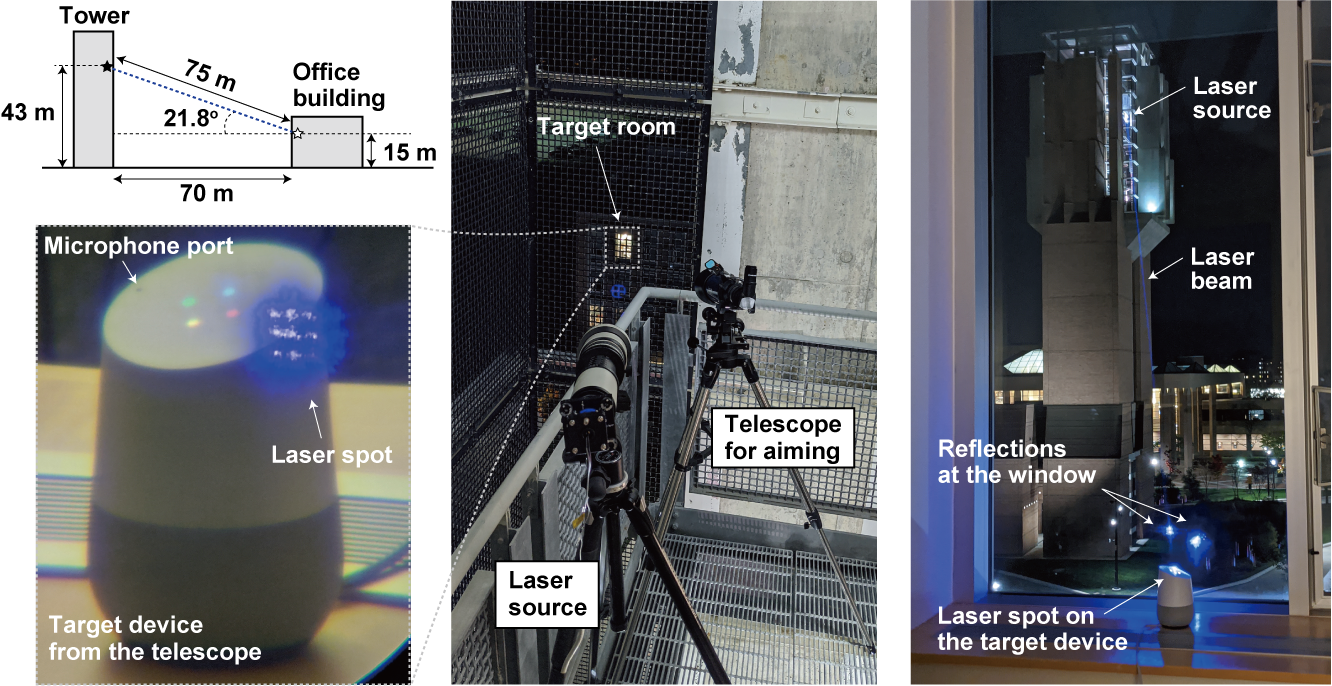
Light Commands is a vulnerability of MEMS microphones that allows attackers to remotely inject inaudible and invisible commands into voice assistants, such as Google assistant, Amazon Alexa, Facebook Portal, and Apple Siri using light.
In our paper we demonstrate this effect, successfully using light to inject malicious commands into several voice controlled devices such as smart speakers, tablets, and phones across large distances and through glass windows.
The implications of injecting unauthorized voice commands vary in severity based on the type of commands that can be executed through voice. As an example, in our paper we show how an attacker can use light-injected voice commands to unlock the victim’s smart-lock protected home doors, or even locate, unlock and start various vehicles.
Google patched last month an Android bug that can let hackers spread malware to a nearby phone via a little-known Android OS feature called NFC beaming.
NFC beaming works via an internal Android OS service known as Android Beam. This service allows an Android device to send data such as images, files, videos, or even apps, to another nearby device using NFC (Near-Field Communication) radio waves, as an alternative to WiFi or Bluetooth.
Typically, apps (APK files) sent via NFC beaming are stored on disk and a notification is shown on screen. The notification asks the device owner if he wants to allow the NFC service to install an app from an unknown source.
But, in January this year, a security researcher named Y. Shafranovich discovered that apps sent via NFC beaming on Android 8 (Oreo) or later versions would not show this prompt. Instead, the notification would allow the user to install the app with one tap, without any security warning.
While the lack of one prompt sounds unimportant, this is a major issue in Android’s security model. Android devices aren’t allowed to install apps from “unknown sources” — as anything installed from outside the official Play Store is considered untrusted and unverified.
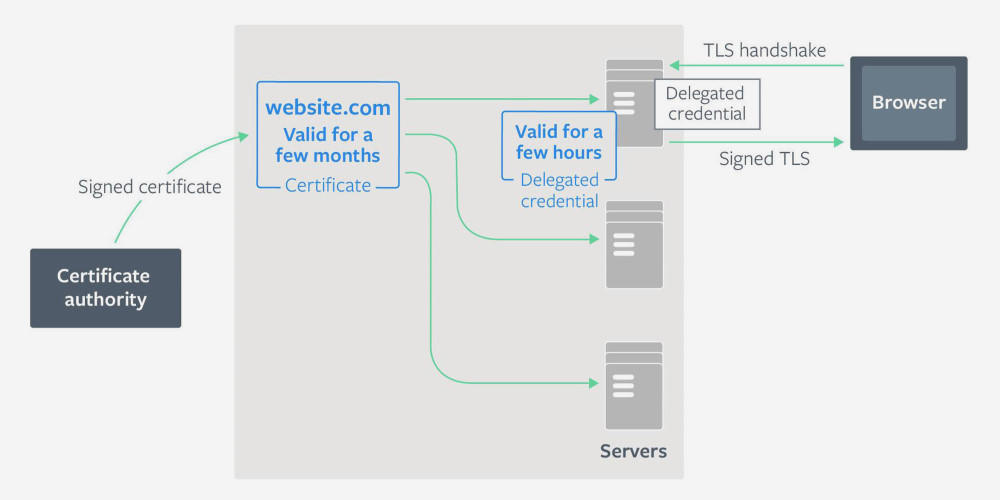
The new standard will work as an extension to TLS, a cryptographic protocol that underpins the more widely-known HTTPS protocol, used for loading websites inside browsers via an encrypted connection.
The TLS Delegate Credentials extension was specifically developed for large website setups, such as Facebook, or for website using content delivery networks (CDNs), such as Cloudflare.
How TLS Delegate Credentials works
For example, a big website like Facebook has thousands of servers spread all over the world. In order to support HTTPS traffic on all, Facebook has to place a copy of its TLS certificate private key on each one.
This is a dangerous setup. If an attacker hacks one server and steals the TLS private key, the attacker can impersonate Facebook servers and intercept user traffic until the stolen certificate expires.
The same thing is also valid with CDN services like Cloudflare. Anyone hosting an HTTPS website on Cloudflare’s infrastructure must upload their TLS private key to Cloudflare’s service, which then distributes it to thousands of servers across the world.
The TLS Delegate Credentials extension allows site owners to create short-lived TLS private keys (called delegated credentials) that they can deploy to these multi-server setups, instead of the real TLS private key.
The delegated credentials can live up to seven days and can be rotated automatically once they expire.
The most important security improvement that comes with this new TLS extension is that if — in the worst-case scenarios — an attacker does manage to hack a server, the stolen private key (actually a delegated credential) won’t work for more than a few days, rather than weeks, months, or even a year, as it does now.
You can read more in-depth technical explanations about the new TLS Delegated Credentials extensions on the Facebook, Mozilla, and Cloudflare blogs.
The IETF draft specification is available here. TLS Delegated Credentials will be compatible with the TLS protocol v1.3 and later.
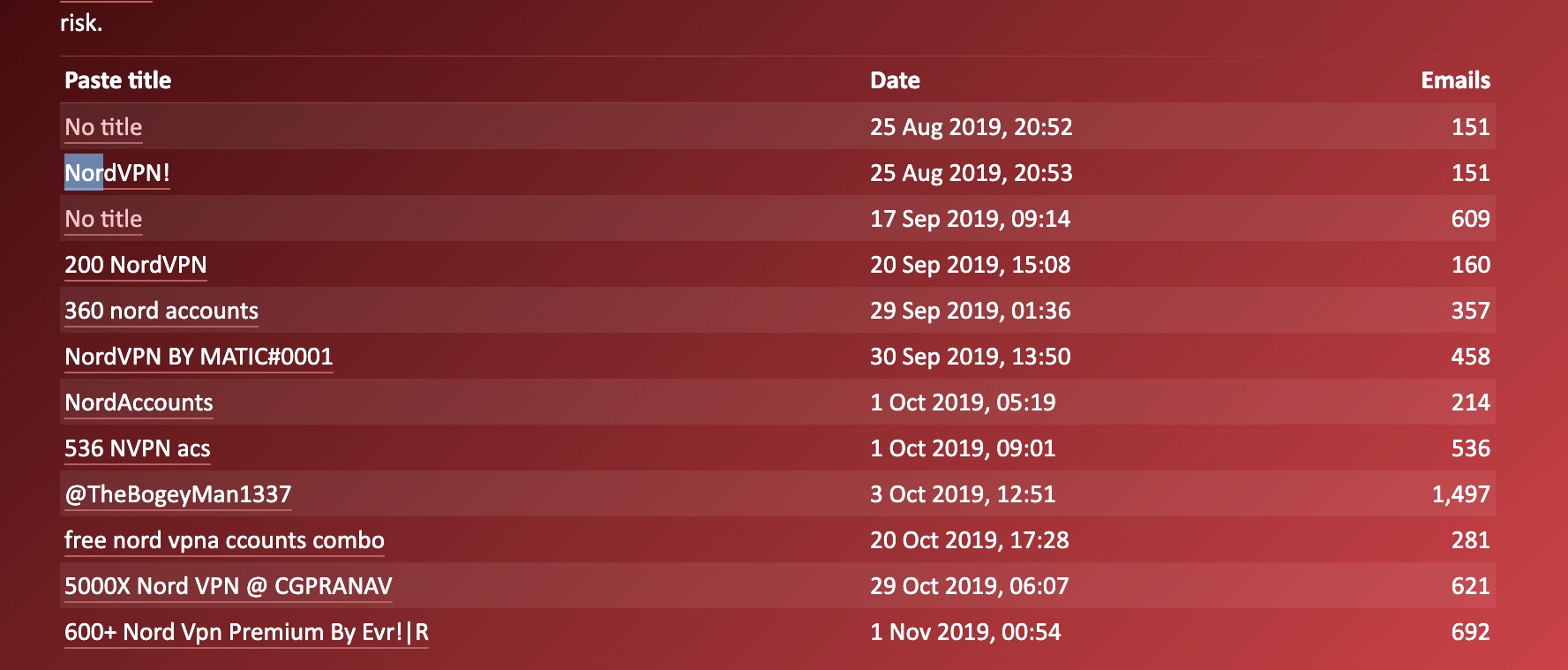
As many as 2,000 users of NordVPN, the virtual private network service that recently disclosed a server hack that leaked crypto keys, have fallen victim to credential-stuffing attacks that allow unauthorized access to their accounts.
In recent weeks, credentials for NordVPN users have circulated on Pastebin and other online forums. They contain the email addresses, plain-text passwords, and expiration dates associated with NordVPN user accounts.
I received a list of 753 credentials on Thursday and polled a small sample of users. The passwords listed for all but one were still in use. The one user who had changed their password did so after receiving an unrequested password reset email. It would appear someone who gained unauthorized access was trying to take over the account. Several other people said their accounts had been accessed by unauthorized people.
Over the past week, breach notification service Have I Been Pwned has reported at least 10 lists of NordVPN credentials similar to the one I obtained.
While it’s likely that some accounts are listed in multiple lists, the number of user accounts easily tops 2,000. What’s more, a large number of the email addresses in the list I received weren’t indexed at all by Have I Been Pwned, indicating that some compromised credentials are still leaking into public view. Most of the Web pages that host these credentials have been taken down, but at the time this post was going live, at least one remained available on Pastebin, despite the fact Ars brought it to NordVPN’s attention more than 17 hours earlier.
Without exception, all of the plain-text passwords are weak. In some cases, they’re the string of characters to the left of the @ sign in the email address. In other cases, they’re words found in most dictionaries. Others appear to be surnames, sometimes with two or three numbers tacked onto the end. These common traits mean that the most likely way these passwords became public is through credential stuffing. That’s the term for attacks that take credentials divulged in one leak to break into other accounts that use the same username and password. Attackers typically use automated scripts to carry out these attacks.
Though this somewhat-new “xHelper” malware has affected a low number of Android users so far (around 45,000, estimates Symantec), the fact that nobody has any clear advice on how to remove it is a worrisome fact. While the odds are good that you won’t get hit with this malware, given its low installation rate so far—even though it’s been active since March—you should still know what it does and how to (hopefully) avoid it.
As Malwarebytes describes, xHelper starts by concealing itself as a regular app by spoofing legitimate apps’ package names. Once it’s on your device, you’re either stuck with a “semi-stealth” version, which drops an xHelper icon blatantly in your notifications—but no app or shortcut icons—or a “full-stealth” version, which you’ll only notice if you visit Settings > Apps & notifications > App Info (or whatever the navigation is on your specific Android device) and scroll down to see the installed “xHelper” app.
What does xHelper do?
Thankfully, xHelper isn’t destructive malware in the sense that it’s not recording your passwords, credit card data, or anything else you’re doing on your device and sending it off to some unknown attacker. Instead, it simply spams you with pop-up advertisements on your device and annoying notifications that all try to get you to install more apps from Google Play—presumably how the xHelper’s authors are making cash from the malware.
The dark side, as reported by ZDNet, is that xHelper can allegedly download and install apps on your behalf. It doesn’t appear to be doing so at the moment, but if this were to happen—coupled with the app’s mysterious ability to persist past uninstallations and factory resets—would be a huge backdoor for anyone affected by the malware.
Wait, I can’t uninstall it?
Yep. This is the insidious part of xHelper. Neither Symantec nor Malwarebytes have any good recommendations for getting this malware off your device once it’s installed, as the mechanisms it uses to persist past a full factory reset of your device are unknown.
Pagers used within the United Kingdom’s National Health Service are leaking sensitive patient information, and an amateur radio enthusiast has been broadcasting some of that medical data on a webcam livestream, a security researcher has found.
TechCrunch reports that Florida-based security researcher Daley Borda stumbled upon the strange confluence of archaic tech that flowed together to create a security nightmare.
Borda regularly scans the internet looking for concerning privacy and security activity. He recently discovered a grainy livestream showing a radio rig in North London that picked up radio waves and converted the transmissions into text that was displayed on a computer screen, according to TechCrunch. The hobbyist had set up a webcam that captured what was on the display, which showed medical emergencies as they were being reported. The webcam reportedly had no password, so anyone could find it and see the messages that showed directions meant for ambulances responding to emergency calls.
“You can see details of calls coming in—their name, address, and injury,” Borda told TechCrunch, which verified his discovery.
The tech news outlet reviewed several concerning messages that showed the location where people were reporting medical emergencies, including one that showed the address where a 49-year-old man was having chest pains and one that showed the address of a 98-year old man who had fallen.
[…]
A spokesperson for NHS told Gizmodo that the NHS consists of several different organizations, like hospital trusts and ambulances trusts, and “each organization is responsible for the technology it buys and uses (including pagers).” They pointed Gizmodo to a statement that Health and Social Care Secretary Matt Hancock issued in February instructed the NHS to stop using pagers by 2022. In his statement, he said the NHS uses 130,000 pagers.
WASHINGTON (Reuters) – Senior government officials in multiple U.S.-allied countries were targeted earlier this year with hacking software that used Facebook Inc’s (FB.O) WhatsApp to take over users’ phones, according to people familiar with the messaging company’s investigation.
Sources familiar with WhatsApp’s internal investigation into the breach said a “significant” portion of the known victims are high-profile government and military officials spread across at least 20 countries on five continents. Many of the nations are U.S. allies, they said.
The hacking of a wider group of top government officials’ smartphones than previously reported suggests the WhatsApp cyber intrusion could have broad political and diplomatic consequences.
WhatsApp filed a lawsuit on Tuesday against Israeli hacking tool developer NSO Group. The Facebook-owned software giant alleges that NSO Group built and sold a hacking platform that exploited a flaw in WhatsApp-owned servers to help clients hack into the cellphones of at least 1,400 users between April 29, 2019, and May 10, 2019.
The total number of WhatsApp users hacked could be even higher. A London-based human rights lawyer, who was among the targets, sent Reuters photographs showing attempts to break into his phone dating back to April 1.
While it is not clear who used the software to hack officials’ phones, NSO has said it sells its spyware exclusively to government customers.
Some victims are in the United States, United Arab Emirates, Bahrain, Mexico, Pakistan and India, said people familiar with the investigation. Reuters could not verify whether the government officials were from those countries or elsewhere.
Some Indian nationals have gone public with allegations they were among the targets over the past couple of days; they include journalists, academics, lawyers and defenders of India’s Dalit community.
NSO said in a statement that it was “not able to disclose who is or is not a client or discuss specific uses of its technology.” Previously it has denied any wrongdoing, saying its products are only meant to help governments catch terrorists and criminals.
Cybersecurity researchers have cast doubt on those claims over the years, saying NSO products were used against a wide range of targets, including protesters in countries under authoritarian rule.
An open database exposing records containing the sensitive data of hotel customers as well as US military personnel and officials has been disclosed by researchers.
On Monday, vpnMentor’s cybersecurity team, led by Noam Rotem and Ran Locar, said the database belonged to Autoclerk, a service owned by Best Western Hotels and Resorts group.
Autoclerk is a reservations management system used by resorts to manage web bookings, revenue, loyalty programs, guest profiles, and payment processing.
In a report shared with ZDNet, the researchers said the open Elasticsearch database was discovered through vpnMentor’s web mapping project. It was possible to access the database, given it had no encryption or security barriers whatsoever, and perform searches to examine the records contained within.
The team says that “thousands” of individuals were impacted, although due to ethical reasons it was not possible to examine every record in the leaking database to come up with a specific number.
Hundreds of thousands of booking reservations for guests were available to view and data including full names, dates of birth, home addresses, phone numbers, dates and travel costs, some check-in times and room numbers, and masked credit card details were also exposed.
Data breaches are a common occurrence and can end up compromising information belonging to thousands or millions of us in single cases of a successful cyberattack.
What is more uncommon, however, is that the US government and military figures have also been involved in this security incident.
It appears that one of the platforms connected to Autoclerk exposed in the breach is a contractor of the US government that deals with travel arrangements.
vpnMentor was able to view records relating to the travel arrangements of government and military personnel — both past and future — who are connected to the US government, military, and Department of Homeland Security (DHS).
Within the records, for example, were logs for US Army generals visiting Russia and Israel, among other countries.
Mercedes-Benz car owners have said that the app they used to remotely locate, unlock and start their cars was displaying other people’s account and vehicle information.
TechCrunch spoke to two customers who said the Mercedes-Benz’ connected car app was pulling in information from other accounts and not their own, allowing them to see other car owners’ names, recent activity, phone numbers, and more.
The apparent security lapse happened late-Friday before the app went offline “due to site maintenance” a few hours later.
Japanese hotel chain HIS Group has apologised for ignoring warnings that its in-room robots were hackable to allow pervs to remotely view video footage from the devices.
The Henn na Hotel is staffed by robots: guests can be checked in by humanoid or dinosaur reception bots before proceeding to their room.
Having heard nothing, the researcher made the hack public on 13 October. The vulnerability allows guests to gain access to cameras and microphones in the robot remotely so they could watch and listen to anyone in the room in the future.
The hotel is one of a chain of 10 in Japan which use a variety of robots instead of meat-based staff.
So far the reference is only to Tapia robots at one hotel, although it is not clear if the rest of the chain uses different devices.
The HIS Group tweeted: “We apologize for any uneasiness caused,” according to the Tokyo Reporter.
The paper was told that the company had decided the risks of unauthorised access were low, however, the robots have now been updated.
The chain has suffered a bunch of other issues with the robots, including problems with voice recognition systems reacting to guests snoring and a failure of the reception dinosaurs to understand guests’ names
As with browser add-ons, you’re entirely at the mercy of a developer. And should they use their powers for evil, you could be giving up everything you’re saying to your device to some random person.
At least, that’s the scenario presented by Germany’s Security Research Labs (SRLabs), who built a number of dummy Skills (Amazon) and Actions (Google) that passed both company’s checks and were actually listed for download to your Echo or Google Home devices. The catch? As Ars Technica describes:
“The malicious apps had different names and slightly different ways of working, but they all followed similar flows. A user would say a phrase such as: ‘Hey Alexa, ask My Lucky Horoscope to give me the horoscope for Taurus’ or ‘OK Google, ask My Lucky Horoscope to give me the horoscope for Taurus.’ The eavesdropping apps responded with the requested information while the phishing apps gave a fake error message. Then the apps gave the impression they were no longer running when they, in fact, silently waited for the next phase of the attack.
The security researchers actually developed two kinds of apps—one for eavesdropping, one for phishing—that both worked similarly. In the former, the app would simply do whatever it is you told it to, but it wouldn’t stop recording your voice; in the latter, the app would pretend to accomplish a task, wait a bit, then give you a fake message that your device was updated and you needed to provide your password for the update to complete. And any password you then provided was shuffled off to the developer’s servers.
Both Amazon and Google have since pulled the offending skills/actions—after being notified of their existence by SRLabs—and are working on extra “mechanisms” and “mitigations” to ensure these kind of exploits don’t make their way into other skills and actions
It was recently discovered that the Samsung Galaxy S10 and S10+ have a major security flaw that makes it easy to bypass their fingerprint locks. On a scale of “one” to “not good,” we are definitely towards the right on this one.
To be fair, fingerprint sensors and other biometric security features aren’t ironclad; hackers can successfully get around these kinds of security measures, albeit with a fair amount of work. However, the Galaxy S10’s fingerprint sensor can be fooled with the simple addition of a screen protector or phone case made of silicone, tempered glass, or plastic. The interference from the protective material is apparently enough to confuse the sensor so anyone’s finger tap can unlock the phone. (Ugh.)
Firefox is the only browser that received top marks in a recent audit carried out by Germany’s cyber-security agency — the German Federal Office for Information Security (or the Bundesamt für Sicherheit in der Informationstechnik — BSI).
The BSI tested Mozilla Firefox 68 (ESR), Google Chrome 76, Microsoft Internet Explorer 11, and Microsoft Edge 44. The tests did not include other browsers like Safari, Brave, Opera, or Vivaldi.
The BSI updated its guide to account for improved security measures added to modern browsers, such as HSTS, SRI, CSP 2.0, telemetry handling, and improved certificate handling mechanisms.
A user got his revenge on the ransomware gang who encrypted his files by hacking their server and releasing the decryption keys for all other victims.
This happened earlier today and involved the Muhstik gang. Muhstik is a recent strain of ransomware that has been active since late September, according to reports [1, 2, 3].
This ransomware targets network-attached storage (NAS) devices made by Taiwanese hardware vendor QNAP. The gang behind the Muhstik ransomware is brute-forcing QNAP NAS devices that use weak passwords for the built-in phpMyAdmin service, according to a security advisory published by the company last week.
After gaining access to the phpMyAdmin installation, Muhstik operators encrypt users’ files and save a copy of the decryption keys on their command and control (C&C) server. QNAP files encrypted by Muhstik can be recognized by each file’s new “.muhstik” file extension.
Annoyed software dev hacks back
One of the gang’s victims was Tobias Frömel, a German software developer. Frömel was one of the victims who paid the ransom demand so he could regain access to his files.
However, after paying the ransom, Frömel also analyzed the ransomware, gained insight into how Muhstik operated, and then retrieved the crooks’ database from their server.
Besides releasing the decryption keys, the German developer also published a decrypter that all Muhstik victims can use to unlock their files. The decrypter is available on MEGA [VirusTotal scan], and usage instructions are avaiable on the Bleeping Computer forum.
In the meantime, Frömel has been busy notifying Muhstik victims on Twitter about the decrypter’s availability, advising users against paying the ransom.
Twitter says it was just an accident that caused the microblogging giant to let advertisers use private information to better target their marketing materials at users.
The social networking giant on Tuesday admitted to an “error” that let advertisers have access to the private information customers had given Twitter in order to place additional security protections on their accounts.
“We recently discovered that when you provided an email address or phone number for safety or security purposes (for example, two-factor authentication) this data may have inadvertently been used for advertising purposes, specifically in our Tailored Audiences and Partner Audiences advertising system,” Twitter said.
“When an advertiser uploaded their marketing list, we may have matched people on Twitter to their list based on the email or phone number the Twitter account holder provided for safety and security purposes. This was an error and we apologize.”
Twitter assures users that no “personal” information was shared, though we’re not sure what Twitter would consider “personal information” if your phone number and email address do not meet the bar.
Basically sim swapping, man in the middle attacks and poor URL protections
FBI warns about SIM swapping and tools like Muraen and NecroBrowser.
“The FBI has observed cyber actors circumventing multi-factor authentication through common social engineering and technical attacks,” the FBI wrote in a Private Industry Notification (PIN) sent out on September 17.
Past incidents of MFA bypasses
While nowadays there are multiple ways of bypassing MFA protections, the FBI alert specifically warned about SIM swapping, vulnerabilities in online pages handling MFA operations, and the use of transparent proxies like Muraen and NecroBrowser.
To get the point across, the FBI listed recent incidents where hackers had used these techniques to bypass MFA and steal money from companies and regular users alike. We cite from the report:
In 2016 customers of a US banking institution were targeted by a cyber attacker who ported their phone numbers to a phone he owned-an attack called SIM swapping. The attacker called the phone companies’ customer service representatives, finding some who were more willing to provide him information to complete the SIM swap. Once the attacker had control over the customers’ phone numbers, he called the bank to request a wire transfer from the victims’ accounts to another account he owned. The bank, recognizing the phone number as belonging to the customer, did not ask for full security questions but requested a one-time code sent to the phone number from which he was calling. He also requested to change PINs and passwords and was able to attach victims’ credit card numbers to a mobile payment application.
Over the course of 2018 and 2019, the FBI’s Internet Crime Complaint Center and FBI victim complaints observed the above attack-SIM swapping-as a common tactic from cyber criminals seeking to circumvent two-factor authentication. Victims of these attacks have had their phone numbers stolen, their bank accounts drained, and their passwords and PINs changed. Many of these attacks rely on socially engineering customer service representatives for major phone companies, who give information to the attackers.
In 2019 a US banking institution was targeted by a cyber attacker who was able to take advantage of a flaw in the bank’s website to circumvent the two-factor authentication implemented to protect accounts. The cyber attacker logged in with stolen victim credentials and, when reaching the secondary page where the customer would normally need to enter a PIN and answer a security question, the attacker entered a manipulated string into the Web URL setting the computer as one recognized on the account. This allowed him to bypass the PIN and security question pages and initiate wire transfers from the victims’ accounts.
In February 2019 a cyber security expert at the RSA Conference in San Francisco, demonstrated a large variety of schemes and attacks cyber actors could use to circumvent multi-factor authentication. The security expert presented real-time examples of how cyber actors could use man-in-the-middle attacks and session hijacking to intercept the traffic between a user and a website to conduct these attacks and maintain access for as long as possible. He also demonstrated social engineering attacks, including phishing schemes or fraudulent text messages purporting to be a bank or other service to cause a user to log into a fake website and give up their private information.
At the June 2019 Hack-in-the-Box conference in Amsterdam, cyber security experts demonstrated a pair of tools – Muraena and NecroBrowser – which worked in tandem to automate a phishing scheme against users of multi-factor authentication. The Muraena tool intercepts traffic between a user and a target website where they are requested to enter login credentials and a token code as usual. Once authenticated, NecroBrowser stores the data for the victims of this attack and hijacks the session cookie, allowing cyber actors to log into these private accounts, take them over, and change user passwords and recovery e-mail addresses while maintaining access as long as possible.
MFA is still effective
The FBI made it very clear that its alert should be taken only as a precaution, and not an attack on the efficiency of MFA, which the agency still recommends. The FBI still recommends that companies use MFA.