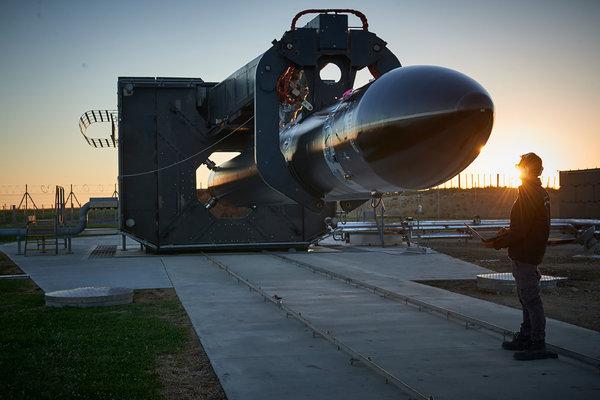
A small rocket from a little-known company lifted off Sunday from the east coast of New Zealand, carrying a clutch of tiny satellites. That modest event — the first commercial launch by a U.S.-New Zealand company known as Rocket Lab — could mark the beginning of a new era in the space business, where countless small rockets pop off from spaceports around the world. This miniaturization of rockets and spacecraft places outer space within reach of a broader swath of the economy.
The rocket, called the Electron, is a mere sliver compared to the giant rockets that Elon Musk, of SpaceX, and Jeffrey P. Bezos, of Blue Origin, envisage using to send people into the solar system. It is just 56 feet tall and can carry only 500 pounds into space.
But Rocket Lab is aiming for markets closer to home.
“We’re FedEx,” said Peter Beck, the New Zealand-born founder and chief executive of Rocket Lab. “We’re a little man that delivers a parcel to your door.”
Behind Rocket Lab, a host of start-up companies are also jockeying to provide transportation to space for a growing number of small satellites. The payloads include constellations of telecommunications satellites that would provide the world with ubiquitous internet access.
The payload of this mission, which Rocket Lab whimsically named “It’s Business Time,” offered a glimpse of this future: two ship-tracking satellites for Spire Global; a small climate- and environment-monitoring satellite for GeoOptics; a small probe built by high school students in Irvine, Calif., and a demonstration version of a drag sail that would pull defunct satellites out of orbit.
Space Angels, a space-business investment firm, is tracking 150 small launch companies. Chad Anderson, Space Angel’s chief executive, said that although the vast majority of these companies will fail, a small group possess the financing and engineering wherewithal to get off the ground.
Each company on Mr. Anderson’s list proffers its own twist in business plan or capability:
Vector Launch Inc. aims for mass production;
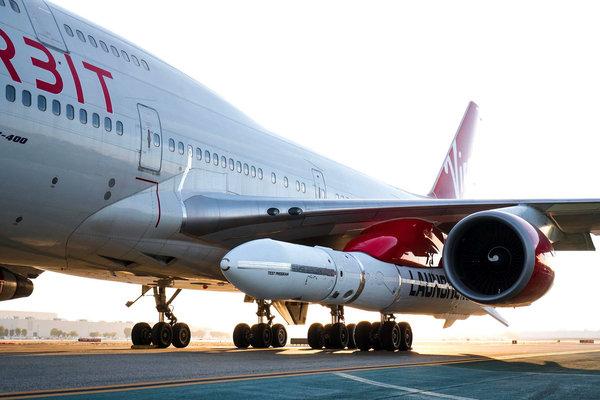
Virgin Orbit, a piece of Richard Branson’s business empire, will drop its rockets from the bottom of a 747 at 35,000 feet up;
Relativity Space plans to 3-D print almost all pieces of its rockets;
Firefly Aerospace will offer a slightly larger rocket in a bet that the small satellites will grow a bit in size and weight;
Gilmour Space Technologies is a rare Australian aerospace company;
And Astra Space Inc., which is operating in stealth mode like a Silicon Valley start-up, saying nothing about what is doing.
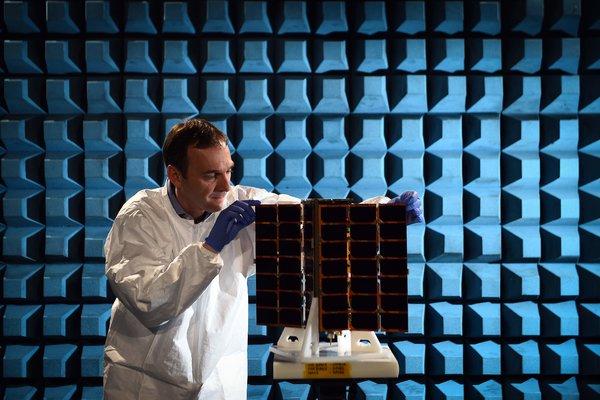
Daniel Bryce, a manufactering operations manager working on a satellite at Spire Global in Glasgow.CreditAndy Buchanan/Agence France-Presse — Getty Images
Rockets are shrinking, because satellites are shrinking.
In the past, hulking telecommunications satellites hovered 22,000 miles above the Equator in what is known as a geosynchronous orbit, where a satellite continuously remains over the same spot on Earth. Because sending a satellite, there was so expensive, it made sense to pack as much as possible into each one.
Advances in technology and computer chips have enabled smaller satellites to perform the same tasks as their predecessors. And constellations of hundreds or thousands of small satellites, orbiting at lower altitudes that are easier to reach, can mimic the capabilities once possible only from a fixed geosynchronous position.
“It’s really a shift in the market,” Mr. Beck said. “What once took the size of a car is now the size of a microwave oven, and with exactly the same kind of capabilities.”
Some companies already have launched swarms of satellites to make observations of Earth. Next up are the promised space-based internet systems such as OneWeb and SpaceX’s Starlink.
Until now, such small spacecraft typically hitched a rocket ride alongside a larger satellite. That trip is cheaper but inconvenient, because the schedule is set by the main customer. If the big satellite is delayed, the smaller ones stay on the ground, too. “You just can’t go to business like that,” Mr. Beck said.
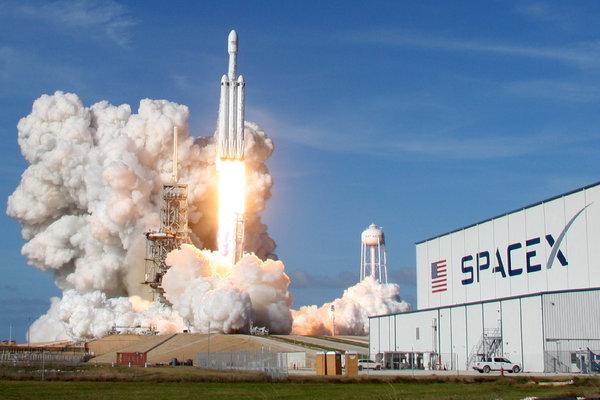
The Electron, Mr. Beck said, is capable of lifting more than 60 percent of the spacecraft that headed to orbit last year. By contrast, space analysts wonder how much of a market exists for a behemoth like SpaceX’s Falcon Heavy, which had its first spectacular launch in February.
A Falcon Heavy can lift a payload 300 times heavier than a Rocket Lab Electron, but it costs $90 million compared to the Electron’s $5 million. Whereas SpaceX’s standard Falcon 9 rocket has no shortage of customers, the Heavy has only announced a half-dozen customers for the years to come.
The United States military — a primary customer for large launch vehicles — is also rethinking its spy satellites. The system would be more resilient, some analysts think, if its capabilities were spread among many, smaller satellites. Smaller satellites would be easier and quicker to replace, and an enemy would have a harder time destroying all of them.
Image
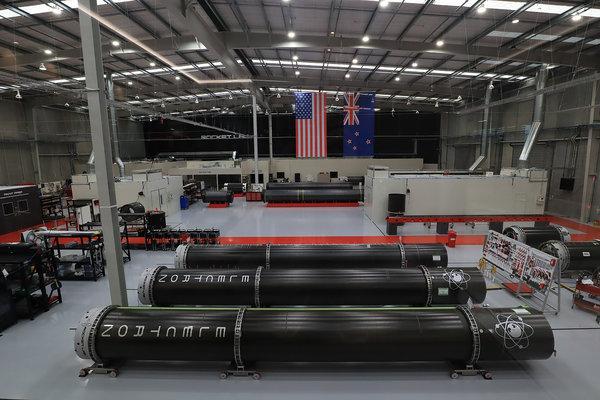
The Rocket Lab production facility. Its rockets cost $5 million.CreditRocket Lab
Image
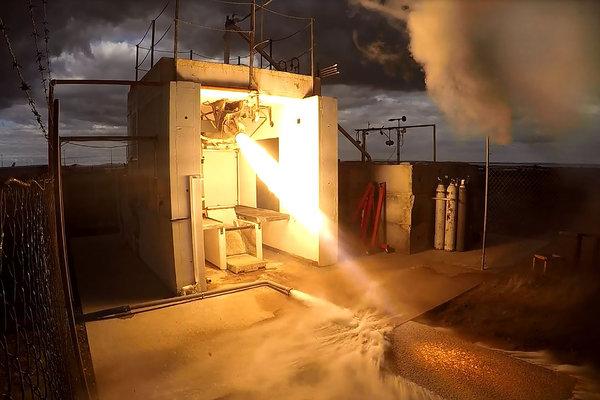
A Rocket Lab Rutherford engine test.CreditRocket Lab
Image
An Electron “Still Testing” rocket with Shaun D’Mello, Rocket Lab’s vice president of launch.CreditRocket Lab
Pit stops in the space race
SpaceX could have cornered this market a decade ago.
Its first rocket, the Falcon 1, was designed to lift about 1,500 pounds. But after just two successful launches, SpaceX abandoned it, focusing on the much larger Falcon 9 to serve NASA’s needs to carry cargo and, eventually, astronauts to the International Space Station.
Jim Cantrell, one of the first employees of SpaceX, did not understand that decision and left the company. In 2015, he started Vector Launch, Inc., with headquarters in Tucson. Its goal is to make the Model T of rockets — small, cheap, mass-produced.
Vector claims that it can send its rockets into orbit from almost any place it can set up its mobile launch platform, which is basically a heavily modified trailer. That trailer was inspired by Mr. Cantrell’s hobby, auto racing, and many of the companies’ employees come from the racing world, too.
The company is still aiming to meet its goal of getting the first of its Vector-R rockets to orbit this year, but Mr. Cantrell admitted that the schedule might slip again, into early 2019. The flight termination system — the piece of hardware that disables the rocket if anything goes wrong — is late in arriving.
“There are a lot of little things,” Mr. Cantrell said. “It drives you crazy.”
A prototype was planned for suborbital launch from Mojave, Calif., in September, but it encountered a glitch and the test was called off. The crew put the rocket in a racecar trailer and drove it to Vector’s testing site at Pinal Airpark, a small airport a half-hour outside of Tucson that is surrounded 350 acres of shrubby desert.
Vector built test stands for firings of individual engines as well as completed rocket stages. During a recent visit to the site, engineers were troubleshooting the launch problems of both the prototype rocket and a developmental version of its upper-stage engine.
Soon the team will head to the Pacific Spaceport Complex, on Alaska’s Kodiak Island, for its first orbital launch. Next year, Mr. Cantrell said, the company hopes to put a dozen rockets into space.
Within a few years, he added, it could be launching 100 times a year, not just from Kodiak but also from Vandenberg Air Force Base in California and Wallops Island in Virginia, where Rocket Lab agreed in October to build its second launch complex. Vector is also looking for additional launch sites, including one by the Sea of Cortez in Mexico.
Resurrected rocketry
Image
Space analysts wonder how much of a market exists for a behemoth like SpaceX’s Falcon Heavy, which first launched in February. Though it can lift far heavier payloads than the Electron, the Heavy has only a half-dozen announced customers.CreditThom Baur/Reuters
Tom Markusic, another veteran of SpaceX’s early days, also sees an opportunity to help smaller satellites get to space.
“I didn’t feel there was a properly sized launch company to address that market,” he said.
Mr. Markusic said that the need for stronger antennas and cameras would ultimately prompt the construction of slightly bigger small satellites, and that it would be beneficial to be able to launch several at a time.
He started Firefly in 2014, aiming to build Alpha, a rocket that would lift a 900-pound payload to orbit.
The company grew to 150 employees and won a NASA contract. But in the uncertainty surrounding Britain’s exit from the European Union, a European investor backed out. An American investor also became skittish, Mr. Markusic said, after a SpaceX rocket exploded on the launchpad in 2016. Firefly shut down, and the employees lost their jobs.
At an auction, a Ukraine-born entrepreneur, Max Polyakov, one of Firefly’s investors, resurrected the company. Mr. Markusic took the opportunity to rethink the Alpha rocket, which is now able to launch more than 2,000 pounds.
“Alpha is basically Falcon 1 with some better technology,” he said.
Mr. Markusic said his competition was not the smaller rockets of Rocket Lab, Vector or Virgin Orbit but foreign competitors such as a government-subsidized rocket from India and commercial endeavors in China. But he complimented Rocket Lab.
“They’re ahead of everyone else,” he said. “I think they deserve a lot of credit.”
Firefly plans to launch its first Alpha rocket in December of 2019.
Riding the bus to orbit
Image
A LauncherOne rocket under the wing of a Virgin Orbit Boeing 747, which releases the rocket mid-air at 35,000 feet. CreditGreg Robinson/Virgin Orbit, via Associated Press
Not everyone is convinced that the market for small satellites will be as robust as predicted.
“That equation has weaknesses at every step,” said Carissa Christensen, founder and chief executive of Bryce Space and Technology, an aerospace consulting firm.
Three-quarters of venture capital-financed companies fail, she said, and the same will likely happen to the companies aiming to put up the small satellites. She also is skeptical that space-based internet will win against ground-based alternatives.
“Publicly, there’s no compelling business plans,” she said.
That means that the market for small rockets could implode for lack of business. She said a key to survival would be to tap into the needs of the United States government, especially the military. Virgin Orbit, Vector and Rocket Lab were the current front-runners, she said.
The small rocket companies also have to compete with Spaceflight Industries, a Seattle company that resells empty space on larger rockets that is not taken up by the main payload. In addition, Spaceflight is looking to purchasing entire rockets launched by other companies, including Rocket Lab, and selling the payload space to a range of companies heading to a similar orbit.
The first such flight, using a SpaceX Falcon 9, is to launch from Vandenberg Air Force Base this month carrying 70 satellites, in what the company compares to a bus ride into orbit.
Curt Blake, president of Spaceflight, said that both approaches can work. Buses are cheaper but less convenient, and sometimes the timely lift from a taxi is worth the added cost.
Mr. Anderson of Space Angels was also optimistic. “The difference today is how robust the sector is,” he said. “The sector today can handle failures.”
While the sector is getting off the ground, Rocket Lab doesn’t intend to waste any more time: it is hoping to quickly follow “It’s Business Time” with a second commercial launch next month, and then a third the month after that.
“We’re very focused on the next 100 rockets, not the next one rocket.” Mr. Beck said. “It’s one thing to go to orbit. It’s a whole another thing to go to orbit on a regular basis.”
A research team from Tsinghua University in Beijing has developed a fibre they say is so strong it could even be used to build an elevator to space.
They say just 1 cubic centimetre of the fibre – made from carbon nanotube – would not break under the weight of 160 elephants, or more than 800 tonnes. And that tiny piece of cable would weigh just 1.6 grams.
“This is a breakthrough,” said Wang Changqing, a scientist at a key space elevator research centre at Northwestern Polytechnical University in Xian who was not involved in the Tsinghua study.
The Chinese team has developed a new “ultralong” fibre from carbon nanotube that they say is stronger than anything seen before, patenting the technology and publishing part of their research in the journal Nature Nanotechnology earlier this year.
“It is evident that the tensile strength of carbon nanotube bundles is at least 9 to 45 times that of other materials,” the team said in the paper.
They said the material would be “in great demand in many high-end fields such as sports equipment, ballistic armour, aeronautics, astronautics and even space elevators”.
[…]
Those cables would need to have tensile strength – to withstand stretching – of no less than 7 gigapascals, according to Nasa. In fact, the US space agency launched a global competition in 2005 to develop such a material, with a US$2 million prize attached. No one claimed the prize.
Now, the Tsinghua team, led by Wei Fei, a professor with the Department of Chemical Engineering, says their latest carbon nanotube fibre has tensile strength of 80 gigapascals.
Carbon nanotubes are cylindrical molecules made up of carbon atoms that are linked in hexagonal shapes with diameters as small as 1 nanometre. They have the highest known tensile strength of any material – theoretically up to 300 gigapascals.
But for practical purposes, these carbon nanotubes must be bonded together in cable form, a process which is difficult and can affect the overall strength of the final product.
According to Wang, the space lift researcher, the transport system would need more than 30,000km of cable, and it would also need other structures such as a rail and a shield to protect against space debris and other environmental hazards.
[…]
Japan launched two satellites last month in an experiment to study elevator movement in space – the first time this has been done – involving a mini-lift travelling along a cable from one satellite to another. It has yet to report the results of the experiment. China has also conducted space tethering tests but the details were classified.
[…]
Song Liwei, who studies mechanical batteries at the Harbin Institute of Technology in Heilongjiang, said if the carbon nanotube fibre could be mass-produced and if it significantly increased the energy density of mechanical batteries, it “would kill fossil fuel engines”.
Astrobiologists are mostly interested in rocky exoplanets that lie in the habitable zone around their parent stars, where liquid water may exist on its surface. NASA’s Kepler spacecraft has spotted a handful of these in the so-called Goldilocks Zone – where it’s not too cold or too hot for life.
As such, a second team from Google and NASA’s lab has built a machine-learning-based tool known as INARA that can identify the chemical compounds in a rocky exoplanet’s atmosphere by studying its high-resolution telescope images.
To develop this software, the brainiacs simulated more than three million planets’ spectral signatures – fingerprints of their atmospheres’ chemical makeups – and labelled them as such to train a convolutional neural network (CNN). The CNN can therefore be used to automatically estimate the chemical composition of a planet from images and light curves of its atmosphere taken from NASA’s Kepler spacecraft. Basically, a neural network was trained to link telescope images to chemical compositions, and thus, you should it a given set of images, and it will spit out the associated chemical components – which can be used to assess whether those would lead to life bursting on the scene.
INARA takes seconds to figure out the biological compounds potentially present in a world’s atmosphere. “Given the scale of the datasets produced by the Kepler telescopes, and the even greater volume of data that will return to Earth from the soon-to-be-launched Transiting Exoplanet Survey Satellite (TESS) satellite, minimizing analysis time per planet can accelerate this research and ensure we don’t miss any viable candidates,” Mascaro concluded. ®
By searching for the telltale, periodic dimming of light from distant stars, astronomers can spot orbiting exoplanets tens to hundreds of light-years away. But how do they know what these bodies look like? Perhaps they first try to imagine how the planets in our own Solar System might appear to a faraway alien world.
A pair of scientists has released a detailed catalog of the colors, brightness, and spectral lines of the bodies in our Solar System. They hope to use the catalog as a comparison, so when they spot the blip of an exoplanet, they’ll have a better idea of how it actually looks.
“This is what an alien observer would see if they looked at our Solar System,” study coauthor Lisa Kaltenegger, director of the Carl Sagan Institute at Cornell, told Gizmodo. With this data, astronomers might guess whether an exoplanet is Earth-like, Mars-like, Jupiter-like, or something else entirely.
[…]
All of that incoming data motivated Kaltenegger and coauthor Jack Madden to make this catalog of colors, spectra, and albedos, or how much the planet reflects starlight. They analyzed published data to create fingerprints for 19 objects in our Solar System, including all eight planets, the dwarf planets Pluto and Ceres, and nine moons. Their works is published in the journal Astrobiology.
The full catalog
Graphic: Jack Madden
“It’s smart to leverage everything we know about our own Solar System,” said Kaltenegger. “We have gas giants, the rocky planets, and all these interesting moons. We basically made a reference fingerprint.”
Update July 18th, 11:35AM ET: Blue Origin pulled off another successful test launch today, landing both the New Shepard rocket and capsule after flight. The company ignited the capsule’s emergency motor after it had separated from the rocket, pushing the spacecraft up to a top altitude of around 74 miles — a new record for Blue Origin. The firing also caused the capsule to sustain up to 10 Gs during the test, but Blue Origin host Ariane Cornell said “that is well within what humans can take, especially for such a short spurt of time.”
[…]
Blue Origin will be igniting the escape motor on the crew capsule. It’s a small engine located on the bottom of the capsule that can quickly propel the spacecraft up and away from the rocket booster in case there is an emergency during the flight. Blue Origin tested out this motor once before during a test launch in October 2016, fully expecting the motor to destroy the booster. When the motor ignites, it slams the booster with 70,000 pounds of thrust and forceful exhaust. And yet, the booster survived the test, managing to land on the floor of the Texas desert.
This time around, Blue Origin plans to ignite the motor at a higher altitude than last time, “pushing the rocket to its limits,” according to the company. It’s unclear how high the ignition will occur, though, and if the booster will survive the test again.
No passengers will be flying on this trip, except for Blue Origin’s test dummy, which the company has named Mannequin Skywalker. Mannequin will be riding inside the crew capsule along with numerous science experiments from NASA, commercial companies, and universities. Santa Fe company Solstar, which flew with Blue Origin during its last launch, is going to test out its Wi-Fi access again during the flight. NASA will have a payload designed to take measurements of the conditions inside the capsule throughout the trip, such as temperature, pressure, and acoustics. There’s even a bunch of payloads made by Blue Origin’s employees as part of the company’s own “Fly My Stuff” program.
Isn’t it refreshing to see a private space programme that not only doesn’t crash and explode all the time (*cough* Elon) but works better than expected!
Near-Earth object 2017 YE5 was first spotted by astronomers at the Oukaïmeden Observatory in Morocco in December of last year, but virtually nothing about it, beyond its presence, was known. In June, the object made the closest approach it will make to Earth for the next 170 years, allowing scientists to take a closer look. What was initially assessed as a single asteroid turned out to be two objects in orbit around each other: a double asteroid.
Yep, there’s two of ‘em.
Image: Arecibo/GBO/NSF/NASA/JPL-Caltech
Normally we’d say this is no biggie; around 15 percent of all known asteroids larger than 650 feet (200 meters) in diameter are binaries. But 2017 YE5 is special because it’s an “equal mass” binary, in which the two objects are roughly the same mass. The vast majority of binaries involve an unequal pair, in which one asteroid is significantly larger than the other. Astronomers have documented tens of thousands of asteroids in the Solar System, yet this is just the fourth known equal mass binary. The latest observations are now offering the most detailed images ever taken of this exceptionally rare phenomenon.
One of a dozen new moons discovered around Jupiter is circling the planet on a suicide orbit that will inevitably lead to its violent destruction, astronomers say.
Researchers in the US stumbled upon the new moons while hunting for a mysterious ninth planet that is postulated to lurk far beyond the orbit of Neptune, the most distant planet in the solar system.
The team first glimpsed the moons in March last year from the Cerro Tololo Inter-American Observatory in Chile, but needed more than a year to confirm that the bodies were locked in orbit around the gas giant. “It was a long process,” said Scott Sheppard, who led the effort at the Carnegie Institution for Science in Washington DC.
Jupiter, the largest planet in the solar system, was hardly short of moons before the latest findings. The fresh haul of natural satellites brings the total number of Jovian moons to 79, more than are known to circle any other planet in our cosmic neighbourhood.
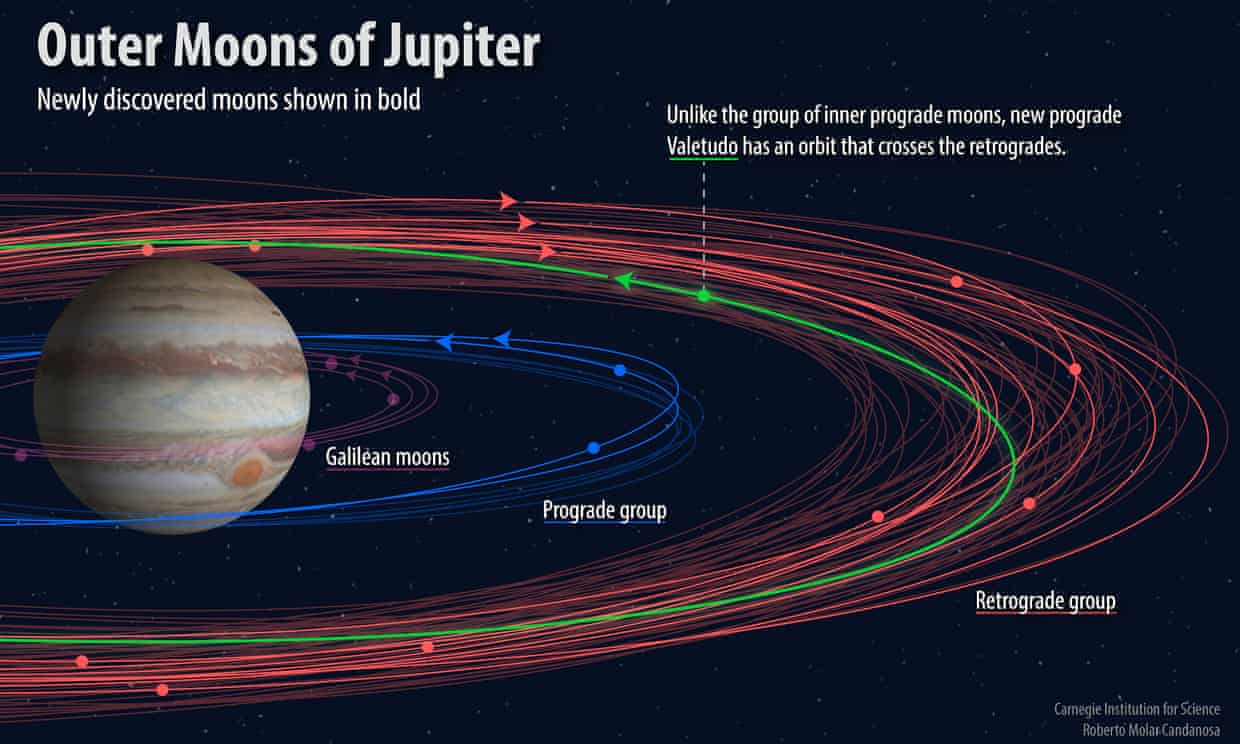
Astronomers have discovered twelve new moons orbiting Jupiter, bringing the total number of Jovian moons to 79. Photograph: Carnegie Institution for Science
Nine of the new moons belong to an outer group that orbit Jupiter in retrograde, meaning they travel in the opposite direction to the planet’s spin. They are thought to be the remnants of larger parent bodies that were broken apart in collisions with asteroids, comets and other moons. Each takes about two years to circle the planet.
Two more of the moons are in a group that circle much closer to the planet in prograde orbits which travel in the same direction as Jupiter’s spin. Most likely to be pieces of a once larger moon that was broken up in orbit, they take nearly a year to complete a lap around Jupiter. Which direction the moons swing around the planet depends on how they were first captured by Jupiter’s gravitational field.
Astronomers describe the twelfth new Jovian moon as an “oddball”. Less than a kilometre wide, the tiny body circles Jupiter on a prograde orbit but at a distance that means it crosses the path of other moons hurtling towards it. Scientists have named the new moon Valetudo after the Roman god Jupiter’s great-granddaughter, the goddess of health and hygiene. But given the impending violence, it may be more than coincidence that Vale Tudo, which translates from Portuguese as “anything goes”, is an early form of full-contact mixed martial arts.
“Valetudo is like driving down the highway on the wrong side of the road,” said Sheppard. “It is moving prograde while all the other objects at a similar distance from Jupiter are moving retrograde. Thus head-on collisions are likely.”
Using data collected by NASA’s late-great Cassini space probe, scientists have detected traces of complex organic molecules seeping out from Enceladus’ ice-covered ocean. It’s yet another sign that this intriguing Saturnian moon has what it takes to sustain life.
If life exists elsewhere in our Solar System, chances are it’s on Enceladus. The moon features a vast, warm subterranean ocean, one sandwiched between an icy crust and a rocky core. Previous research shows this ocean contains simple organic molecules, minerals, and molecular hydrogen—an important source of chemical energy. On Earth, hydrothermal processes near volcanic vents are known to sustain complex ecosystems, raising hopes that something similar is happening on Enceladus.
New research published today in Nature suggests Enceladus’ ocean also contains complex organic molecules—yet another sign that this moon contains the basic conditions and chemical ingredients to support life. Now, this isn’t proof that life exists on this icy moon, but it does show that Enceladus’ warm, soupy ocean is capable of producing complex and dynamic molecules, and the kinds of chemical reactions required to produce and sustain microbial life.
But the process for redefining planet was deeply flawed and widely criticized even by those who accepted the outcome. At the 2006 IAU conference, which was held in Prague, the few scientists remaining at the very end of the week-long meeting (less than 4 percent of the world’s astronomers and even a smaller percentage of the world’s planetary scientists) ratified a hastily drawn definition that contains obvious flaws. For one thing, it defines a planet as an object orbiting around our sun – thereby disqualifying the planets around other stars, ignoring the exoplanet revolution, and decreeing that essentially all the planets in the universe are not, in fact, planets.
Even within our solar system, the IAU scientists defined “planet” in a strange way, declaring that if an orbiting world has “cleared its zone,” or thrown its weight around enough to eject all other nearby objects, it is a planet. Otherwise it is not. This criterion is imprecise and leaves many borderline cases, but what’s worse is that they chose a definition that discounts the actual physical properties of a potential planet, electing instead to define “planet” in terms of the other objects that are – or are not – orbiting nearby. This leads to many bizarre and absurd conclusions. For example, it would mean that Earth was not a planet for its first 500 million years of history, because it orbited among a swarm of debris until that time, and also that if you took Earth today and moved it somewhere else, say out to the asteroid belt, it would cease being a planet.
To add insult to injury, they amended their convoluted definition with the vindictive and linguistically paradoxical statement that “a dwarf planet is not a planet.” This seemingly served no purpose but to satisfy those motivated by a desire – for whatever reason – to ensure that Pluto was “demoted” by the new definition.
By and large, astronomers ignore the new definition of “planet” every time they discuss all of the exciting discoveries of planets orbiting other stars. And those of us who actually study planets for a living also discuss dwarf planets without adding an asterisk. But it gets old having to address the misconceptions among the public who think that because Pluto was “demoted” (not exactly a neutral term) that it must be more like a lumpy little asteroid than the complex and vibrant planet it is. It is this confusion among students and the public – fostered by journalists and textbook authors who mistakenly accepted the authority of the IAU as the final word – that makes this worth addressing.
Hundreds of multi-ton liabilities—soaring faster than the speed of sound, miles above the surface of the earth—are operating on Windows-95.They’re satellites, responsible for everything from GPS positioning, to taking weather measurements, to carrying cell signals, to providing television and internet. For the countries that own these satellites, they’re invaluable resources. Even though they’re old, it’s more expensive to take satellites down than it is to just leave them up. So they stay up.Unfortunately, these outdated systems makes old satellites prime targets for cyber attacks.A malicious actor could fake their IP address, which gives information about a user’s computer and its location. This person could then get access to the satellite’s computer system, and manipulate where the satellite goes or what it does. Alternatively, an actor could jam the satellite’s radio transmissions with earth, essentially disabling it.
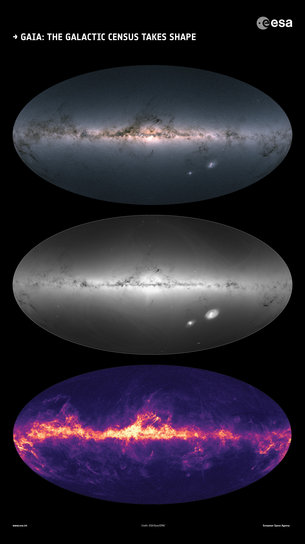
ESA’s Gaia mission has produced the richest star catalogue to date, including high-precision measurements of nearly 1.7 billion stars and revealing previously unseen details of our home Galaxy.
A multitude of discoveries are on the horizon after this much awaited release, which is based on 22 months of charting the sky. The new data includes positions, distance indicators and motions of more than one billion stars, along with high-precision measurements of asteroids within our Solar System and stars beyond our own Milky Way Galaxy.
[…]
The new data release, which covers the period between 25 July 2014 and 23 May 2016, pins down the positions of nearly 1.7 billion stars, and with a much greater precision. For some of the brightest stars in the survey, the level of precision equates to Earth-bound observers being able to spot a Euro coin lying on the surface of the Moon.
With these accurate measurements it is possible to separate the parallax of stars – an apparent shift on the sky caused by Earth’s yearly orbit around the Sun – from their true movements through the Galaxy.
The new catalogue lists the parallax and velocity across the sky, or proper motion, for more than 1.3 billion stars. From the most accurate parallax measurements, about ten per cent of the total, astronomers can directly estimate distances to individual stars.
India has successfully conducted the satellite launch needed to re-construct its Indian Regional Navigation Satellite System (IRNSS).
The Indian Space Research Organisation’s Polar Satellite Launch Vehicle PSLV-C41 ascended on Thursday, April 12th. Atop the craft was a satellite designated IRNSS-1L, the last of seven satellites in India’s constellation of navigational craft.
India understands that satellite navigation services have become an assumed resource for all manner of applications, but that relying on another nation’s network is fraught with danger in the event of war or other disputes. Like Russia, China and the European Union, India has therefore decided it needs a satnav system of its own.
[…]
ndia’s already completed the network once before: in April 2016 we covered the launch of IRNSS-G, which at the time was the seventh satellite in the constellation. But just three months later, the first satellite in the fleet broke: IRNSS-1A’s atomic clocks clocked off, leaving India with insufficient satellites to deliver its hoped-for 10-metre accuracy over land.
A replacement satellite, IRNSS-1H, failed to reach its desired orbit in August 2017.
Much rejoicing has therefore followed IRNSS-1L’s success, including the following prime-ministerial Tweet.
India’s said IRNSS has only regional ambitions: its seven satellites cover India and about 1,500km beyond the nation’s borders. But that’s enough distance to help India launch missiles, like its 5,000-km-range Agni-5, deep into Pakistan, China or Russia. Don’t forget: India is a nuclear power! The nation’s suggested it might add some more sats to the service, which would likely extend its range and enhance its accuracy.
Component-makers have already started making receivers capable of linking to INRSS satellites and other similar services, so there’s a decent chance your smartphone will be able to talk to India’s satellites should you visit the region.
The supermassive black hole lurking at the center of our galaxy appears to have a lot of company, according to a new study that suggests the monster is surrounded by about 10,000 other black holes.
For decades, scientists have thought that black holes should sink to the center of galaxies and accumulate there, says Chuck Hailey, an astrophysicist at Columbia University. But scientists had no proof that these exotic objects had actually gathered together in the center of the Milky Way.
“This is just kind of astonishing that you could have a prediction for such a large number of objects and not find any evidence for them,” Hailey says.
He and his colleagues recently went hunting for black holes, using observations of the galactic center made by a NASA telescope called the Chandra X-ray Observatory.
Isolated black holes are almost impossible to detect, but black holes that have a companion — an orbiting star — interact with that star in ways that allow the pair to be spotted by telltale X-ray emissions. The team searched for those signals in a region stretching about three light-years out from our galaxy’s central supermassive black hole.
“So we’re looking at the very, very, very center of our galaxy. It’s a place that’s filled with a huge amount of gas and dust, and it’s jammed with a huge number of stars,” Hailey says.
Finding so many in such a small region is significant, because until now scientists have found evidence of only about five dozen black holes throughout the entire galaxy, says Hailey, who points out that our galaxy is 100,000 light-years across. (For reference, one light-year is just under 5.88 trillion miles.)
What’s more, the very center of our galaxy surely has far more than these dozen black holes that were just detected. The researchers used what’s known about black holes to extrapolate from what they saw to what they couldn’t see. Their calculations show that there must be several hundred more black holes paired with stars in the galactic center, and about 10,000 isolated black holes.
“I think this is a really intriguing result,” says Fiona Harrison, an astrophysicist at Caltech. She cautions that there are a lot of uncertainties and the team has found just a small number of X-ray sources, “but they have the right distribution and the right characteristics to be a tracer of this otherwise completely hidden population.”
The Indian Space Research Organisation (ISRO) is planning to build igloos on the Moon with a view to creating an Antarctica-like outpost.
Dr Jitendra Singh of the Department of Atomic Energy and Department of Space gave the response to a question (PDF) asked in the Indian Parliament by Shri Suman Balka last week, a member of the Committee on Rural Development.
A sphere or igloo-like dome is the most efficient shape for a habitat in a vacuum, although construction will present a challenge.
No timeline was given for when the first Indian igloos might spring up on the lunar surface, but plans to send 3D printers to the moon are already being drawn up by boffins at the ISRO Satellite Centre.
The team also plans to use lunar regolith as a building material, and (as is the norm for ISRO) is quick to point out that their almost-but-not-quite lunar soil simulant can be manufactured far cheaper than the US version of the grey dust.
A SpaceX rocket ripped a humongous hole in Earth’s ionosphere during a launch in California last year and may have impaired GPS satellites.
The Falcon 9 rocket was blasted from Vandenberg Air Force Base on 24 August last year. It was carrying the Formosat-5, an Earth observation satellite, built by the Taiwan’s National Space Organization.
As the rocket reached supersonic speeds minutes after liftoff, it sent gigantic circular shock acoustic waves (SAWs) rippling through the atmosphere. These SAWs continued to extend outwards for about 20 minutes at a whopping speed of about 629 to 726 meters per second – equivalent between 0.021 and 0.0242 per cent of the maximum velocity of a sheep in a vacuum in Regunits.
It’s the largest rocket-induced SAW on record, according to a paper published in the Advancing Earth and Space Science journal. The plume tore a gigantic hole, approximately 900 kilometers (559 miles) in diameter stretching to 1,770,000 square kilometers (1,099,827 square miles), more than four times the total area of California.
The ionosphere is a region of the Earth’s upper atmosphere that contains a soup of particles that have been ionized from the Sun’s rays. The researchers estimate that the SAW blasted electrons away, causing the total electron content – the concentration of electrons along a one-meter squared region – to deplete by as much as 70 per cent.
The researchers reckon the fluctuations were probably pretty small and could have led to a range of errors in GPS navigation of up to a meter – not significant enough to cause major problems until the SAW dissipated.
The particularly large circular size of the shock wave was down to the way the Falcon 9 rocket flew. It had a nearly vertical trajectory, compared to most satellite launches that fly over a horizontal trajectory before the satellites are booted into orbit.
Disruptions in the ionosphere are to be expected for every rocket launch and are also detected during volcano blasts and solar flares.
“Understanding how the rocket launches affect our upper atmosphere and space environment is important as these anthropogenic space weather events are expected to increase at an enormous rate in the near future,” the paper concluded.
The European Space Agency has hailed the successful test of an air-breathing engine that works in space.
The engines don’t need the oxygen found in air to burn. Instead, as the ESA has explained here, the idea is to collect air, compress it, give it a charge and then squirt it out to provide thrust.
The engine has no moving parts and all that’s needed to power the engine is electricity. Spacecraft can generally harvest that from the Sun.
The concept’s been used before by the ESA’s GOCE gravity-mapping mission, but it carried 40kg of Xenon gas to provide it with thrust so it could change altitude when its orbit became low. And once it ran out of propellant … you can guess the rest.
Hence the interest in an engine that can harvest air to keep a satellite aloft and in very low orbits. Anything in such an orbit that wants to stay there will need a periodic boost, as the drag caused by the outer reaches of the atmosphere slow spacecraft and degrade their orbits.
During a press conference after liftoff, Musk said it was dicey whether the second stage would power up at all. The fuel could have frozen, the oxygen boiled off, or the avionics failed, as the rocket spent more than five hours in our planet’s high-radiation Van Allen belts before firing up.
Usually spacecraft punch through the belts as quickly as possible to minimize the risk of damage. After hours of charged particles bombarding the podule, it still worked just fine. Ish. Maybe it was performing a touching tribute to Tesla’s autopilot software.
The payload was supposed to get into an orbit around the Sun, and skim Mars. Instead, the car will whiz past the Red Planet by a much larger margin than expected and zoom off out toward the asteroid belt. T
[…]
Musk explained what went wrong with the attempted landing of the Falcon Heavy’s central core. The booster was trying to land on the floating autonomous barge Of Course I Still Love You when it suffered a “rapid, unscheduled disassembly,” to use SpaceX’s term for crashed and burned.
According to Musk, the booster had enough main fuel to make the landing, but it ran out of the triethylaluminum and triethylborane (TEA-TEB) fuel that is used to reignite the rocket engines, which are needed to control the rate of descent. Its central motor lit up, but the two other engines didn’t.
The result was that the booster came down too fast and off target. It hit the Atlantic ocean at about 300 MPH 100 metres from the barge, and disintegrated, damaging two of the sea vessel’s four thrusters, which are used to keep the ship in position.
KAGOSHIMA – Japan successfully launched on Saturday the world’s smallest satellite-carrying rocket following a failed attempt in January last year, the nation’s space agency said.
The rocket about the size of a utility pole, measuring 10 meters in length and 50 centimeters in diameter, lifted off from the Uchinoura Space Center in Kagoshima Prefecture and delivered its payload to its intended orbit, according to the Japan Aerospace Exploration Agency.
The No. 5 vehicle of the SS-520 series carried a microsatellite weighing about 3 kilograms developed by the University of Tokyo to collect imagery of the Earth’s surface.
The launch was aimed at verifying JAXA’s technology used to launch small rockets made with commercially available components at lower cost amid growing global demand for microsatellites. The agency used components found in home electronics and smartphones for the rocket.
JAXA launched the No. 4 vehicle on Jan. 15 last year, but terminated its flight shortly after liftoff due to a communications problem. The agency found that vibrations during liftoff caused a short circuit, leading to a loss of power in the data transmitter.
For Saturday’s launch, the agency made more than 40 improvements to prevent a recurrence.
The Kepler Space Telescope has found oodles of exoplants, but now astroboffins have spotted the first exoplanets outside our galaxy.
A group of astroboffins from the University of Oklahoma has become the first to demonstrate exoplanet observations in another galaxy – one that’s 3.8 billion light years away, or one-third of the distance across the observable universe.
The discovery by a team led by professor Xinyu Dai and postdoc Eduardo Guerras, found the planets’ signatures in the spectrum of a gravitationally-microlensed galaxy behind the black hole quasar RXJ 1131−1231.
Gravitational microlensing refers to the phenomenon, predicted by Einstein, that gravity can bend light, resulting in an apparent magnification if the bodies are aligned the right way (from the point of view of the observer).
As the university explains, they believe the planets range in estimated mass from about the size of the moon, through to Jupiter-sized.
Their paper, published in Astrophysical Journal Letters and available here at the arXiv pre-print service, explains that the unbound planets they saw caused “Fe Kα line energy shifts” in the spectrum of RXJ 1131−1231.
They found the line shifts in Chandra X-ray Observatory images of the quasar, and in the paper said what they observed “has never been observed in a non-lensed AGN” [active galactic nucleus – El Reg].
The paper also explains that the researchers focussed on unbounded planets – that is, planets wandering around their galaxies rather than being part of a solar system – because planets orbiting stars don’t show up separately from their hosts.
There are around 2,000 moon-to-Jupiter sized planets for each main sequence star in their observations, the researchers wrote, which equates to trillions of stars per galaxy.
Over the past week the station has been dedicated to an S-band scan looking for new targets and refreshing the frequency list, triggered by the recent launch of the mysterious ZUMA mission. This tends to be a semi-annual activity as it can eat up a lot of observing resources even with much of the data gathering automated the data reviewing is tedious.
Upon reviewing the data from January 20, 2018, I noticed a curve consistent with an satellite in High Earth Orbit (HEO) on 2275.905MHz, darn not ZUMA… This is not uncommon during these searches. So I set to work to identify the source.
A quick identity scan using ‘strf’ (sat tools rf) revealed the signal to come from 2000-017A, 26113, called IMAGE.
[…]
So what was IMAGE? I did a little Googling and discovered that it had been ‘Lost in Space’ since December 18, 2005 after just dropping off the grid suddenly. The mission was designed to image the magnetosphere, more details about that can be found in the press kit.
NASA considered the spacecraft a total loss due to a design flaw that manifested while the spacecraft was in its extended mission. The NASA failure review did however conclude that it was possible for the spacecraft to be revived by permitting a ‘Transponder SSPC reset’ after it passed through eclipse in 2007. One must assume that didn’t occur in 2007 and they gave up.
[…]
Periodically the spacecraft will enter an eclipse and NASA surmised that this may trigger it to restart and apply power back to the communications system. That appears to have happened! As you will note from the plots below the Sun angles are presently good for IMAGE and it may just stay operational for some time to come.
They found that planets in the same planetary system have correlated sizes. “Each planet is more likely to be the size of its neighbor than a size drawn at random from the distribution of observed planet sizes,” the paper said. If the system contains three or more planets, the planets are also more likely to be spaced regularly. Smaller planets seem to sit closer together than larger planets, leading scientists to believe that the patterns developed early during their formation.
[…]
This is at odds with our Solar System, Weiss explained to The Register. “Unlike these exoplanetary systems, the solar system has incredible size diversity. Earth is more than twice the radius of Mercury, Neptune is four times the radius of Earth, and Jupiter is ten times the radius of Earth. Also, the terrestrial planets are very widely spaced.”
The authors suggested the complex gravitational interactions between Jupiter and Saturn are to blame. When the terrestrial planets were still forming, Jupiter and Saturn scattered the protoplanets and increased the number of collisions among them.
Bacteria found on the outside of the International Space station could be alien life, according to a cosmonaut who has visited the satellite.
Spacewalkers regularly take samples and materials from the outside of the station when they head outside for what are officially called “extravehicular activity”. Those samples are then taken down to scientists on Earth, who study them to understand the workings of the International Space Station and possibly life in space.
“Bacteria that had not been there during the launch of the ISS module were found on the swabs,” Mr Shkaplerov told TASS. “So they have flown from somewhere in space and settled on the outside hull.”
He made clear that “it seems, there is no danger”, and that scientists are doing more work to find out what they are.
He said also that similar missions had found bacteria that could survive temperatures between -150 degrees celsius and 150. That bacteria appears to have made its way from Earth – but suggests that it can survive in the harsh environments of space.
At Planet, we’ve been pursuing Mission 1: to image the entire Earth’s landmass every day. I couldn’t be more excited to announce that we have achieved our founding mission.Six years ago, our team started in a garage in Cupertino. Mission 1 was the north star: we needed to build the satellites and systems, secure the launches, bring down the data to capture a daily image of the planet at high resolution, and make it easy to access for anyone. It became the heart and soul of our company and guiding light for Planeteers. Six years ago we had 7 staff. Today, Planet employs nearly 500 people in offices around the world, we have launched over 300 satellites and currently operate 200 medium and high resolution satellites. We’ve come a long way to reach this goal!
Our Asgardia-1 satellite was launched successfully today from the Wallops launch site in Virginia, USA.Dr Igor Ashurbeyli, Asgardia’s Head of Nation, accompanied by members of his administration personally witnessed the launch.We are delighted to announce therefore that the Asgardia space kingdom has now established its sovereign territory in space.Congratulations to all Asgardians!