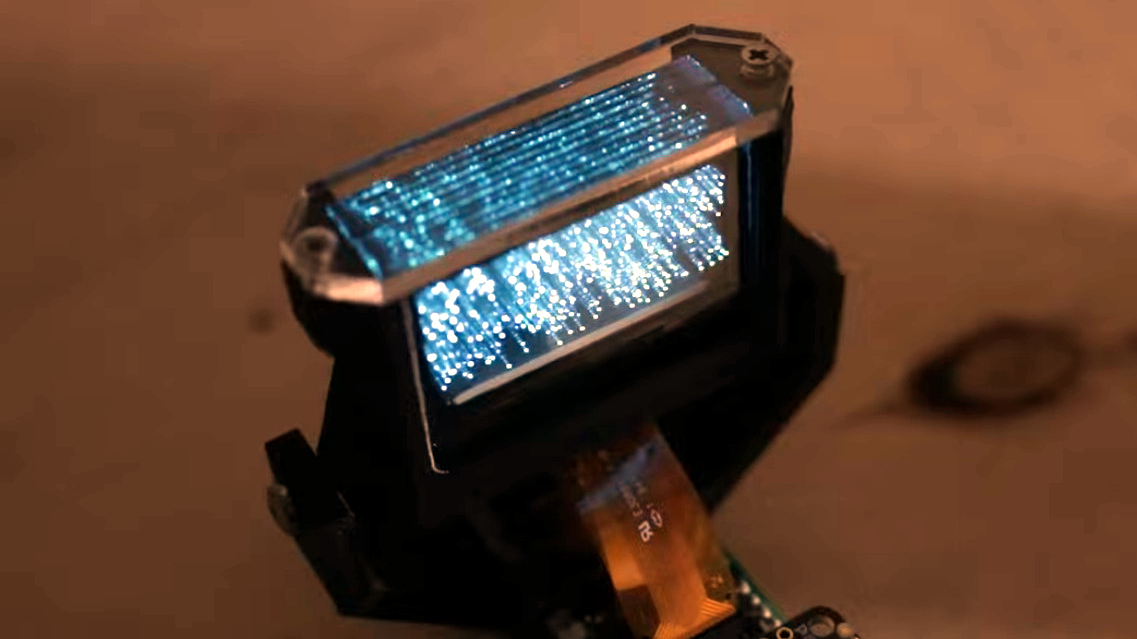
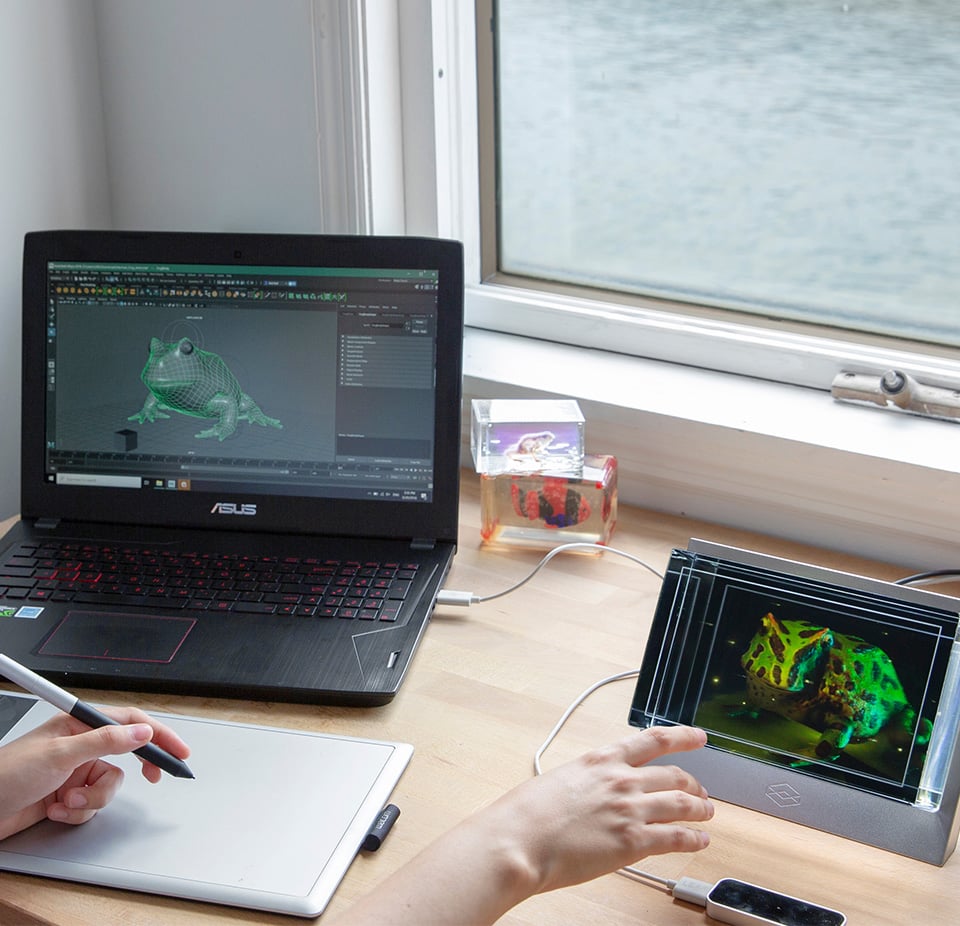
The trick of a volumetric display is the ability to add a third dimension for positioning pixels. Here [Sean] delivered that ability with a stack up of ten screens to add a depth element. This is not such an easy trick. These small OLED displays are all over the place but they share a common element: a dark background over which the pixels appear. [Sean] has gotten his hands on some transparent OLED panels and with some Duck-Duck-Go-Fu we think it’s probably a Crystalfontz 128×56 display. Why is it we don’t see more of these? Anyone know if it’s possible to remove the backing from other OLED displays to get here. (Let us know in the comments.)
The rest of the built is fairly straight-forward with a Feather M4 board driving the ten screens via SPI, and an MPU-6050 IMU for motion input. The form factor lends an aesthetic of an augmented reality device and the production approach for the video puts this in a Bladerunner or Johnny Mneumonic universe. Kudos for expanding the awesome of the build with an implied backstory!
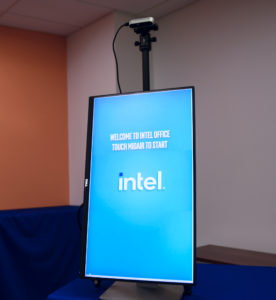
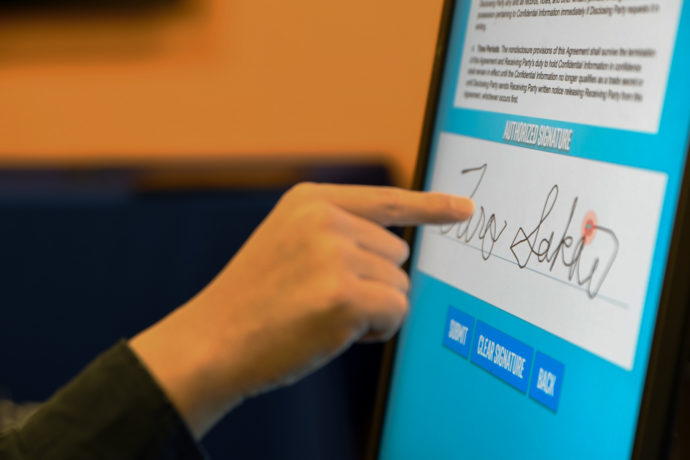
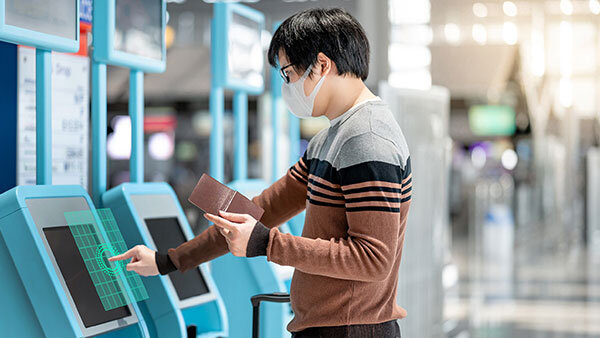
Today, Intel announced Intel® RealSense™ Touchless Control Software (TCS), a simple solution for converting a touch-based kiosk or digital sign into a safer, touchless one while maintaining a familiar and intuitive user experience. With the pandemic affecting people worldwide, pay and check-in stations, automated teller machines and ordering kiosks could use the Intel RealSense software and camera to offer safer, touch-free options.
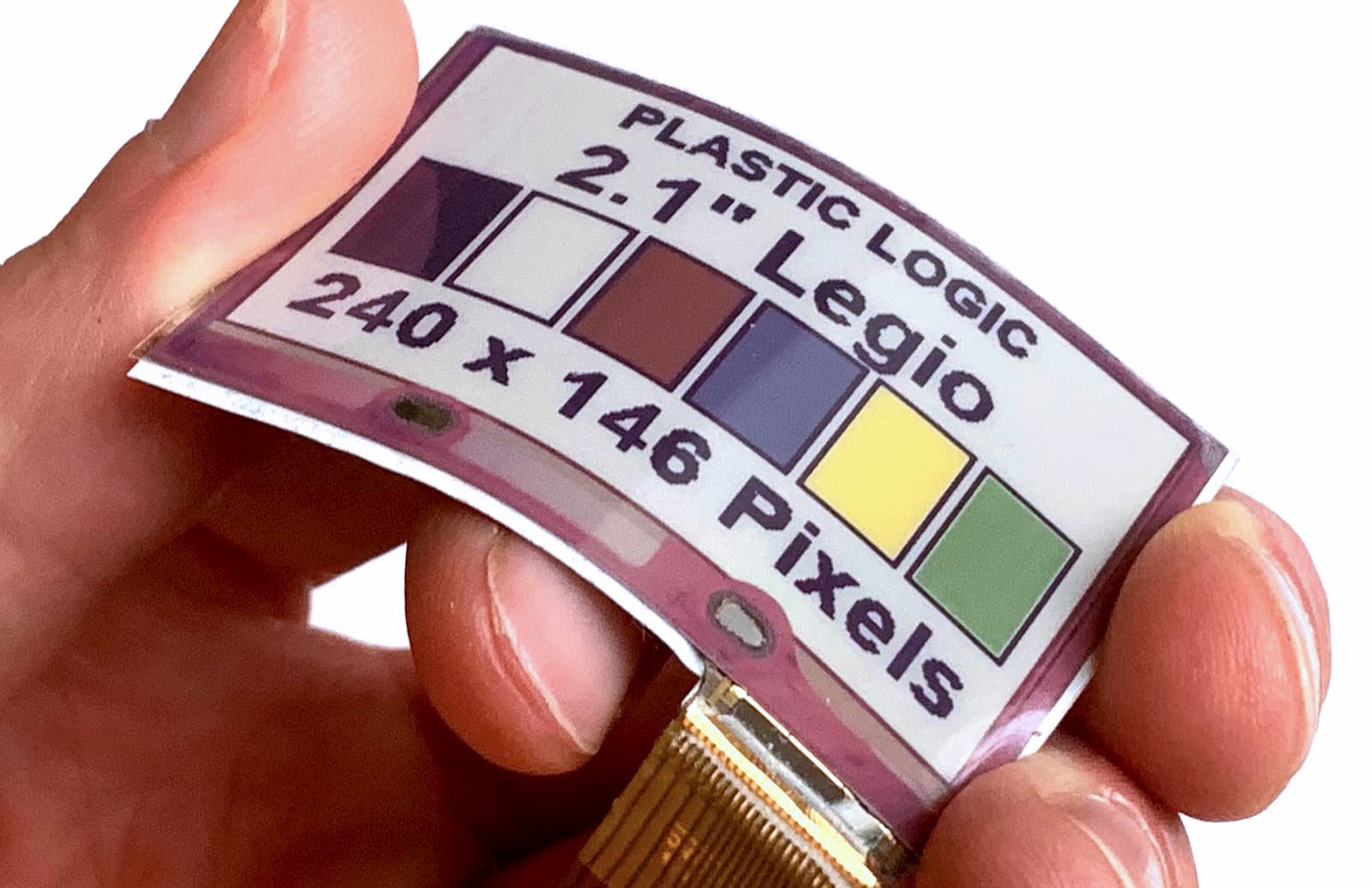
The glass-free organic Thin Film Transistor (oTFT) displays are lightweight and ultra low-power. E Ink claims they’re more durable, thinner and lighter than glass-based TFTs. That, according to the company, makes oTFT displays “ideal” for wearables. For instance, designers could build the Legio-branded displays into smart clothing and jewelry. Until now, ACeP displays have mainly been used for signage, which of course doesn’t require panels to be flexible.
The first Legio panel is a 2.1-inch, 240 x 146-pixel display with support for six colors, including black and white. It’s powered by an Ultrachip UC8156 single-chip controller.
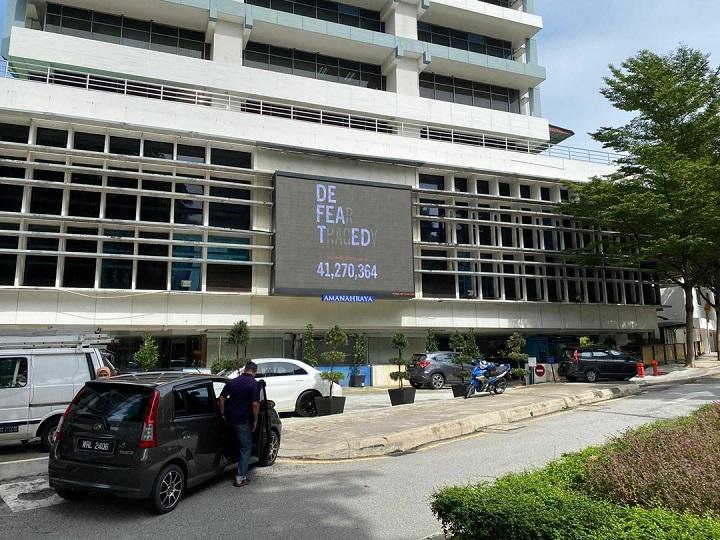
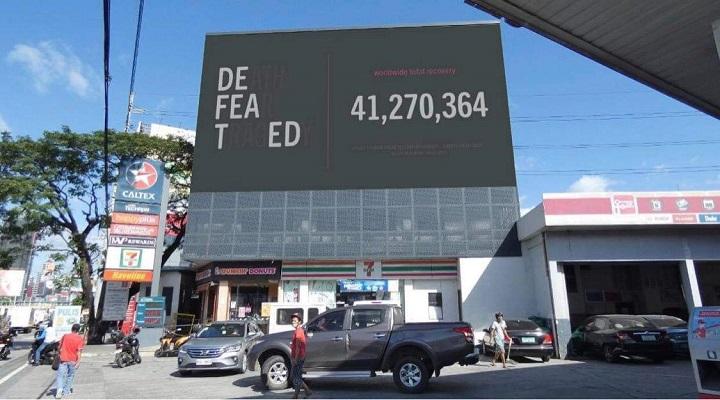
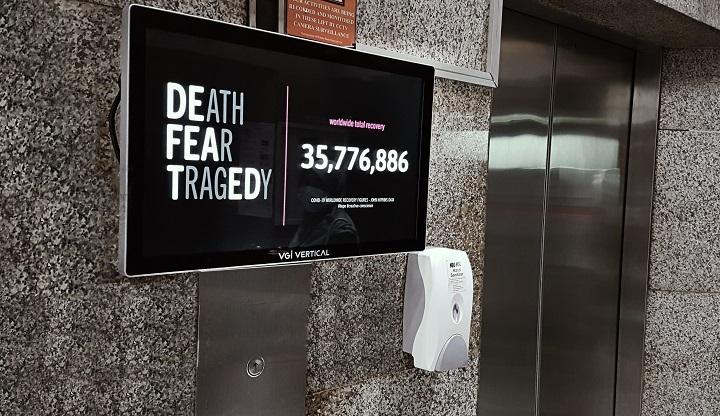
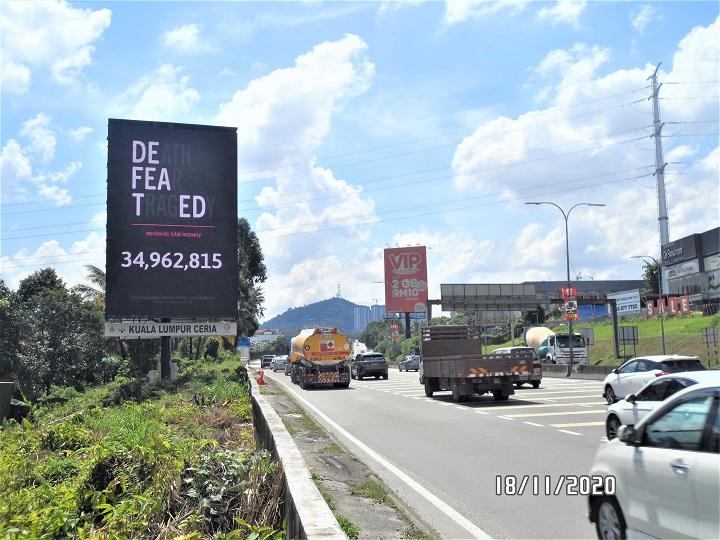
The campaign was conceived by DOOH firm Orb Screen, produced by Creative Conscience and L&CO, developed by Voodooh and Nicole Yershon, and designed by advertising graduate Megan Williams. It has now made its way to Asia, with Location Media Xchange (LMX), the supply-focused arm of Moving Walls Group, amplifying the creatives on partner screens across Singapore, Malaysia, Indonesia, Philippines and India.
The displays run a tally of individuals known to have recovered from COVID-19 worldwide, while showcasing inspiring messages of how survivors have defeated it by refocusing some of the grim language often associated with the pandemic. A+M has reached out to Moving Walls for comment.
Among the list of media owners in Asia Pacific that ran the dynamic creatives include Dana Intelek, VGI Global Media Malaysia, Visual Retale, Vestigia Malaysia, LOOKhere Network, Titanium Compass, Spectrum Outdoor Marketing, 3thirds Inc, LEDtronics Media, Danendra Abyudaya Adika, KALMS, Pitchworks Incorporated Philippines and Nexyite Entertainment.
Ask VR fans about their gripes and they’ll likely mention the “screen door” effect, or the gaps between pixels that you notice when looking at a display so close to your eyes. That annoyance might disappear entirely if Samsung and Stanford University have their way. They’ve developed (via IEEE Spectrum) OLED technology that supports resolutions up to 10,000 pixels per inch — well above what you see in virtually any existing display, let alone what you’d find in a modern VR headset like the Oculus Quest 2.
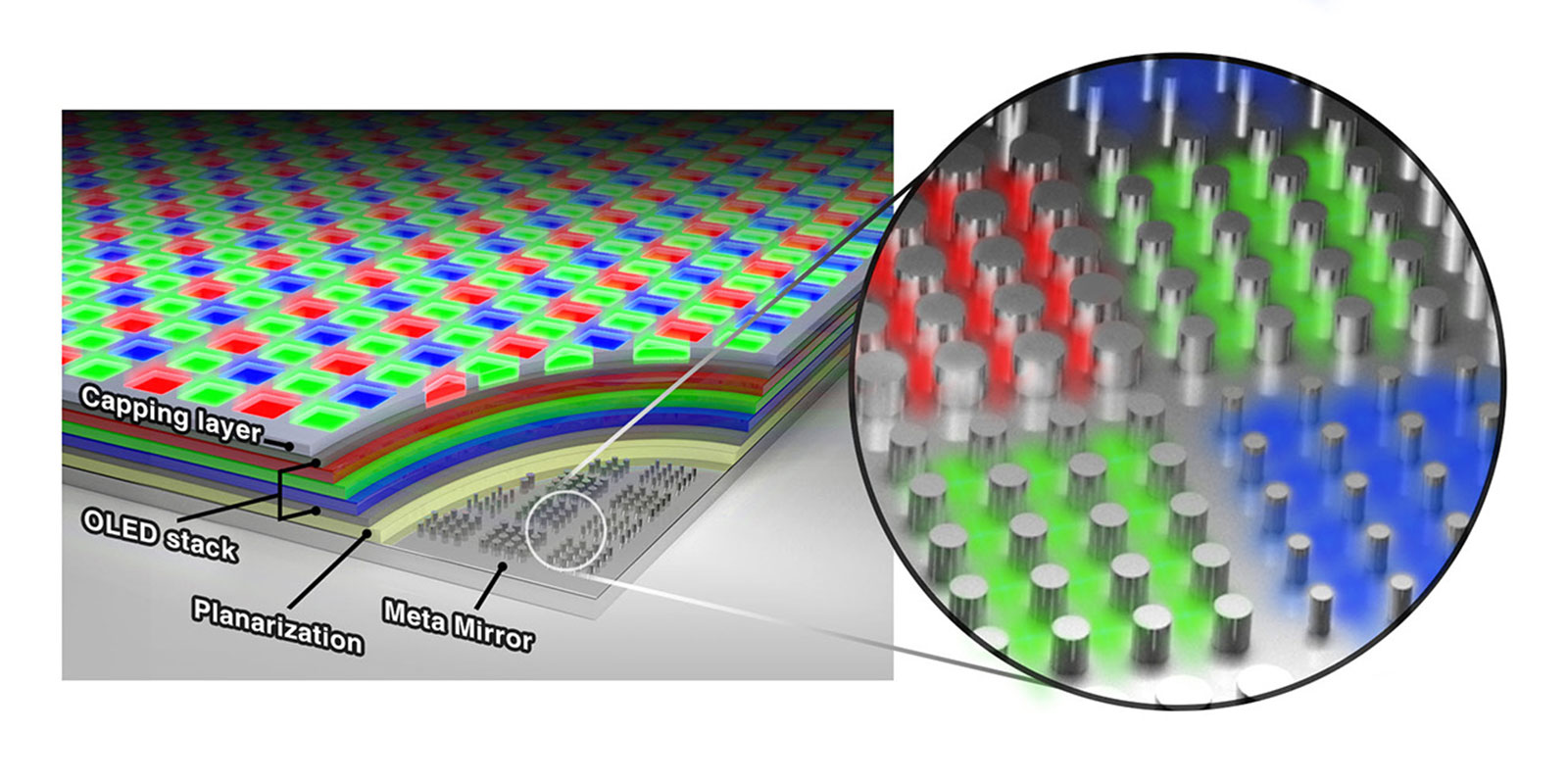
The newOLED tech uses films to emit white light between reflective layers, one silver and another made of reflective metal with nano-sized corrugations. This “optical metasurface” changes the reflective properties and allows specific colors to resonate through pixels. The design allows for much higher pixel densities than you see in the RGB OLEDs on phones, but doesn’t hurt brightness to the degree you see with white OLEDs in some TVs.
This would be ideal for VR and AR, creating a virtually ‘flawless’ image where you can’t see the screen door effect or even individual pixels. This might take years to arrive when it would require much more computing power, but OLED tech would no longer be an obstacle.
It’s also more practical than you might think. Samsung is already working on a “full-size” display using the 10,000PPI tech, and the design of the corrugations makes large-scale manufacturing viable. It may just be a question of when and where you see this OLED rather than “if.”
After years of teasing, LG is finally selling a rollable OLED TV. The RX-branded Signature OLED R launched in South Korea today, offering a 65-inch 4K display that tucks away into its base at the press of a button. Besides being able to hide completely, as LG has promised in CES previews, the TV has different settings (Full View, Line View and Zero View) for different situations.
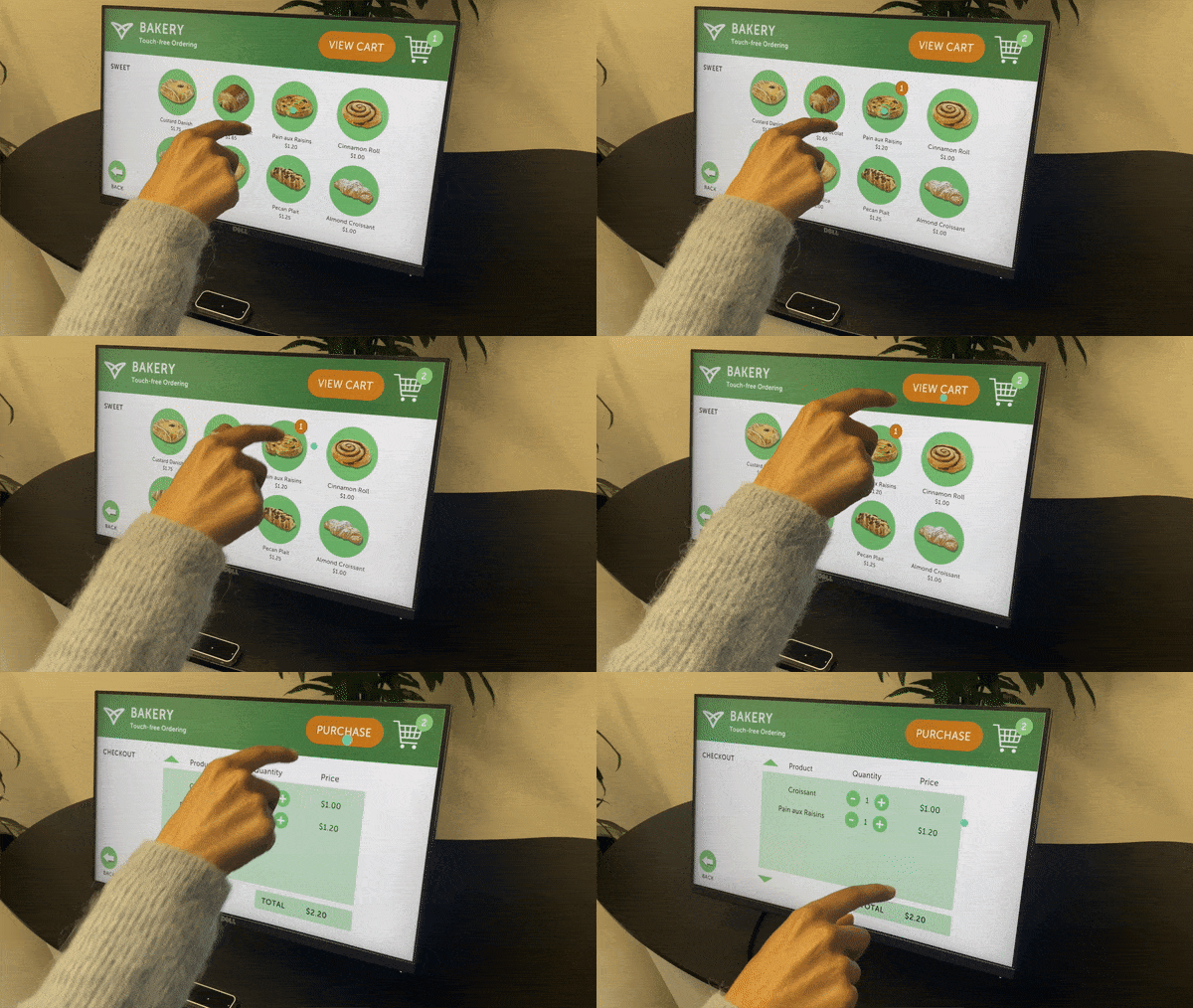
TouchFree is a software application that runs on an interactive kiosk or advertising totem. It detects a user’s hand in mid-air and converts it to an on-screen cursor.
Easy to integrate, deploy, and use
• Runs invisibly on top of existing user interfaces
• Add touchless interaction without writing a single line of code
• Familiar touchscreen-style interactions
How users interact
• A user’s hand is detected, and shown as a cursor displayed on the screen
• Users can select items without touching the screen using a simple “air push” motion, similar to tapping a screen but in mid-air.
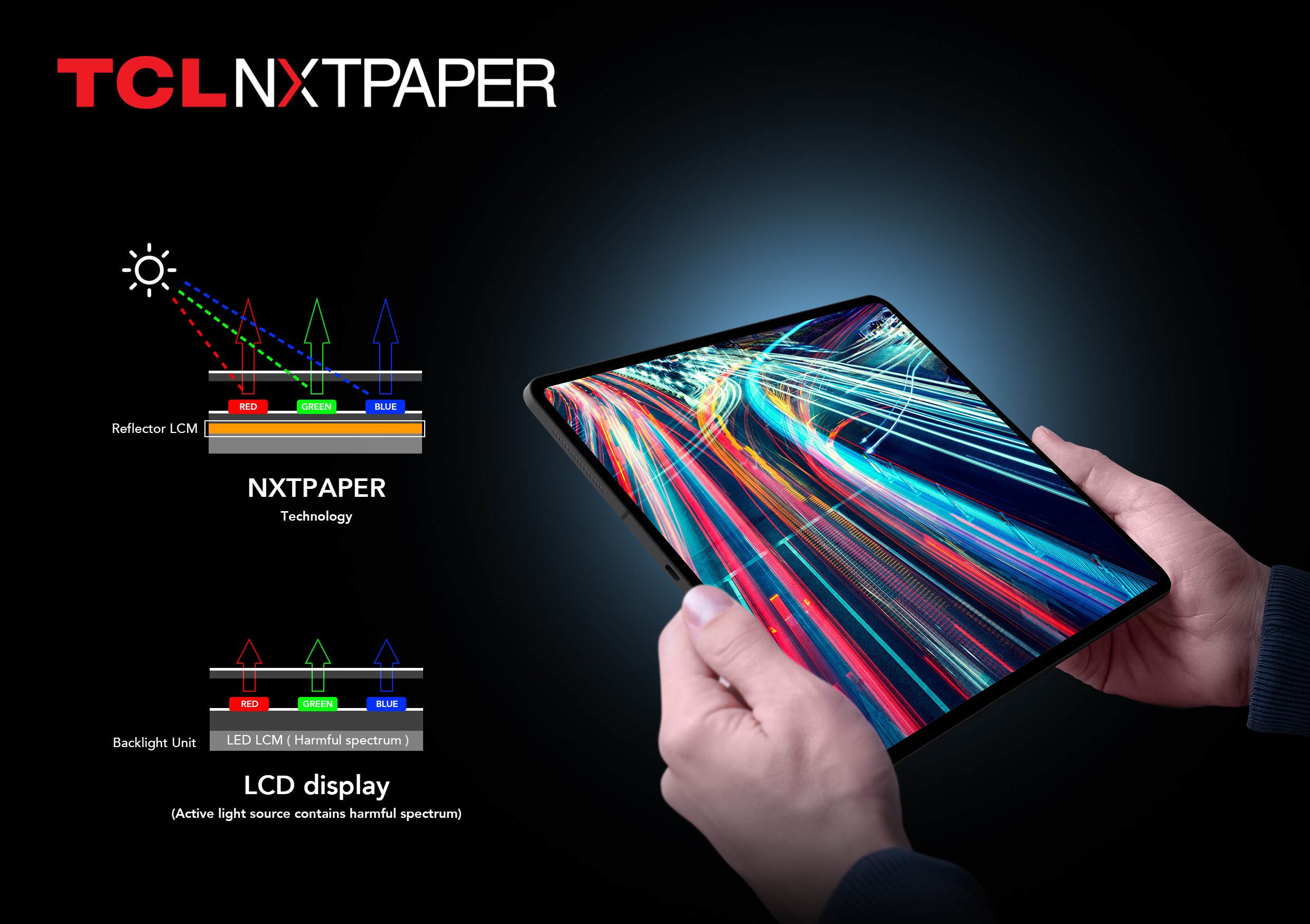
NXTPAPER today — a new type of display that’s meant to offer better eye protection by reducing flicker, blue light and light output. The company said the effect is similar to E Ink, calling it a “combination of screen and paper.” TCL also said it has received eye protection certifications from the German Rhine laboratory, and has 11 different patents for eye protection.
Don’t expect to see NXTPAPER appear on a smartphone, though. TCL said it’s meant for larger devices like tablets or e-readers. The new screen tech will support Full HD definition and allow for smooth video playback on a paper-like experience. Compared to E Ink, TCL said its version will offer 25 percent higher contrast. It uses a “highly reflective screen” to “reuse natural light,” doing away with backlighting in the process. TCL said NXTPAPER will be 36 percent thinner than typical LCD while offering higher contrast. Because it doesn’t require its own lights, the company said the new screen tech is also 65 percent more power efficient. This way, devices won’t need large unwieldy batteries for prolonged use.
Known for its tablets, TVs, and phones, TCL has this week announced a new technology, NXTPAPER, that could totally change how you think about e ink. E ink displays are known for being great to stare at for hours and perfect for reading books (and sometimes even comics), but the latest color displays from E Ink have low resolution and slow refresh rates, making them unusable for video. TCL claims its new NXTPAPER tech could be a solution.
TCL’s press release is a little confusing, as it appears to compare NXTPAPER both to E Ink’s displays and to traditional LCD displays that you find in most tablets and phones today. But by all accounts, the technology used in NXTPAPER sounds like e ink technology. The press release claims it will be 36% thinner than LCD displays and 65% more power-efficient—which lines up with the gains you get from e ink.
Last week, E Ink told the blog Good Ereader that it had plans to improve its own color E Ink technology. While we adore the first color E Ink devices, they’ve not been without their flaws, including a paltry 100-PPI resolution and slower refresh rates. E Ink promised to at least double the resolution to 200 PPI by 2021, with a goal of hitting 300 PPI—the resolution of high-end LCD and monochrome E Ink displays—at a later date.
We don’t know the exact planned resolution for TCL’s competing NXTPAPER technology, but the company claims it will be full HD, and that the text incorporated will allow it to have 25% higher contrast than traditional e ink devices
TCL also says it will offer a “paper-like visual experience in full color with no flicker and no harmful blue light” and that it will rely on natural light—which, again, sounds like e ink.
Fraunhofer HHI (together with partners from industry including Apple, Ericsson, Intel, Huawei, Microsoft, Qualcomm, and Sony) is celebrating the release and official adoption of the new global video coding standard H.266/Versatile Video Coding (VVC). This new standard offers improved compression, which reduces data requirements by around 50% of the bit rate relative to the previous standard H.265/High Efficiency Video Coding (HEVC) without compromising visual quality. In other words, H.266/VVC offers faster video transmission for equal perceptual quality. Overall, H.266/VVC provides efficient transmission and storage of all video resolutions from SD to HD up to 4K and 8K, while supporting high dynamic range video and omnidirectional 360° video.
[…]
Through a reduction of data requirements, H.266/VVC makes video transmission in mobile networks (where data capacity is limited) more efficient. For instance, the previous standard H.265/HEVC requires ca. 10 gigabytes of data to transmit a 90-min UHD video. With this new technology, only 5 gigabytes of data are required to achieve the same quality. Because H.266/VVC was developed with ultra-high-resolution video content in mind, the new standard is particularly beneficial when streaming 4K or 8K videos on a flat screen TV. Furthermore, H.266/VVC is ideal for all types of moving images: from high-resolution 360° video panoramas to screen sharing contents.
With touch screens getting more and more prevalent, we’re seeing more experimentation with haptics. Being able to feel something other than just the smooth glass surface can be incredibly advantageous. Have you been in a car with a touch screen radio system? If so you’ll know the frustration.
Tanvas is a system that adds haptics by changing the amount of adhesion your finger tip experiences on the screen. Basically, they’re increasing the friction in a controlled manner. The result is a distinct difference between various areas of the screen. To be clear, you’re not feeling ridges, edges, or other 3 dimensional items, but you can definitely feel where something exists and something does not.
The touch screen itself isn’t really a consumer product. This is a dev kit, so you could incorporate their tech into your projects. Admittedly, this is only appealing to a very narrow subset of our readership (those developing a product that uses a touch screen) but I felt the tech was very interesting and wanted to share. Personally, I’d love to see this technology employed in popular consumer devices such as iPads!
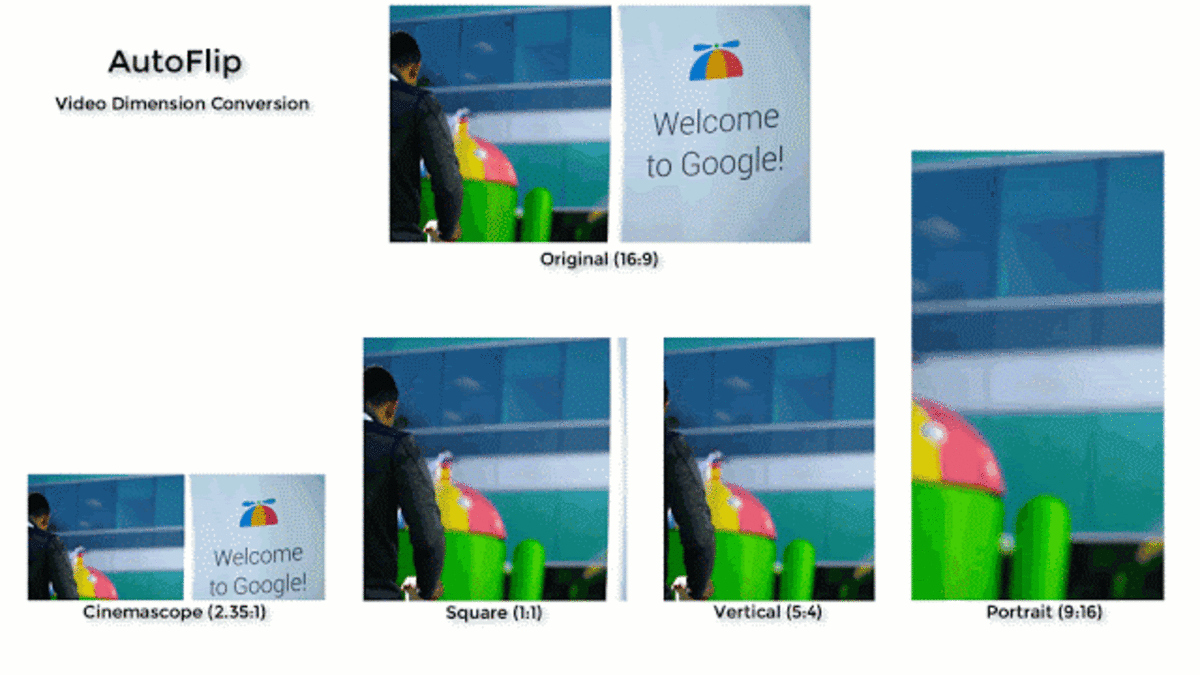
Google has released an open-source tool, Autoflip, that could make bad cropping a thing of the past by intelligently reframing video to correctly fit alternate aspect ratios.
In a blog post, Google’s AI team wrote that footage shot for television and desktop computers normally comes in a 16:9 or 4:3 format, but with mobile devices now outpacing TV in terms of video consumption, the footage is often displayed in a way that looks odd to the end-user. Fixing this problem typically requires “video curators to manually identify salient contents on each frame, track their transitions from frame-to-frame, and adjust crop regions accordingly throughout the video,” soaking up time and effort that could be better spent on other work.
Autoflip aims to fix that with a framework that applies video stabilizer-esque techniques to keep the camera focused on what’s important in the footage. Using “ML-enabled object detection and tracking technologies to intelligently understand video content” built on the MediaPipe framework, Google’s team wrote, it’s able to adjust the frame of a video on the fly.
What’s more, Autoflip automatically adjusts between scenes by identifying “changes in the composition that signify scene changes in order to isolate scenes for processing,” according to the company. Finally, it analyzes each scene to determine whether it should use a static frame or tracking mode.
This is pretty neat and offers obvious advantages over static cropping of videos, though it’s probably better suited to things like news footage and Snapchat videos than movies and TV shows (where being able to view an entire shot is more important).
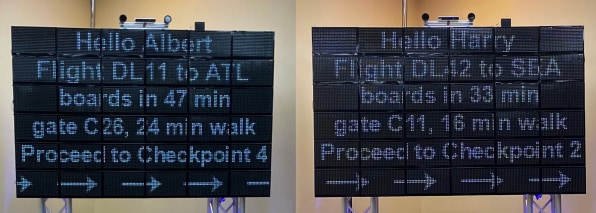
In a ritual I’ve undertaken at least a thousand times, I lift my head to consult an airport display and determine which gate my plane will depart from. Normally, that involves skimming through a sprawling list of flights to places I’m not going. This time, however, all I see is information meant just for me:
Hello Harry
Flight DL42 to SEA boards in 33 min
Gate C11, 16 min walk
Proceed to Checkpoint 2
Stranger still, a leather-jacketed guy standing next to me is looking at the same display at the same time—and all he sees is his own travel information:
Hello Albert
Flight DL11 to ATL boards in 47 min
Gate C26, 25 min walk
Proceed to Checkpoint 4
Okay, confession time: I’m not at an airport. Instead, I’m visiting the office of Misapplied Sciences, a Redmond, Washington, startup located in a dinky strip mall whose other tenants include a teppanyaki joint and a children’s hair salon. Albert is not another traveler but rather the company’s cofounder and CEO, Albert Ng. We’ve been play-acting our way through a demo of the company’s display, which can show different things to different people at one time—no special glasses, smartphone-camera trickery, or other intermediary technology required. The company calls it parallel reality.
The simulated airport terminal is only one of the scenarios that Ng and his cofounder Dave Thompson show off for me in their headquarters. They also set up a mock store with a Pikachu doll, a Katy Perry CD, a James Bond DVD, and other goods, all in front of one screen. When I glance up at it, I see video related to whichever item I’m standing near. In a makeshift movie theater, I watch The Sound of Music with closed captions in English on a display above the movie screen, while Ng sits one seat over and sees Chinese captions on the same display. And I flick a wand to control colored lights on Seattle’s Space Needle (or for the sake of the demo, a large poster of it).
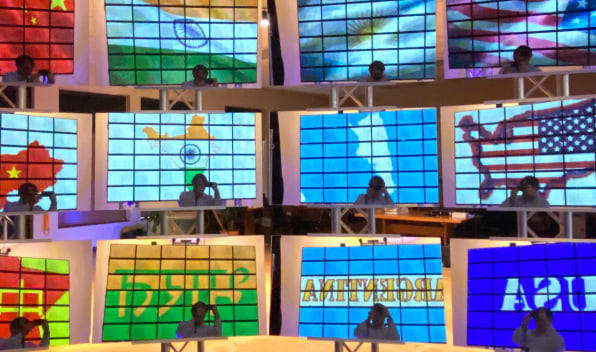
At one point, just to definitively prove that their screen can show multiple images at once, Ng and Thompson push a grid of mirrors up in front of it. Even though they’re all reflecting the same screen, each shows an animated sequence based on the flag or map of a different country.
[…]
The potential applications for the technology—from outdoor advertising to traffic signs to theme-park entertainment—are many. But if all goes according to plan, the first consumers who will see it in action will be travelers at the Detroit Metropolitan Airport. Starting in the middle of this year, Delta Air Lines plans to offer parallel-reality signage, located just past TSA, that can simultaneously show almost 100 customers unique information on their flights, once they’ve scanned their boarding passes. Available in English, Spanish, Japanese, Korean, and other languages, it will be a slicked-up, real-world deployment of the demo I got in Redmond.
[…]
At a January 2014 hackathon, a researcher named Paul Dietz came up with an idea to synchronize crowds in stadiums via a smartphone app that gave individual spectators cues to stand up, sit down, or hold up a card. The idea was to “use people as pixels,” he says, by turning the entire audience into a giant, human-powered animated display. It worked. “But the participants complained that they were so busy looking at their phones, they couldn’t enjoy the effect,” Dietz remembers.
That led him to wonder if there was a more elegant way to signal individuals in a crowd, such as beaming different colors to different people. As part of this investigation, he set up a pocket projector in an atrium and projected stripes of red and green. “The projector was very dim,” he says. “But when I looked into it from across the atrium, it was this beautiful, bright, saturated green light. Then I moved over a few inches into a red stripe, and then it looked like an intense red light.”
Based on this discovery, Dietz concluded that it might be possible to create displays that precisely aimed differing images at people depending on their position. Later in 2014, that epiphany gave birth to Misapplied Sciences, which he cofounded with Ng—who’d been his Microsoft intern while studying high-performance computing at Stanford—and Thompson, whom Dietz had met when both were creating theme-park experiences at Walt Disney Imagineering.
[…]
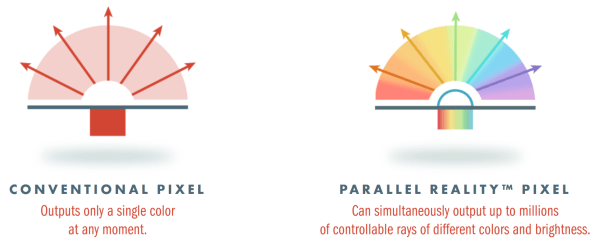
the basic principle—directing different colors in different directions—remains the same. With garden-variety screens, the whole idea is to create a consistent picture, and the wider the viewing angle, the better. By contrast, with Misapplied’s displays, “at one time, a single pixel can emit green light towards you,” says Ng. “Whereas simultaneously that same pixel can emit red light to the person next to you.”
The parallel-reality effect is all in the pixels. [Image: courtesy of Misapplied Sciences]
In one version of the tech, it can control the display in 18,000 directions; in another, meant for large-scale outdoor signage, it can control it in a million. The company has engineered display modules that can be arranged, Lego-like, in different configurations that allow for signage of varying sizes and shapes. A Windows PC performs the heavy computational lifting, and there’s software that lets a user assign different images to different viewing positions by pointing and clicking. As displays reach the market, Ng says that the price will “rival that of advanced LED video walls.” Not cheap, maybe, but also not impossibly stratospheric.
For all its science-fiction feel, parallel reality does have its gotchas, at least in its current incarnation. In the demos I saw, the pixels were blocky, with a noticeable amount of space around them—plus black bezels around the modules that make up a sign—giving the displays a look reminiscent of a sporting-arena electronic sign from a few generations back. They’re also capable of generating only 256 colors, so photos and videos aren’t exactly hyperrealistic. Perhaps the biggest wrinkle is that you need to stand at least 15 feet back for the parallel-reality effect to work. (Venture too close, and you see one mishmashed image.)
[…]
The other part of the equation is figuring out which traveler is standing where, so people see their own flight details. Delta is accomplishing that with a bit of AI software and some ceiling-mounted cameras. When you scan your boarding pass, you get associated with your flight info—not through facial recognition, but simply as a discrete blob in the cameras’ view. As you roam near the parallel-reality display, the software keeps tabs on your location, so that the signage can point your information at your precise spot.
Delta is taking pains to alleviate any privacy concerns relating to this system. “It’s all going to be housed on Delta systems and Delta software, and it’s always going to be opt-in,” says Robbie Schaefer, general manager of Delta’s airport customer experience. The software won’t store anything once a customer moves on, and the display won’t display any highly sensitive information. (It’s possible to steal a peek at other people’s displays, but only by invading their personal space—which is what I did to Ng, at his invitation, to see for myself.)
The other demos I witnessed at Misapplied’s office involved less tracking of individuals and handling of their personal data. In the retail-store scenario, for instance, all that mattered was which product I was standing in front of. And in the captioning one, the display only needed to know what language to display for each seat, which involved audience members using a smartphone app to scan a QR code on their seat and then select a language.
A pentad of bit boffins have devised a way to integrate electronic objects into augmented reality applications using their existing visible light sources, like power lights and signal strength indicators, to transmit data.
In a recent research paper, “LightAnchors: Appropriating Point Lights for Spatially-Anchored Augmented Reality Interfaces,” Carnegie Mellon computer scientists Karan Ahuja, Sujeath Pareddy, Robert Xiao, Mayank Goel, and Chris Harrison describe a technique for fetching data from device LEDs and then using those lights as anchor points for overlaid augmented reality graphics.
As depicted in a video published earlier this week on YouTube, LightAnchors allow an augmented reality scene, displayed on a mobile phone, to incorporate data derived from an LED embedded in the real-world object being shown on screen. You can see it here.
Unlike various visual tagging schemes that have been employed for this purpose, like using stickers or QR codes to hold information, LightAnchors rely on existing object features (device LEDs) and can be dynamic, reading live information from LED modulations.
The reason to do so is that device LEDs can serve not only as a point to affix AR interface elements, but also as an output port for the binary data being translated into human-readable form in the on-screen UI.
“Many devices such as routers, thermostats, security cameras already have LEDs that are addressable,” Karan Ahuja, a doctoral student at the Human-Computer Interaction Institute in the School of Computer Science at Carnegie Mellon University told The Register.
“For devices such as glue guns and power strips, their LED can be co-opted with a very cheap micro-controller (less than US$1) to blink it at high frame rates.”
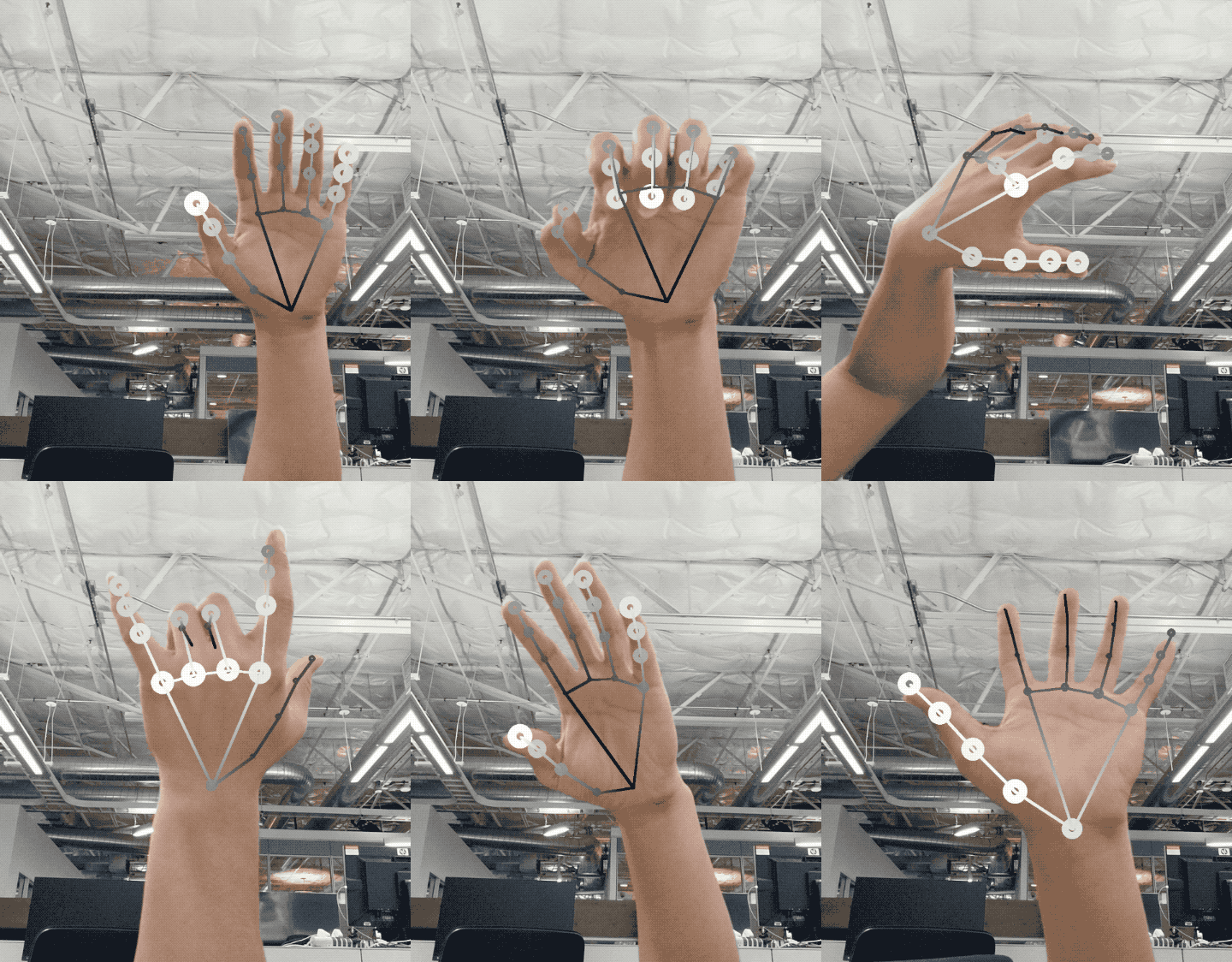
The ability to perceive the shape and motion of hands can be a vital component in improving the user experience across a variety of technological domains and platforms. For example, it can form the basis for sign language understanding and hand gesture control, and can also enable the overlay of digital content and information on top of the physical world in augmented reality. While coming naturally to people, robust real-time hand perception is a decidedly challenging computer vision task, as hands often occlude themselves or each other (e.g. finger/palm occlusions and hand shakes) and lack high contrast patterns. Today we are announcing the release of a new approach to hand perception, which we previewed CVPR 2019 in June, implemented in MediaPipe—an open source cross platform framework for building pipelines to process perceptual data of different modalities, such as video and audio. This approach provides high-fidelity hand and finger tracking by employing machine learning (ML) to infer 21 3D keypoints of a hand from just a single frame. Whereas current state-of-the-art approaches rely primarily on powerful desktop environments for inference, our method achieves real-time performance on a mobile phone, and even scales to multiple hands. We hope that providing this hand perception functionality to the wider research and development community will result in an emergence of creative use cases, stimulating new applications and new research avenues.
3D hand perception in real-time on a mobile phone via MediaPipe. Our solution uses machine learning to compute 21 3D keypoints of a hand from a video frame. Depth is indicated in grayscale.
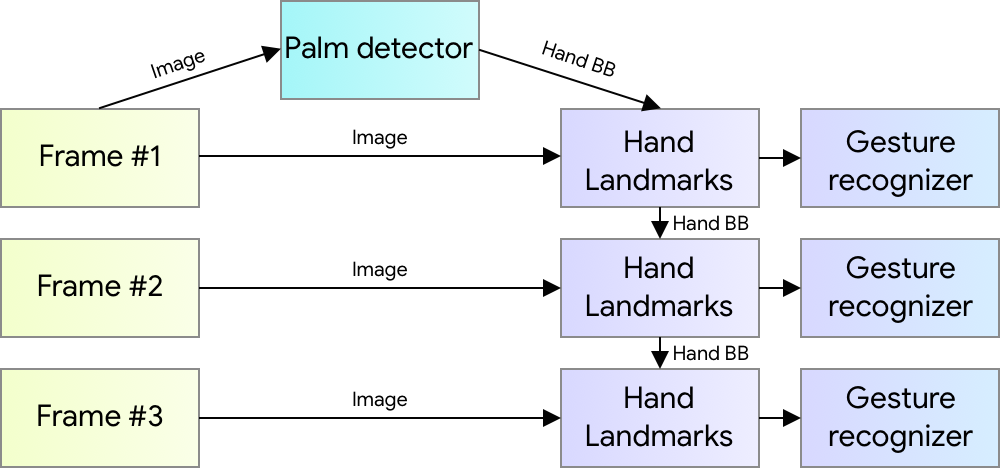
An ML Pipeline for Hand Tracking and Gesture Recognition Our hand tracking solution utilizes an ML pipeline consisting of several models working together:
A palm detector model (called BlazePalm) that operates on the full image and returns an oriented hand bounding box.
A hand landmark model that operates on the cropped image region defined by the palm detector and returns high fidelity 3D hand keypoints.
A gesture recognizer that classifies the previously computed keypoint configuration into a discrete set of gestures.
This architecture is similar to that employed by our recently published face meshML pipeline and that others have used for pose estimation. Providing the accurately cropped palm image to the hand landmark model drastically reduces the need for data augmentation (e.g. rotations, translation and scale) and instead allows the network to dedicate most of its capacity towards coordinate prediction accuracy.
Hand perception pipeline overview.
BlazePalm: Realtime Hand/Palm Detection To detect initial hand locations, we employ a single-shot detector model called BlazePalm, optimized for mobile real-time uses in a manner similar to BlazeFace, which is also available in MediaPipe. Detecting hands is a decidedly complex task: our model has to work across a variety of hand sizes with a large scale span (~20x) relative to the image frame and be able to detect occluded and self-occluded hands. Whereas faces have high contrast patterns, e.g., in the eye and mouth region, the lack of such features in hands makes it comparatively difficult to detect them reliably from their visual features alone. Instead, providing additional context, like arm, body, or person features, aids accurate hand localization. Our solution addresses the above challenges using different strategies. First, we train a palm detector instead of a hand detector, since estimating bounding boxes of rigid objects like palms and fists is significantly simpler than detecting hands with articulated fingers. In addition, as palms are smaller objects, the non-maximum suppression algorithm works well even for two-hand self-occlusion cases, like handshakes. Moreover, palms can be modelled using square bounding boxes (anchors in ML terminology) ignoring other aspect ratios, and therefore reducing the number of anchors by a factor of 3-5. Second, an encoder-decoder feature extractor is used for bigger scene context awareness even for small objects (similar to the RetinaNet approach). Lastly, we minimize the focal loss during training to support a large amount of anchors resulting from the high scale variance. With the above techniques, we achieve an average precision of 95.7% in palm detection. Using a regular cross entropy loss and no decoder gives a baseline of just 86.22%.
Researchers in Sussex have built a device that displays 3D animated objects that can talk and interact with onlookers.
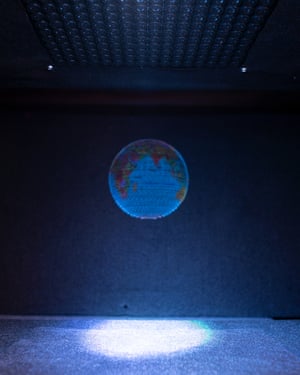
A demonstration of the display showed a butterfly flapping its wings, a countdown spelled out by numbers hanging in the air, and a rotating, multicoloured planet Earth. Beyond interactive digital signs and animations, scientists want to use it to visualise and even feel data.
[…]
it uses a 3D field of ultrasound waves to levitate a polystyrene bead and whip it around at high speed to trace shapes in the air.
The 2mm-wide bead moves so fast, at speeds approaching 20mph, that it traces out the shape of an object in less than one-tenth of a second. At such a speed, the brain doesn’t see the moving bead, only the completed shape it creates. The colours are added by LEDs built into the display that shine light on the bead as it zips around.
Because the images are created in 3D space, they can be viewed from any angle. And by careful control of the ultrasonic field, the scientists can make objects speak, or add sound effects and musical accompaniments to the animated images. Further manipulation of the sound field enables users to interact with the objects and even feel them in their hands.
[…]
The images are created between two horizontal plates that are studded with small ultrasonic transducers. These create an inaudible 3D sound field that contains a tiny pocket of low pressure air that traps the polystyrene bead. Move the pocket around, by tweaking the output of the transducers, and the bead moves with it.
The most basic version of the display creates 3D colour animations, but writing in the journal Nature, the scientists describe how they improved the display to produce sounds and tactile responses to people reaching out to the image.
Speech and other sounds, such as a musical accompaniment, were added by vibrating the polystyrene bead as it hares around. The vibrations can be tuned to produce soundwaves across the entire range of human hearing, creating, for example, crisp and clear speech. Another trick makes the display tactile by manipulating the ultrasonic field to create a virtual “button” in mid-air.
The prototype uses a single bead and can create images inside a 10cm-wide cube of air. But future displays could use more powerful transducers to make larger animations, and employ multiple beads at once. Subramanian said existing computer software can be used to ensure the tiny beads do not crash into one another, although choreographing the illumination of multiple beads mid-air is another problem.
[…]
“The interesting thing about the tactile content is that it’s created using ultrasound waves. Unlike the simple vibrations most people are familiar with through smartphones or games consoles, the ultrasound waves move through the air to create precise patterns against your hands. This allows multimedia experiences where the objects you feel are just as rich and dynamic as the objects you see in the display.”
Julie Williamson, also at Glasgow, said levitating displays are a first step towards truly interactive 3D displays. “I imagine a future where 3D displays can create experiences that are indistinguishable from the physical objects they are simulating,” she said.
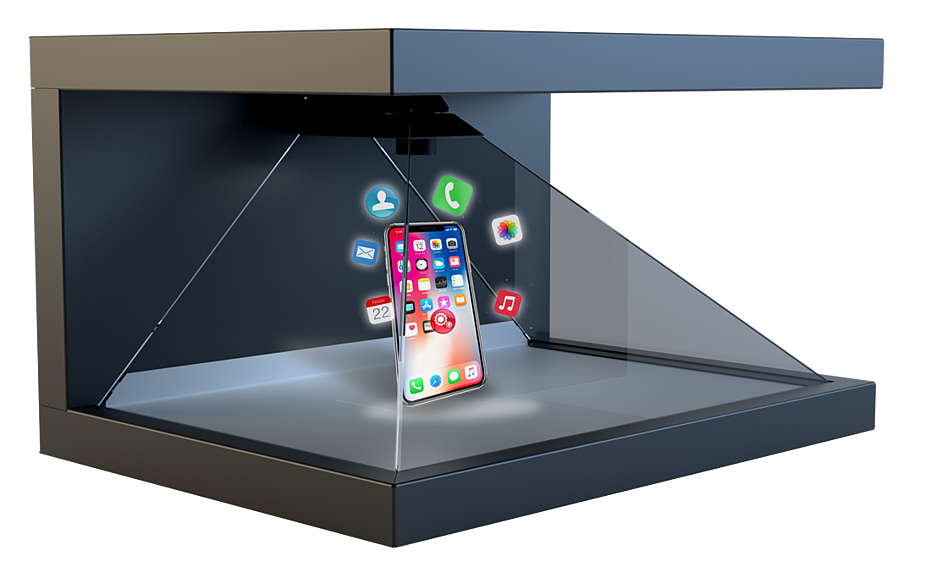
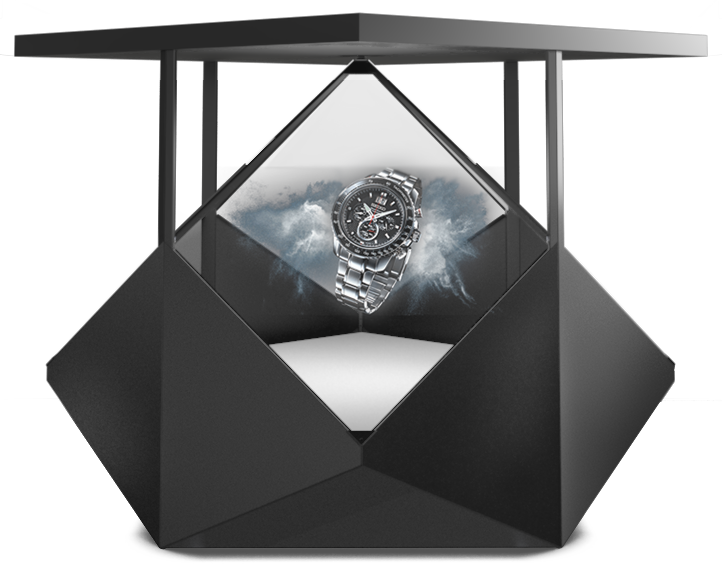
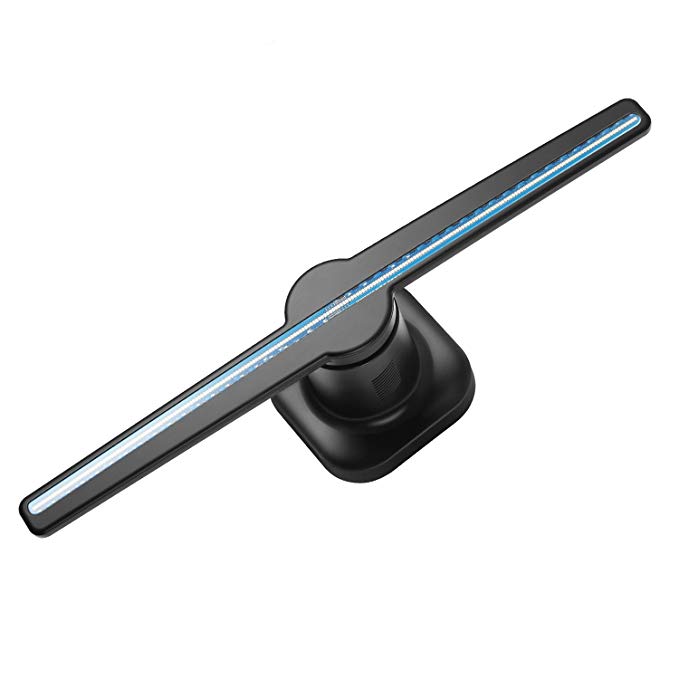
TOP-NOTCH 3D EFFECT – The image has no borders and backgrounds,makes you feel it completely appears in the air and creates best attraction for your products or events.Widely used in department store,shopping mall,casino,bars,railway station signage display
🔥EYE-CATCHING BLACK TECH PRODUCT – Stand out from your competitors.Holo One is far beyond being “just a cool thing”. It is a comprehensive solution that can be seamlessly integrated into your business delivering you a complete media planning system and helping you outshine industry competition.
🔥MAIN PARAMETERS – 224pcs led lights,8G Kingston SD Card( be careful when inserting the card slot) , display support format: MP4, AVI, RMVB, MKV, GIF, JPG, PNG with a black background.Software compatible with Windows XP / Windows 7 / Windows 8 / Windows 10(NOT SUPPORT MAC BOOK).Resolution is 450*224 px
The smallest pixels yet created—a million times smaller than those in smartphones, made by trapping particles of light under tiny rocks of gold—could be used for new types of large-scale flexible displays, big enough to cover entire buildings.
The colour pixels, developed by a team of scientists led by the University of Cambridge, are compatible with roll-to-roll fabrication on flexible plastic films, dramatically reducing their production cost. The results are reported in the journal Science Advances.
It has been a long-held dream to mimic the colour-changing skin of octopus or squid, allowing people or objects to disappear into the natural background, but making large-area flexible display screens is still prohibitively expensive because they are constructed from highly precise multiple layers.
At the centre of the pixels developed by the Cambridge scientists is a tiny particle of gold a few billionths of a metre across. The grain sits on top of a reflective surface, trapping light in the gap in between. Surrounding each grain is a thin sticky coating which changes chemically when electrically switched, causing the pixel to change colour across the spectrum.
The team of scientists, from different disciplines including physics, chemistry and manufacturing, made the pixels by coating vats of golden grains with an active polymer called polyaniline and then spraying them onto flexible mirror-coated plastic, to dramatically drive down production cost.
The pixels are the smallest yet created, a million times smaller than typical smartphone pixels. They can be seen in bright sunlight and because they do not need constant power to keep their set colour, have an energy performance that make large areas feasible and sustainable. “We started by washing them over aluminized food packets, but then found aerosol spraying is faster,” said co-lead author Hyeon-Ho Jeong from Cambridge’s Cavendish Laboratory.
“These are not the normal tools of nanotechnology, but this sort of radical approach is needed to make sustainable technologies feasible,” said Professor Jeremy J Baumberg of the NanoPhotonics Centre at Cambridge’s Cavendish Laboratory, who led the research. “The strange physics of light on the nanoscale allows it to be switched, even if less than a tenth of the film is coated with our active pixels. That’s because the apparent size of each pixel for light is many times larger than their physical area when using these resonant gold architectures.”
The pixels could enable a host of new application possibilities such as building-sized display screens, architecture which can switch off solar heat load, active camouflage clothing and coatings, as well as tiny indicators for coming internet-of-things devices.
The team are currently working at improving the colour range and are looking for partners to develop the technology further.
An international collaboration between several universities around the world has led to an innovation in LEDs that could potentially result in a giant leap forward when it comes to increasing the resolution on TV screens and mobile devices. For the first time ever, a single LED can now change color all by itself.
The current design and chemical makeup of LEDs limit the technology to producing light in just a single color. “But Andrew, what about my color-changing LED smart bulbs,” you’re probably asking. Those actually rely on a cluster of LEDs inside that each produce either red, green, or blue light. When their individual intensities are adjusted, the colors that each light produces mix to produce an overall shade of light. LED-backlit LCD TVs work in a similar fashion, but to produce one-colored pixel, three filtered LEDs are required. Even the next big breakthrough in flatscreen TV technology, MicroLEDs, require a trio of ultra-tiny light-producing diodes to create a single pixel, which limits how many can be squeezed into a given area, and resolution.
In a paper recently published to the ACS Photonics Journal, researchers from Lehigh University and West Chester University in Pennsylvania, Osaka University in Japan, and the University of Amsterdam, detail a new approach to making LEDs that uses a rare earth ion called Europium that when paired with Gallium Nitride (an alternative to silicon that’s now showing up in electronics other than LEDs, like Anker’s impossibly tiny PowerPort Atom PD 1 laptop charger) allows the LED’s color to be adjusted on the fly. The secret sauce is how power is used to excite the Europium and Gallium Nitride-different ratios and intensities of current can be selectively applied to produce the emission of three primary colors: red, blue, and green.
Using this approach, LED lightbulbs with specific color temperatures could be produced and sold at much cheaper price points since the colors from multiple tint-specific LEDs don’t have to be mixed. The technology could yield similar benefits for TVs and the screens that end up in mobile devices. Instead of three LEDs (red, green, and blue) needed to generate every pixel, a single Europium-based LED could do the job. Even more exciting than cheaper price tags is the fact that replacing three LEDs with just one could result in a display with three times the resolution. Your eyes probably wouldn’t be able to discern that many pixels on a smartphone screen, but in smaller displays, like those used in the viewfinders of digital cameras, a significant step in resolution would be a noticeable improvement.
There is no camera to creep people out, no button to push, no gesture area to swipe, no glowing LCD screen, no weird arm floating in front of the lens, no speaker, and no microphone (for now).
From the outside, the Vaunt glasses look just like eyeglasses. When you’re wearing them, you see a stream of information on what looks like a screen — but it’s actually being projected onto your retina.
The prototypes I wore in December also felt virtually indistinguishable from regular glasses. They come in several styles, work with prescriptions, and can be worn comfortably all day. Apart from a tiny red glimmer that’s occasionally visible on the right lens, people around you might not even know you’re wearing smart glasses.
Like Google Glass did five years ago, Vaunt will launch an “early access program” for developers later this year. But Intel’s goals are different than Google’s. Instead of trying to convince us we could change our lives for a head-worn display, Intel is trying to change the head-worn display to fit our lives.
Researchers at Brigham Young University in Utah made something they’re calling an Optical Trap Display (OTD). The device traps a tiny opaque particle in mid-air using an invisible laser beam, then moves the beam around a preset path in free space. At the same time, it illuminates the particle with red, green, or blue lights. When the particle moves fast enough, it creates a solid holographic image in the air. Move it even faster, and you can create the illusion of movement.
[…]
“We can think about this image like a 3D-printed object,” lead author Daniel Smalley, an assistant professor in electroholography at Brigham Young University, explained in a Nature video. “A single point was dragged sequentially through all these image points, and as it did, it scattered light. And the accumulated effect of all that scattering and moving was to create this 3D image in space that is visible from all angles.”
Scientifically, what Smalley and his team are creating are known as volumetric images, which differentiates them from 2D-hologram technologies. Other companies and scientists have made devices that create volumetric images, but the researchers say theirs is the first to generate free-floating images that can occupy the same space as other objects, as opposed to volumetric images that need to be contained inside a specially designed field. Other devices often require a much more elaborate set-up as well, while the OTD is relatively cheap, made with commercially available parts and low-cost lasers.
[…]
That said, the device does have its limitations. Namely, that the images produced right now are quite tiny: smaller than a fingernail. Making the images bigger will require the researchers learn how to manipulate more than one particle at a time. And it’s unlikely the device will be usable outdoors for the foreseeable future, since fast moving air particles can muck up the process. Video cameras also have a problem capturing the images the way our eyes or still cameras do—a video’s frame rate makes the image look like it’s flickering, while our eyes only see a solid image.