The Linkielist

Linking ideas with the world

The Linkielist

Google to adapt its ad technology after France hands it a $267 million fine

Google has agreed to pay a €220 million ($267 million) fine and change its ad practices after France’s competition authority found it had abused its dominant online ad position. Following a 2019 complaint by News Corp. and French newspaper Le Figaro, France ruled that Google was favoring its own advertising services to the detriment of rivals.

[…]

In a blog post, Google explained how it planned to change its ad rules by offering publishers “increased flexibility” by improving interoperability between its ad manager and third-party ad servers. “Also, we are reaffirming that we will not limit Ad Manager publishers from negotiating specific terms or pricing directly with other sell-side platforms.”

Google’s ad division has faced scrutiny from French regulators in the past. In 2019, the watchdog fined Google €150 million ($167 million) for opaque and unpredictable advertising rules after it suspended the Google Ads account of a French company without notice. Google has also clashed with regulators and publishers in the nation over the use of snippets of content in its news section.

Source: Google to adapt its ad technology after France hands it a $267 million fine | Engadget

Apple’s tightly controlled App Store is teeming with scams

Apple chief executive Tim Cook has long argued it needs to control app distribution on iPhones, otherwise the App Store would turn into “a flea market.”

But among the 1.8 million apps on the App Store, scams are hiding in plain sight. Customers for several VPN apps, which allegedly protect users’ data, complained in Apple App Store reviews that the apps told users their devices have been infected by a virus to dupe them into downloading and paying for software they don’t need. A QR code reader app that remains on the store tricks customers into paying $4.99 a week for a service that is now included in the camera app of the iPhone. Some apps fraudulently present themselves as being from major brands such as Amazon and Samsung.

Of the highest 1,000 grossing apps on the App Store, nearly two percent are scams, according to an analysis by The Washington Post. And those apps have bilked consumers out of an estimated $48 million during the time they’ve been on the App Store, according to market research firm Appfigures. The scale of the problem has never before been reported. What’s more, Apple profits from these apps because it takes a cut of up to a 30 percent of all revenue generated through the App Store. Even more common, according to The Post’s analysis, are “fleeceware” apps that use inauthentic customer reviews to move up in the App Store rankings and give apps a sense of legitimacy to convince customers to pay higher prices for a service usually offered elsewhere with higher legitimate customer reviews.

Two-thirds of the 18 apps The Post flagged to Apple were removed from the App Store.

[…]

Apple has long maintained that its exclusive control of the App Store is essential to protecting customers, and it only lets the best apps on its system. But Apple’s monopoly over how consumers access apps on iPhones can actually create an environment that gives customers a false sense of safety, according to experts. Because Apple doesn’t face any major competition and so many consumers are locked into using the App Store on iPhones, there’s little incentive for Apple to spend money on improving it, experts say.

[…]

Apple unwittingly may be aiding the most sophisticated scammers by eliminating so many of the less competent ones during its app review process, said Miles, who co-authored a paper called “The Economics of Scams.”

[…]

Apple has argued that it is the only company with the resources and know-how to police the App Store. In the trial that Epic Games, the maker of the popular video game “Fortnite,” brought against Apple last month for alleged abuse of its monopoly power, Apple’s central defense was that competition would loosen protections against unwanted apps that pose security risks to customers. The federal judge in the case said she may issue a verdict by August.

The prevalence of scams on Apple’s App Store played a key role at trial. Apple’s lawyers were so focused on the company’s role in making the App Store safe that Epic’s attorneys accused them of trying to scare the court into a ruling in favor of Apple. In other internal emails unearthed during trial that date as far back as 2013, Apple’s Phil Schiller, who runs the App Store, expressed dismay when fraudulent apps made it past App Store review.

After a rip-off version of the Temple Run video game became the top-rated app, according to Schiller’s email exchange, he sent an irate message to two other Apple executives responsible for the store. “Remember our talking about finding bad apps with low ratings? Remember our talk about becoming the ‘Nordstroms’ of stores in quality of service? How does an obvious rip off of the super popular Temple Run, with no screenshots, garbage marketing text, and almost all 1-star ratings become the #1 free app on the store?” Schiller asked his team. “Is no one reviewing these apps? Is no one minding the store?” Apple declined to make Schiller available to comment. At trial, Schiller defended the safety of the app store on the stand. The app review process is “the best way we could come up with … to make it safe and fair.”

Eric Friedman, head of Apple’s Fraud Engineering Algorithms and Risk unit, or FEAR, said that Apple’s screening process is “more like the pretty lady who greets you with a lei at the Hawaiian airport than the drug sniffing dog,” according to a 2016 internal email uncovered during the Epic Games trial. Apple employs a 500-person App Review team, which sifts through submissions from developers. “App Review is bringing a plastic butter knife to a gun fight,” Friedman wrote in another email.

[…]

Though the App Store ratings section is filled with customer complaints referring to apps as scams, there is no way for Apple customers to report this to Apple, other than reaching out to a regular Apple customer service representative. Apple used to have a button, just under the ratings and reviews section in the App Store, that said “report a problem,” which allowed users to report inappropriate apps. Based on discussions among Apple customers on Apple’s own website, the feature was removed some time around 2016.

[…]


Source: Apple’s tightly controlled App Store is teeming with scams – Anchorage Daily News

Apple settles with student after authorized repair workers leaked her naked pics to her Facebook page. Apple blocks Right to repair for danger by unauthorised parties. Hmm.

Apple has paid a multimillion-dollar settlement to an unnamed Oregon college student after one of its outsourced repair facilities posted explicit pictures and videos of her to her Facebook page.

According to legal documents obtained by The Telegraph, the incident occurred in 2016 at a Pegatron-owned repair centre in Sacramento, California. The student had mailed in her device to have an unspecified fault fixed.

While it was at the facility, two technicians published a series of photographs showing the complainant unclothed to her Facebook account, as well as a “sex video.” The complaint said the post was made in a way that impersonated the victim, and was only removed after friends informed her of its existence.

The two men responsible were fired after an investigation. It is not known if the culprits faced criminal charges.

Much of the details of the case, as well as the exact size of the settlement, were sealed. Lawyers for the plaintiff sought a $5m payout. The settlement included non-disclosure provisions that prevented the student from revealing details about the case, or the exact size of the compensation.

Counsel for the victim threatened to sue for infliction of emotional distress, as well as invasion of privacy. The filings show they warned Apple that any lawsuit would result in inevitable negative publicity for the company.

Pegatron settled with the victim separately, per the filings.

In its fight against the right to repair, Apple has argued that allowing independent third-party businesses to service its computers and smartphones would present an unacceptable risk to user privacy and security.

This incident, which occurred at the facilities of an authorised contractor, has undercut that argument somewhat.

It follows a similar incident in November 2019, where a Genius Bar employee texted himself an explicit image taken from an iPhone he was repairing. After the victim complained, the employee was fired.

[…]

Source: Apple settles with student after authorized repair workers leaked her naked pics to her Facebook page • The Register

Bing Censors Image Search for ‘Tank Man’ Even in US

Bing, the search engine owned by Microsoft, is not displaying image results for a search for “Tank man,” even when searching from the United States. The apparent censorship comes on the anniversary of China’s violent crackdown on protests in Tiananmen Square in 1989.

“There are no results for tank man,” the Bing website reads after searching for the term. “Tank man” relates to the infamous image of a single protester standing in front of a line of Chinese tanks during the crackdown.

China censors and blocks distribution of discussion of tank man and Tiananmen Square more generally. This year, anniversary events in Hong Kong have dwindled in size after authorities banned a vigil.

tankman.png

Image: A screenshot of the search results.

Bing displays ordinary, non-image search results for tank man when searching from a U.S. IP address; the issue only impacts the images and videos tabs. Google, for its part, displays both when connecting from the same IP address.

[…]

Source: Bing Censors Image Search for ‘Tank Man’ Even in US

Google, Facebook, Chaos Computer Club join forces to oppose German state spyware

Plans by the German government to allow the police to deploy malware on any target’s devices, and force the tech world to help them, has run into some opposition, funnily enough.

In an open letter this month, the Chaos Computer Club – along with Google, Facebook, and others – said they are against proposals to dramatically expand the use of so-called state trojans, aka government-made spyware, in Germany. Under planned legislation, even people not suspected of committing a crime can be infected, and service providers will be forced to help. Plus all German spy agencies will be allowed to infiltrate people’s electronics and communications.

The proposals bypass the whole issue of backdooring or weakening encryption that American politicians seem fixated on. Once you have root access on a person’s computer or handheld, the the device can be an open book, encryption or not.

“The proposals are so absurd that all of the experts invited to the committee hearing in the Bundestag sharply criticized the ideas,” the CCC said.

“Even Facebook and Google – so far not positively recognized as pioneers of privacy – speak out vehemently against the project. Protect security and trust online – against an unlimited expansion of surveillance and for the protection of encryption.”

Source: Google, Facebook, Chaos Computer Club join forces to oppose German state spyware • The Register

The Navy’s Tanker Drone Makes History By Refueling A Manned Aircraft For The First Time (Updated)

Boeing’s MQ-25 Stingray test asset, known as T1, has conducted the first successful aerial refueling of a manned receiver aircraft by an unmanned tanker. The landmark is a vital one as the U.S. Navy looks forward to adding the MQ-25 to its carrier air wings, or CVWs, in the future.

The Navy’s Naval Air Systems Command (NAVAIR) and Boeing announced today that the T1 test article had demonstrated its tanker capability with an F/A-18F Super Hornet jet fighter on June 4, 2021. The drone had flown from MidAmerica Airport in Mascoutah, Illinois. The MQ-25 demonstrator aircraft passed fuel to the Super Hornet using an Aerial Refueling Store (ARS) mounted under its wing.

Boeing

The MQ-25 T1 refuels an F/A-18F during the drone’s June 4 flight out of MidAmerica Airport, Illinois.

As well as the fighter actually ‘plugging in’ to the drone to receive fuel, the same test mission involved evaluation of formation flying between the manned and unmanned assets, with as little as 20 feet separation between the two. Other test points included tracking the drogue — the basket-like assembly trailed by the MQ-25 that connects with a receiver aircraft’s standard refueling probe. Both aircraft were flying at operationally relevant speeds and altitudes, according to Boeing.

“This flight lays the foundation for integration into the carrier environment, allowing for greater capability toward manned-unmanned teaming concepts,” said Navy Rear Admiral Brian Corey, head of the Program Executive Office for Unmanned Aviation and Strike Weapons. “MQ-25 will greatly increase the range and endurance of the future carrier air wing — equipping our aircraft carriers with additional assets well into the future.”

[…]

In 2015, Northrop Grumman and the Navy successfully demonstrated fully autonomous aerial refueling using the X-47B Unmanned Combat Air System Demonstration (UCAS-D) drone, which refueled in flight from a contractor-operated Boeing 707 tanker. That was the first time an unmanned aircraft had been refueled in-flight.

U.S. Navy

An X-47B completes the first autonomous aerial refueling demonstration over Chesapeake Bay on April 22, 2015.

Prior to that, in 2012, DARPA’s Autonomous High-Altitude Refueling program demonstrated fully autonomous aerial refueling of unmanned air vehicles at high altitude. This culminated with two modified RQ-4 Global Hawkdrones flying in close formation to test probe-and-drogue contacts, as seen in this video:

The first refueling sortie for the MQ-25 demonstrator was the 26th for the T1 test vehicle but there has also been extensive simulations of aerial refueling using MQ-25 digital models.

[…]

Source: The Navy’s Tanker Drone Makes History By Refueling A Manned Aircraft For The First Time (Updated)

Mapped: A Detailed Map of the Online World in Incredible Detail

View the giant full-size (20 MB) version of this map.

Map of the internet's most popular websites

A Map of the Online World in Incredible Detail

The internet is intangible, and because you can’t see it, it can be hard to comprehend its sheer vastness. As well, it’s difficult to gauge the relative size of different web properties. However, this map of the internet by Halcyon Maps offers a unique solution to these problems.

Inspired by the look and design of historical maps, this graphic provides a snapshot of the current state of the World Wide Web, as of April 2021. Let’s take a closer look!

But First, Methodology

Before diving into an analysis, it’s worth touching on the methodology behind this graphic’s design.

This map highlights thousands of the world’s most popular websites by visualizing them as “countries.” These “countries” are organized into clusters that are grouped by their content type (whether it’s a news website, search engine, e-commerce platform, etc).

Visual Capitalist on the mapEditor’s fun fact: Can you spot Visual Capitalist? We’re right in between TechCrunch and The Guardian above.


The colored borders represent a website’s logo or user interface. In terms of scale, each website’s territory size is based on its average Alexa web traffic ranking. The data is a yearly average, measured from January 2020 to January 2021.

Along the borders of the map, you can find additional information, from ranked lists of social media consumption to a mini-map of average download speeds across the globe.

According to the designer Martin Vargic, this map took about a year to complete.

[…]

Source: Mapped: A Detailed Map of the Online World in Incredible Detail

Posted in Art

Researchers Trained People to Echolocate in Just 10 Weeks

Scientists in the UK say the same sort of echolocation practiced by bats may also help people living with blindness better navigate the world. In a new study, they found that blind and sighted participants who took part in a 10-week training program were able to learn how to perform echolocation, and the blind participants largely reported that it seemed to improve their mobility and ability to live independently afterward.

[…]

In this new research, published in PLOS One, Thaler and her team wanted to test if inexperienced people, both with and without sight, could be taught how to echolocate in a relatively short period of time and if this skill would then actually help people with blindness.

They recruited 14 sighted people and 12 people who became blind early in life for the experiment, which involved 20 training sessions conducted over 10 weeks. The volunteers were between the ages of 21 and 79, and none had regularly used echolocation in their lives beforehand (two of the blind individuals did have some experience, but everyone else had none). To validate their tests and set a benchmark, they also enlisted the help of seven people who had been practicing echolocation for at least a decade.

Overall, the team found that all of the individuals noticeably improved their performance on tests of echolocation over the 10-week period. These tests would involve situations like being able to recognize the relative location and size of nearby objects or being able to navigate through a natural environment outside of the lab without sight. These improvements didn’t seem to be influenced by the age or degree of blindness among participants. A few people even performed as well as expert echolocators on certain tasks, while some sighted people did better than some blind people.

Blind volunteers were also surveyed three months later about how the training may have affected their lives. They all reported experiencing improvements in their mobility as a result of the training, while 83% also reported feeling more independent. The findings, according to Thaler, suggest that this training can be easily adopted by many people—and that it can help blind people with everyday activities.

[…]

Source: Researchers Trained People to Echolocate in Just 10 Weeks

Simple Slide Coating Gives a Boost to the Resolution of a Microscope

A light-powered microscope has a resolution limit of around 200 nanometers—which makes observing specimens smaller or closer together than that all but impossible. Engineers at the University of California San Diego have found a clever way to improve the resolution of a conventional microscope, but surprisingly it involves no upgrades to the lenses or optics inside it.

According to the Rayleigh Criterion theory, proposed by John William Strutt, 3rd Baron Rayleigh, back in 1896, a traditional light-based microscope’s resolution is limited by not only the optics capabilities of glass lenses but the nature of light itself, as a result of diffraction that occurs when light rays are bent. The limitation means that an observer looking through the microscope at two objects that are closer than 200 nanometers apart will perceive them as a single object.

Electron microscopes, by comparison, blast a sample with a highly focused beam of electrons instead of visible light, and can instead achieve resolutions of less than a single nanometer. There’s a trade-off, however, as samples being observed through an electron microscope need to be placed inside a vacuum chamber which has the unfortunate downside of killing living things, so observing cells and other living phenomena in action isn’t possible. To date, there hasn’t been an in-between option, but it sounds like that’s exactly what these engineers have created.

“Artistic rendering of the new super resolution microscopy technology. Animal cells (red) are mounted on a slide coated with the multilayer hyperbolic metamaterial. Nanoscale structured light (blue) is generated by the metamaterial and then illuminates the animal cells.”
Artistic rendering of the new super resolution microscopy technology. Animal cells (red) are mounted on a slide coated with the multilayer hyperbolic metamaterial. Nanoscale structured light (blue) is generated by the metamaterial and then illuminates the animal cells.”
Illustration: Yeon Ui Lee – University of California San Diego

To create what’s known as a “super-resolution microscope” the engineers didn’t actually upgrade the microscope at all. Instead, they developed a hyperbolic metamaterial—materials with unique structures that manipulate light, originally developed to improve optical imaging—that’s applied to a microscope slide, onto which the sample is placed. This particular hyperbolic metamaterial is made from “nanometers-thin alternating layers of silver and silica glass” which have the effect of shortening and scattering the wavelengths of visible light that pass through it, resulting in a series of random speckled patterns.

Those speckled light patterns end up illuminating the sample sitting on the microscope slide from different angles, allowing a series of low-resolution images to be captured, each highlighting a different part. Those images are then fed into a reconstruction algorithm which intelligently combines them and spits out a high-resolution image.

Comparison of images taken by a light microscope without the hyperbolic metamaterial (left) and with the hyperbolic metamaterial (right): quantum dots.
Image: University of California San Diego

It’s not unlike the sensor-shift approach used in some digital cameras to produce super-resolution photos where the image sensor is moved ever so slightly in various directions while multiple images are captured and then combined to merge all of the extra details captured. This technology—detailed in a paper recently published in the Nature Communications journal—can boost a conventional light microscope’s resolution to 40 nanometers, while still allowing living organisms to be observed. It still can’t compete with what electron microscopes are capable of, but it’s no less remarkable given how easily it can improve the capabilities of more affordable and safer hardware already in use in labs all around the world.

Source: Simple Slide Coating Gives a Boost to the Resolution of a Microscope

A.I. used at sea for first time off coast of Scotland to engage threats to ships

For the first time, Artificial Intelligence (A.I.) is being used by the Royal Navy at sea as part of Exercise Formidable Shield, which is currently taking place off the coast of Scotland.

This Operational Experiment (OpEx) on the Type 45 Destroyer (HMS Dragon) and Type 23 Frigate (HMS Lancaster), is using the A.I. applications, Startle and Sycoiea, which were tested against a supersonic missile threat.

As part of the Above Water Systems programme, led by Defence Science and Technology Laboratory (Dstl) scientists, the A.I. improves the early detection of lethal threat, accelerates engagement timelines and provides Royal Navy Commanders with a rapid hazard assessment to select the optimum weapon or measure to counter and destroy the target.

[…]

As outlined in the recent Defence Command Paper, the MOD is committed to investing in A.I. and increased automation to transform capabilities as the Armed Forces adapt to meet future threats, which will be supported by the £24bn uplift in defence spending over the next four years.

HMS Lancaster and HMS Dragon are currently trialling the use of A.I. as part of a glimpse into the future of air defence at sea.

HMS Lancaster’s Weapon Engineer Officer, Lieutenant Commander Adam Leveridge said:

Observing Startle and Sycoiea augment the human warfighter in real time against a live supersonic missile threat was truly impressive – a glimpse into our highly-autonomous future.

[…]

Source: A.I. used at sea for first time off coast of Scotland – GOV.UK

This Is What Pilots Actually See Inside Red 6’s Augmented Reality Dogfighting Goggles

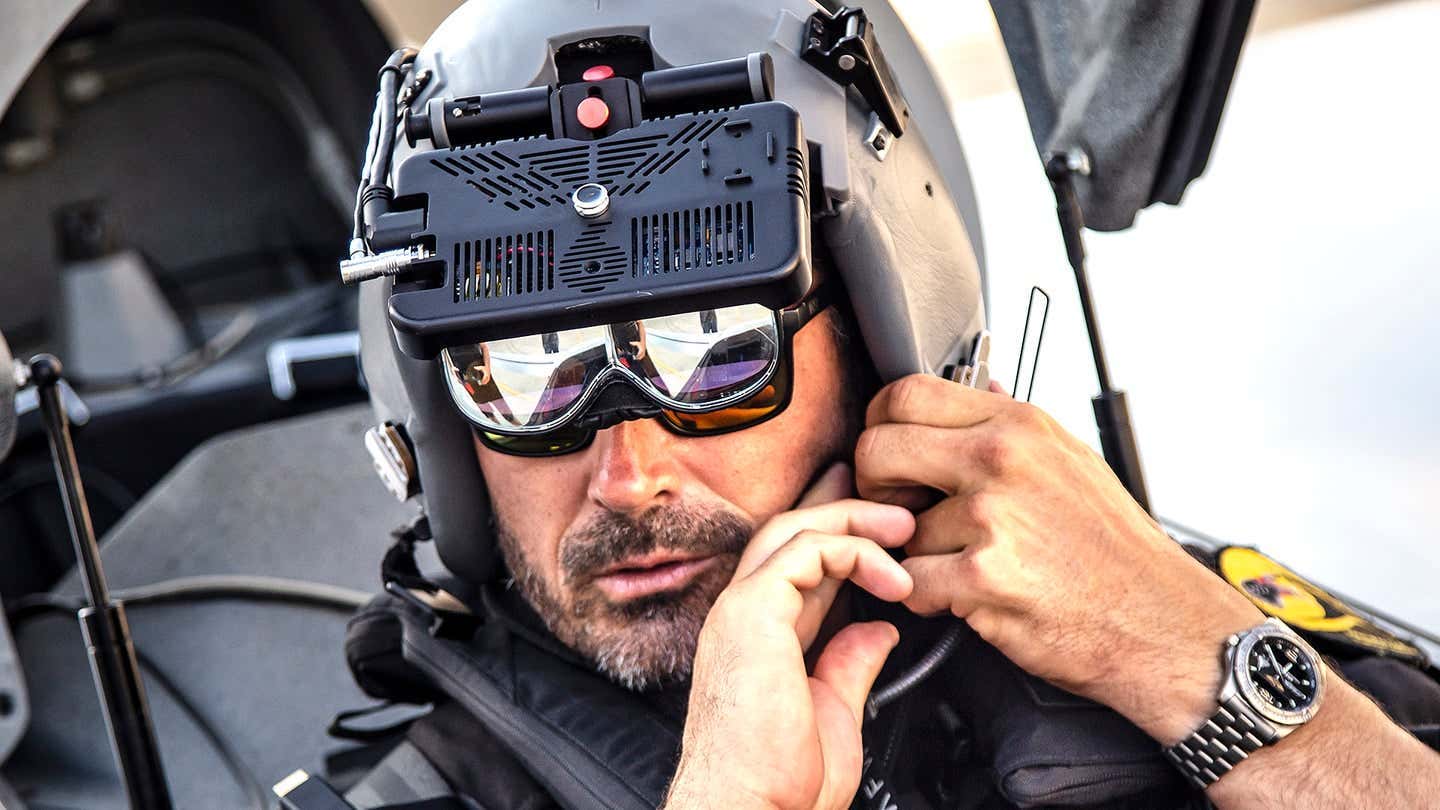
Augmented reality systems are on the verge of making a huge impact on how America’s military fights and trains. When it comes to the latter, one company, aptly named Red 6, has identified an inflection point where cost and existing capabilities become problematic for America’s tactical aircraft communities—training for air-to-air combat. While contractor aggressor services have ballooned in recent years to bring down the cost of providing bad guys for frontline fighter pilots to train against, while also upping the potential density and complexity of the threats that can be portrayed, Red 6 thinks it can do much of this without any other jets, pilots, and millions in yearly fuel costs all. This can be accomplished by moving the adversary aircraft into the synthetic realm via augmented reality goggles. Now we finally get to see exactly what the pilots do when donning Red 6’s increasingly capable helmet-mounted hardware.

You can read all about Red 6, where the company has been, and where it plans to go, in this in-depth feature interview with its founder and former F-22 Raptor pilot, Daniel Robinson. In it, he talks about how Red 6 started out by creating a huge geometric open-sided cube in the sky to test the original idea and has progressed with better hardware and software ever since. The tech has developed to the point where pilots are actually dogfighting synthetic AI-enabled fighters in augmented reality using Red 6’s gear. And, of course, without any actual flying hardware constraints, any aircraft with any performance capabilities can be accurately represented. So what does this look like from the pilot’s perspective? We can finally share the answer to that question below:

Red 6’s system is called the Airborne Tactical Augmented Reality System (ATARS). The company officially describes ATARS as “the first wide field-of-view, full color, demonstrably proven outdoor Augmented Reality solution that works in dynamic outdoor environments. ATARS allows Virtual and Constructive assets into the real world by allowing pilots and ground operators to see synthetic threats in real-time, outdoors. and critically, in high-speed environments. By blending Augmented Reality and artificial intelligence and using both the indoor and outdoor space around us as a medium, Red 6 has redefined the limits of how the world will experience, share, and interact with its information.”

Red 6

CEO Daniel Robinson donning an ATARS for a test flight.

Red 6, which just closed a $30M Series A financing round, with the vast majority of those funds coming from Snowpoint Ventures, is on the attack and plans on spreading its innovations into other combat domains in the future, just as we discussed in our big interview piece. Still, the potential for this system to revolutionize one of the most costly aspects of preparing for modern warfare—air-to-air combat training—is becoming very real. The savings from introducing this system, even to a limited degree, for some recurrent air-to-air training would be massive in terms of all the costs involved, including the wear-and-tear these training flights impose on the adversary aircraft, which is usually a similar fighter from the unit’s own squadron.

The company scored another big win last March when Dr. William Roper, who left his previous job as Assistant Secretary of the Air Force for Acquisition, Technology, and Logistics earlier this year, and is considered a highly influential visionary by some, joined Red 6’s advisory board. This vote of confidence from one of the Pentagon’s leading minds on airpower definitely helped the company’s position as a potential major market disruptor.

As for what comes next, Red 6 is about to enter into phase three of their Small Business Innovation Research (SBIR) initiative with AFWERX, which will see ATARS deployed aboard T-38 Talon trainers of the 586th Flight Test Squadron at Holloman Air Force Base in New Mexico. There, Air Force pilots will put ATARS through its paces. The next step will be integrating it into an F-16 Viper fighter jet, which will bring another level of challenging performance to the concept.

USAF

586th Flight Test Squadron T-38 over White Sands Missile Range.

At the very least, we can hope that allied air forces will have another tool to better and more efficiently train their pilots where applicable in the not so distant future, and in essence, augmenting the reality of their training capabilities.

Source: This Is What Pilots Actually See Inside Red 6’s Augmented Reality Dogfighting Goggles

Return to Office: Employees Are Quitting Instead of Giving Up Work From Home

[…]

A May survey of 1,000 U.S. adults showed that 39% would consider quitting if their employers weren’t flexible about remote work. The generational difference is clear: Among millennials and Gen Z, that figure was 49%, according to the poll by Morning Consult on behalf of Bloomberg News.

“High-five to them,” said Sara Sutton, the CEO of FlexJobs, a job-service platform focused on flexible employment. “Remote work and hybrid are here to stay.”

The lack of commutes and cost savings are the top benefits of remote work, according to a FlexJobs survey of 2,100 people released in April. More than a third of the respondents said they save at least $5,000 per year by working remotely.

Perks of Flexibility

Not having to commute is the top benefit for remote workers.

Source: FlexJobs

Survey of 2,181 total respondents ran from March 17, 2021 through April 5, 2021.


[…]

At least some atop the corporate ladder seem to be paying attention. In a Jan. 12 PwC survey of 133 executives, fewer than one in five said they want to go back to pre-pandemic routines. But only 13% were prepared to let go of the office for good.

Senior Management’s View

Days in the office that executives think is needed to maintain company culture.

Source: PwC

PwC surveyed 133 US executives between Nov. 24 and Dec, 5, 2020,from public and private companies in financial services, technology, media and telecommunications and retail products.

[…]


Source: Return to Office: Employees Are Quitting Instead of Giving Up Work From Home – Bloomberg

Space Debris Has Hit And Damaged The International Space Station

The inevitable has occurred. A piece of space debris too small to be tracked has hit and damaged part of the International Space Station – namely, the Canadarm2 robotic arm.

The instrument is still operational, but the object punctured the thermal blanket and damaged the boom beneath. It’s a sobering reminder that the low-Earth orbit’s space junk problem is a ticking time bomb.

Obviously space agencies around the world are aware of the space debris problem. Over 23,000 pieces are being tracked in low-Earth orbit to help satellites and the ISS avoid collisions – but they’re all about the size of a softball or larger.

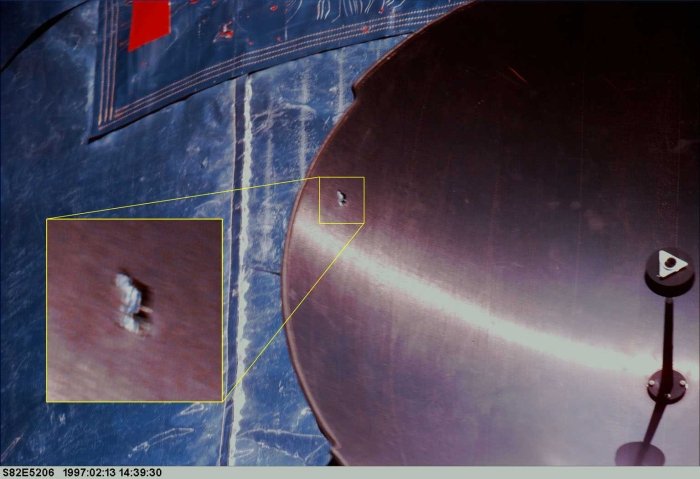
Anything below that size is too small to track, but travelling at orbital velocities can still do some significant damage, including punching right through metal plates.

hubble punchAn impact hole left in the Hubble Space Telescope antenna in 1997. (NASA)

Canadarm2 – formally known as the Space Station Remote Manipulator System (SSRMS), designed by the Canadian Space Agency – has been a fixture on the space station for 20 years. It’s a multi-jointed titanium robotic arm that can assist with maneuvering objects outside the ISS, including cargo shuttles, and performing station maintenance.

It’s unclear exactly when the impact occurred. The damage was first noticed on 12 May, during a routine inspection. NASA and the CSA worked together to take detailed images of and assess the damage.

“Despite the impact, results of the ongoing analysis indicate that the arm’s performance remains unaffected,” the CSA wrote in a blog post. “The damage is limited to a small section of the arm boom and thermal blanket. Canadarm2 is continuing to conduct its planned operations.”

Although the ISS seems to have gotten lucky this time, the space debris problem does seem to be increasing. Last year, the ISS had to perform emergency maneuvers three times in order to avoid collisions with space debris at its altitude of around 400 kilometers (250 miles).

[…]

Source: Space Debris Has Hit And Damaged The International Space Station

NSA spied on European politicians through Danish telecommunications hub

Denmark’s foreign secret service allowed the US National Security Agency to tap into a crucial internet and telecommunications hub in Denmark and spy on the communications of European politicians, a joint investigation by some of Europe’s biggest news agencies revealed on Sunday.

The covert spying operation, called Operation Dunhammer, took place between 2012 and 2014, based on a secret partnership signed by the two agencies.

The secret pact, signed between the NSA and the Danish Defense Intelligence Service (Danish: Forsvarets Efterretningstjeneste, FE) allowed US spies to deploy a data interception system named XKeyscore on the network of Sandagergårdan, an important internet and communications hub in the city of Dragor, near Copenhagen, where several key submarine cables connected Denmark (and continental Europe) to the Scandinavian peninsula.

dragor

The NSA allegedly used XKeyscore to mass-sniff internet and mobile traffic and intercept communications such as emails, phone calls, SMS texts, and chat messages sent to the phone numbers and email addresses of European politicians.

The covert operation abruptly stopped in 2014 after Danish government officials learned of the NSA-FE collaboration following the Snowden leaks.

Danish officials put a stop to the operation after they learned that the NSA had also spied on Danish government members.

Several high-ranking FE officials were suspended from the agency last year for their involvement in the operation, as Danish law prohibits the foreign intelligence agency from using its resources to spy internally.

News of the scandal leaked over the weekend after journalists from Danish broadcaster DR got their hands on a document called the Dunhammer Report, which contained the results of the Danish government’s investigation into the NSA-FE secret pact, and which was presented to Danish government officials back in 2015.

[…]

Source: NSA spied on European politicians through Danish telecommunications hub | The Record by Recorded Future

Many Need For Speed Games Are About To Be Erased From Reality

[…]

Today, via Reddit (while most the English-speaking world is on a holiday), it’s been announced that Need For Speed: Carbon, Need For Speed: Undercover, Need For Speed: Shift, Shift 2: Unleashed and Need For Speed: The Run will be “retired”. Which I suppose is an apposite word, given they’ll be limping off the tracks as they leave digital storefronts today, and their servers switched off come the end of August.

The reasons given are the usual: that maintaining servers for the few remaining players is prohibitively expensive, and hey, look, they’ve released loads of (astoundingly poor) NFS games since then, so you could buy those instead!

“[T]he number of players has come to a point where it’s no longer feasible to continue the work behind the scenes required to keep [the games] up and running. We hope you have gotten many victories, satisfying drifts, moments of friendly rivalry, and hours of joy over the last few years out of these games. And we hope you’ll keep driving with us in one of our newer titles…”

It’s always this way. “Shrug! What else could we do?!” Well, here are some other things they could do:

  • They could release the source code for the 10-15 year old games, and allow others to continue their development in the public domain
  • They could release the server code for the games, to allow enthusiasts to continue to host the few dedicated players remaining
  • They could offer to upgrade players to one of the many NFS games of the 2010s (although this may be crueller than just nothing at all)
  • They could recognise that last year EA made a revenue of $5.5bn, and it’s likely they could just about afford to leave the servers on with minimal maintenance, without taking too big of a hit

[…]

Source: Many Need For Speed Games Are About To Be Erased From Reality

Google reportedly made it harder to find Android privacy settings

Google’s approach to Android privacy is coming under fire following revelations from Arizona’s antitrust lawsuit over phone tracking. As Insider reports, freshly unredacted documents in the case suggest Google made Android privacy settings harder to find. When Google tested OS releases that surfaced privacy features, the company reportedly saw greater use of those features as a “problem” and aimed to put them deeper into the menu system.

The tech giant also “successfully pressured” phone brands like LG to bury location settings as they were popular, according to Arizona’s attorneys. Google personnel further acknowledged that it was difficult to stop the company from determining your home and work locations, and complained that there was “no way” to give third-party apps your location without also handing them to Google.

[…]

Source: Google reportedly made it harder to find Android privacy settings | Engadget

Dark Energy Survey releases most precise look at the universe’s evolution

New results from the Dark Energy Survey use the largest ever sample of galaxies over an enormous piece of the sky to produce the most precise measurements of the universe’s composition and growth to date. Scientists measured that the way matter is distributed throughout the universe is consistent with predictions in the standard cosmological model, the best current model of the universe.

Over the course of six years, DES surveyed 5,000 square degrees — almost one-eighth of the entire sky — in 758 nights of observation, cataloguing hundreds of millions of objects. The results announced today draw on data from the first three years — 226 million galaxies observed over 345 nights — to create the largest and most precise maps yet of the distribution of galaxies in the universe at relatively recent epochs.

[…]

Ordinary matter makes up only about 5% of the universe. Dark energy, which cosmologists hypothesize drives the accelerating expansion of the universe by counteracting the force of gravity, accounts for about 70%. The last 25% is dark matter, whose gravitational influence binds galaxies together. Both dark matter and dark energy remain invisible and mysterious, but DES seeks to illuminate their natures by studying how the competition between them shapes the large-scale structure of the universe over cosmic time.

DES photographed the night sky using the 570-megapixel Dark Energy Camera on the Victor M. Blanco 4-meter Telescope at the Cerro Tololo Inter-American Observatory in Chile, a program of the National Science Foundation’s NOIRLab.

[…]


The Dark Energy Survey is a collaboration of more than 400 scientists from 25 institutions in seven countries. For more information about the survey, please visit the experiment’s website.

[…]

Second, DES detected the signature of dark matter through weak gravitational lensing. As light from a distant galaxy travels through space, the gravity of both ordinary and dark matter can bend it, resulting in a distorted image of the galaxy as seen from Earth. By studying how the apparent shapes of distant galaxies are aligned with each other and with the positions of nearby galaxies along the line of sight, DES scientists inferred the spatial distribution (or clumpiness) of the dark matter in the universe.

[…]

The recent DES results will be presented in a scientific seminar on May 27. Twenty-nine papers are available on the arXiv online repository.

A large blue disc with the top portion open has a has a big white instrument sitting at its center. This instrument sits atop a yellow stand. In a large room with a flight of stairs, the whole instrument is large, much taller than the flight of stairs and equally wide.

The Dark Energy Survey photographed the night sky using the 570-megapixel Dark Energy Camera on the Victor M. Blanco 4-meter Telescope at the Cerro Tololo Inter-American Observatory in Chile, a program of the National Science Foundation’s NOIRLab. Photo: Reidar Hahn, Fermilab

Source: Dark Energy Survey releases most precise look at the universe’s evolution

WhatsApp Won’t Limit Functionality if You Refuse Privacy Policy – for now. But it will pester you about it.

WhatsApp initially threatened to revoke core functions for users that refused to accept its controversial new privacy policy, only to walk back the severity of those consequences earlier this month amid international backlash, and now, it’s doing away with them altogether (for the time being, at least).

In a reversal, the company clarified on Friday that it won’t restrict any functionality even if you haven’t accepted the app’s updated privacy policy yet, TNW reports.

“Given recent discussions with various authorities and privacy experts, we want to make clear that we will not limit the functionality of how WhatsApp works for those who have not yet accepted the update,” a WhatsApp spokesperson said in a statement to the Verge. They added that this is the plan moving forward indefinitely.

In an update to the company’s FAQ page, WhatsApp clarifies that no users will have their accounts deleted or lose functionality if they don’t accept the new policies. That being said, WhatsApp will still send these users reminders to update “from time to time,” WhatsApp told the Verge. On its support page, WhatsApp claims that the majority of users who have seen the update have accepted.

Source: WhatsApp Won’t Limit Functionality if You Refuse Privacy Policy

Israel’s operation against Hamas was the world’s first AI war

Having relied heavily on machine learning, the Israeli military is calling Operation Guardian of the Walls the first artificial-intelligence war.

“For the first time, artificial intelligence was a key component and power multiplier in fighting the enemy,” an IDF Intelligence Corps senior officer said. “This is a first-of-its-kind campaign for the IDF. We implemented new methods of operation and used technological developments that were a force multiplier for the entire IDF.”

In 11 days of fighting in the Gaza Strip, the Israeli military carried out intensive strikes against Hamas and Palestinian Islamic Jihad targets. It targeted key infrastructure and personnel belonging to the two groups, the IDF said.

While the military relied on what was already available on the civilian market and adapted it for military purposes – in the years prior to the fighting – the IDF established an advanced AI technological platform that centralized all data on terrorist groups in the Gaza Strip onto one system that enabled the analysis and extraction of the intelligence.

Soldiers in Unit 8200, an Intelligence Corps elite unit, pioneered algorithms and code that led to several new programs called “Alchemist,” “Gospel” and “Depth of Wisdom,” which were developed and used during the fighting.

Collecting data using signal intelligence (SIGINT), visual intelligence (VISINT), human intelligence (HUMINT), geographical intelligence (GEOINT) and more, the IDF has mountains of raw data that must be combed through to find the key pieces necessary to carry out a strike.

“Gospel” used AI to generate recommendations for troops in the research division of Military Intelligence, which used them to produce quality targets and then passed them on to the IAF to strike.

“For the first time, a multidisciplinary center was created that produces hundreds of targets relevant to developments in the fighting, allowing the military to continue to fight as long as it needs to with more and more new targets,” the senior officer said.

While the IDF had gathered thousands of targets in the densely populated coastal enclave over the past two years, hundreds were gathered in real time, including missile launchers that were aimed at Tel Aviv and Jerusalem.

The military believes using AI helped shorten the length of the fighting, having been effective and quick in gathering targets using super-cognition.

The IDF carried out hundreds of strikes against Hamas and PIJ, including rocket launchers, rocket manufacturing, production and storage sites, military intelligence offices, drones, commanders’ residences and Hamas’s naval commando unit. Israel has destroyed most of the naval commando unit’s infrastructure and weaponry, including several autonomous GPS-guided submarines that can carry 30 kg. of explosives.

IDF Unit 9900’s satellites that have gathered GEOINT over the years. They were able to automatically detect changes in terrain in real time so that during the operation, the military was able to detect launching positions and hit them after firing.

For example, Unit 9900 troops using satellite imagery were able to detect 14 rocket launchers that were located next to a school.

The IDF also killed more than 150 PIJ and Hamas operatives, many of them considered senior commanders or irreplaceable in their roles, especially those who led the research and development of the missile projects.

One strike, against senior Hamas operative Bassem Issa, was carried out with no civilian casualties despite being in a tunnel under a high-rise building surrounded by six schools and a medical clinic. Issa, a brigade commander for Gaza City, was the highest-ranking military figure in Hamas to be killed by Israel since Operation Protective Edge in 2014.

He was killed along with Hamas’s cyber and missile technology chief Jomaa Tahla, head of the development and projects department Jemal Zebda and 13 members of the faction’s weapons manufacturing unit.

Hamas’s underground “Metro” tunnel network was also heavily damaged over the course of several nights of airstrikes. Military sources said they were able to map the network, consisting of hundreds of kilometers under residential areas, to a degree where they knew almost everything about them.

The mapping of Hamas’s underground network was done by a massive intelligence-gathering process that was helped by the technological developments and use of Big Data to fuse all the intelligence. Once mapped, the IDF was able to have a full picture of the network both above and below ground with details, such as the depth of the tunnels, their thickness and the nature of the routes. With that, the military was able to construct an attack plan that was used during the operation.

While the IDF acknowledges that it has not destroyed the entire network, it says it has struck parts of the network that make it nearly impossible for Hamas to use again. And the ability of the IDF to crack Hamas’s network and completely map it removes one of the central dimensions of Hamas’s combat strategy.

“Years of work, out-of-the-box thinking and the fusion of all the power of the intelligence division together with elements in the field led to the breakthrough solution of the underground,” the senior officer said.

Using the data gathered and analyzed through AI, the IAF was able to use the appropriate munitions to hit a target, whether an apartment, a tunnel or a building.

The IDF also used a system dubbed “Alchemist,” which was developed by Unit 8200 and used AI and machine learning to alert troops in the field to possible attacks by Hamas or PIJ. The dynamic and updating system was used by every unit commander in the field who had the system on a user-friendly tablet.

The military said the attack that killed St.-Sgt. Omer Tabib is being investigated. Troops had been alerted to the possibility of anti-tank fire targeting their jeeps outside the community of Netiv Ha’asara.

Tabib was the only soldier killed in the fighting.

The military also relied heavily on intelligence to carry out precision strikes in an attempt to minimize civilian casualties.

The Hamas-run Health Ministry in Gaza said at least 243 Palestinians were killed during the fighting, including 66 children and teens, with 1,910 people wounded.

The IDF said more than 100 operatives belonging to the terrorist groups were killed and that some of the civilian casualties were caused by Hamas rockets falling short or civilian homes collapsing after an airstrike on Hamas’s tunnel network.

In an interview with Channel 12, the head of the United Nations Palestinian refugee agency in Gaza, Matthias Schmale, acknowledged that while the “viciousness and ferocity of the strikes was heavily felt,” he had “the impression that there is a huge sophistication in the way the Israeli military struck.”

Source: Israel’s operation against Hamas was the world’s first AI war – The Jerusalem Post

EU starts protectionist measures, increasing prices of Chinese E-Commerce imports

At Amazon in Spain, France and Italy, Chinese sellers already make up more than half of the largest merchants in the marketplace, says market research firm Marketplace Pulse. The Thuiswinkel Markt Monitor shows that we in the Netherlands spent 1.1 billion euros on products from abroad in 2019. Chinese online stores, such as AliExpress, are in first place with almost 33 percent. One reason for the rise of Chinese retailers is that they supply European customers directly through platforms such as Amazon or AliExpress. They also often pay no import duties and pay little attention to product safety. At the beginning of July, new EU tax rules will come into effect for orders from non-European online retailers. The most important change is the abolition of the current exemption limit of 22 euros for direct imports. As a result, 19 percent import tax is due on all packages. In addition, dealers will have to complete a customs declaration for all shipments in the future. The prices of Chinese articles will therefore rise sharply. If you want to spend something of 22 euros, you will soon pay 4 euros 84 in VAT and approximately 13 euros in handling costs for the delivery person. Then you do not lose 22 euros for the product, but almost 40 euros. Brussels expects a lot from the measures. The tax reform will ensure “fair competition between European and foreign operators in the e-commerce market,” the Brussels government writes in a brochure. It expects an additional tax revenue of 7 billion euros per year. Organization GS1 advises retailers to let marketplaces take care of the VAT return because they know who is buying, at what price and where the package must be delivered. They can also provide the authorities with unique identifiers for the product, the Global Trade Item Number (GTIN), the sales transaction a Global Shipment Identification Number (GSIN) in which the price is recorded and the package identification code, a GS1 Serial Shipping Container Code (SSCC). to enable an automated check. In this way, the customer can look forward to his package without any problems.

Source: EU verscherpt regels voor internationale onlinehandel, Chinese pakketjes fors duurder – Emerce

Creepy Social Media Face Stealing firm Clearview hit with complaints in France, Austria, Italy, Greece and the UK

Data rights groups have filed complaints in the UK, France, Austria, Greece and Italy against Clearview AI, claiming its scraped and searchable database of biometric profiles breaches both the EU and UK General Data Protection Regulation (GDPR).

The facial recognition company, which is based in the US, claims to have “the largest known database of 3+ billion facial images”. Clearview AI’s facial recognition tool is trained on images harvested from YouTube, Facebook, Twitter and attempts to match faces fed into its machine learning software with results from its multi-billion picture database. The business then provides a link to the place it found the “match”.

Google, Twitter, Facebook and even Venmo all sent cease and desist letters to Clearview AI last year asking that it stop scraping people’s photos from their websites. The firm’s CEO defended its business model at the time by saying: “Google can pull in information from all different websites. So if it’s public and it’s out there and could be inside Google’s search engine, it can be inside ours as well.”

The US firm was sued last year by the American Civil Liberties Union. The ACLU also sued the US Department of Homeland Security and its law enforcement agencies last month for failing to respond to Freedom of Information Act requests about their use of Clearview’s tech.

[…]

Back in January this year, [PDF], Chaos Computer Club member Matthias Marx managed to get Clearview to delete the hash value representing his biometric profile – although not the actual images or metadata – after filing a complaint with the Hamburg data protection authorities.

The decision by the Hamburg DPA was that Clearview AI had added his biometric profile to its searchable database without his knowledge or consent. It did not order the deletion of the photographs, however.

“It is long known that Clearview AI has not only me, but many, probably thousands of Europeans in its illegal face database. An order by the European data protection authorities to remove the faces of all Europeans is long overdue,” Marx told The Reg via email. “It is not a solution that every person has to file [their] own complaint.”

[…]


Source: Facial recog firm Clearview hit with complaints in France, Austria, Italy, Greece and the UK • The Register

Boeing KC-46A’s Vision System Can’t Reliably Show The End Of The Refueling Boom. Boom doesn’t work much anyway.

KC-46A’s Remote Vision System (RVS), which the boom operators use to connect the boom with receiving aircraft. It’s a critical system on the Pegasus and fundamental to its ability to operate as a tanker for receptacle-equipped aircraft from the U.S. military and its allies.

It’s also a new kind of technology for Air Force refueling aircraft. The service’s previous tankers have all had position for the boom operator to physically lie in at in the rear fuselage, from where could watch the boom directly with their own eyes and guide it into the receiving aircraft. The KC-46, in contrast, has the boom operator seated in the aircraft’s main cabin where they perform their task via the RVS. Since this is a hybrid 2D/3D system, the operators wear special glasses that are, at least in principle, supposed to provide enhanced depth perception while viewing through a flatscreen.

[…]

“The camera feed does not accurately show the end of the boom — there’s about another foot and a half beyond what is visible on the screen, so boom operators use the shadows to gauge where the tip is before connecting to the receptacle. If there’s no shadow, on a cloudy day, for example, the operator has to rely on experience, rather than technology, to make the connection.”

[…]

“Even with the 3D goggles, depth perception is difficult. Moving the refueling boom around the F-16’s canopy to then line up with the receptacle, flying at 290 knots, is a delicate process. While wearing the goggles, the center of the screen is sharp, but when you look to the edge of the screen, it gets blurry and disorienting.”

[…]

an Air Force official explained to Defense News that “There is a slight difference between the motion viewed in the RVS versus what is actually occurring in the physical world.” That now seems as if it might have been a serious understatement.

At one point in the Mobiliy Guardian maneuvers, for instance, the weather during the sortie prevented a C-5 Galaxy strategic transport aircraft from taking on fuel, when “direct-sunlight washout” meant the RVS screen was no longer useable.

[…]

the RVS has a fundamental problem to begin with and that the shadows, in particular, have been used by boom operators as a workaround. Furthermore, it seems to be apparent that the effects of shadows can be both a solution and a problem, depending on the context.

Amid all the other difficulties that have faced the KC-46, the RVS has surely been the most enduring one. It’s for this reason that work is now underway on an ‘RVS 2.0’ that will provide all-new equipment, including a laser ranger to measure the distance between tanker and receiver, color rather than black and white screens, plus augmented reality for the boom operator.

[…]

it emerged that the ongoing effort to redesign the boom, costing $100 million, could likely have been avoided had the Air Force taken note of problems that had emerged much earlier in the program.

Alarmingly, a technology readiness assessment (TRA) — which assesses the maturity of critical hardware and software technologies — also revealed that Boeing engineers used no new or novel technology in the design of the boom because the design was “based on that of the well-proven KC-10 [refueling boom] and the control laws [were] based on the Italian KC-767A and Japanese KC-767J control laws.”

“We reviewed the preliminary design review documentation and found that it showed a refueling boom design that differed significantly from the proposed design that the independent review team documented in the TRA report,” the Pentagon’s Inspector General states in a recent report into the KC-46 program.

Source: KC-46A’s Long-Troubled Vision System Can’t Even Reliably Show The End Of The Refueling Boom

Bet the US wishes they hadn’t recanted from the Airbus tanker they originally chose.

Flaris’s New LAR-01 May Be World’s Fastest Single-Engine Business Jet, can land on grass fields – at only $1.5m

The Flaris LAR-01 has a number of striking stats, including being a ton lighter (literally) than its competitors, along with an unusually short-field landing capability, and detachable wings. But its most impressive number is the 250-knot true air speed,

[…]

Garmin G600 avionics and Flaris Flight Assistance System flight computer, as well as the landing gear and emergency parachute system. But it also claims more impressive stats like the 250-knot TSA at 10,000 feet. Its 6,000-feet-per-minute climb rate, adds the company, is equal to combat-trainer aircraft. Oh, and the required length of the runway for takeoff is just 650 feet

[…]

It is able to transport four people to a distance of 1,550 miles in less than 3.5 hours

[…]

Accommodating a pilot and four passengers, the LAR-01 has a 4,078-pound maximum takeoff weight, with a service ceiling of 46,000 feet. Its expected range is 1,350 nautical miles. Flaris says the $1.5 million price tag as well as the fuel and operating costs will be much lower than competitors. With an empty weight of 1,543 pounds, the company added that the composite frame is a ton lighter than other VLJ-class aircraft.

Behind the stats is a cool-looking design with a “car-like cabin” that offers good headroom and large windows with a Garmin G600 avionics suite. A parachute is designed into the jet’s nose area. Measuring 28’6” across, the semi-elliptical wings are built for both high speeds and a 62-knot stall.

Flaris is attempting to move beyond a traditional light jet, noting the LAR-01 can take off from grass airstrips and short airfields, and the wings detach, so the jet can be trailered and stored in a home garage.

Source: Flaris’s New LAR-01 May Be World’s Fastest Single-Engine Business Jet – Robb Report

Not entirely sure if detachable wings is the way forward tbh…

Norway fines Tesla for reducing battery capacities and charging speeds

A court in Norway has found Tesla guilty after it was sued by owners who complained of reduced battery capacities and charging speeds. It has been ordered to pay 136,000 kroner ($16,000) each to buyers of certain Model S owners, a judgement that could run into the hundreds of millions of dollars, according to Nettavisen .

Owners in Norway and elsewhere complained about drops in range of up to 30 miles following a 2019 software update, as Electrek reported. They also noticed reduced DC fast-charging rates at Tesla’s Supercharger stations. The issues reportedly involve 2013-2015 models and Tesla said at the time that the aim was to “protect the battery and improve battery longevity.” The company added that it would only affect “a small percentage of owners.”

Some owners saw precipitous drops in battery capacity of up to 11 percent, compared to the normal gradual declines expected. Those issues have led to lawsuits not only in Norway, but in Denmark, the US and elsewhere.

Tesla reportedly failed to reply to the suit, so the judgement was made in absentia. As a result, the 30 owners behind the lawsuit will be awarded $16,000 each unless Tesla appeals. EVs are huge in Norway, however and Nettavisen notes that there are over 10,000 buyers of the affected models in Norway — as such, the lawsuit could get considerably more expensive.

Source: Norway fines Tesla for reducing battery capacities and charging speeds | Engadget

Indonesia’s national health insurance scheme leaks at least a million citizens’ records

Indonesia’s government has admitted to leaks of personal data from the agency that runs its national health insurance scheme

On May 20th Kominfo, Indonesia’s Ministry of Communication and Information Technology, acknowledged it was aware of a post on notorious stolen-data-mart Raidforums offering to sell a million records leaked from the Badan Penyelenggara Jaminan Sosial (BPJS), an agency that runs national health insurance scheme Jaminan Kesehatan Nasional (JKN).

The Ministry said it had found leaked data and that the leak was not “massive”.

By May 21st, the Ministry stated it had identified an entity trying to sell the data and found the data itself on three sites – bayfiles.com, mega.nz, and anonfiles.com. The Ministry claimed only the last-named site had not responded to takedown requests, and that it hosted only around 100,000 records.

Later on the 21st a new announcement raised the number of stolen records to a million, said the fields matched those used by the BPJS, and said further investigation is needed to understand the nature of the data and extent of the breach.

[…]

Source: Indonesia’s national health insurance scheme leaks at least a million citizens’ records • The Register