
The Linkielist

Linking ideas with the world

The Linkielist

26 author report: bottom trawling for fish is responsible for one gigaton of carbon emissions a year—a higher annual total than (pre-pandemic) aviation emissions.

It’s been well established by now that the agricultural systems producing our food contribute at least one fifth of global anthropogenic carbon emissions—and up to a third if waste and transportation are factored in. A troubling new report points to a previously overlooked source: an industrial fishing process practiced by dozens of countries around the world, including the United States, China, and the E.U.

The study, published today in the scientific journal Nature, is the first to calculate the carbon cost of bottom trawling, in which fishing fleets drag immense weighted nets along the ocean floor, scraping up fish, shellfish and crustaceans along with significant portions of their habitats.

According to calculations conducted by the report’s 26 authors, bottom trawling is responsible for one gigaton of carbon emissions a year—a higher annual total than (pre-pandemic) aviation emissions. Not only does the practice contribute to climate change, it is extremely damaging to ocean biodiversity—the “equivalent of ploughing an old-growth forest into the ground, over and over and over again until there is nothing left” according to lead author Enric Sala, a marine biologist who is also National Geographic’s Explorer in Residence.

Bottom trawling is also one of the least cost effective methods of fishing. Most locations have been trawled so many times, there is little left worth catching, says Sala. “Without government subsidies, no one would be making a penny.” But Sala didn’t set out to condemn bottom trawlers when he designed the research project back in 2018. He was looking for the incentives that just might make the fishing industry, and governments, give up on the practice on their own. The carbon findings may just do the trick.

[…]

Refuting a long-held view that ocean protection harms fisheries, the study found that well placed marine protected areas (MPAs) that ban fishing would actually boost the production of marine life by functioning as fish nurseries and biodiversity generators capable of seeding stocks elsewhere. According to the study results, protecting the right places could increase the global seafood catch by over 8 million metric tons a year, despite the challenges of overfishing and climate change.

Bottom trawling, however, would have to stop, says Sala. While mangroves, kelp forests and sea grass meadows are good at capturing carbon, the bottom of the ocean, piled deep with marine animal debris, is a far greater carbon sink. But when the trawlers’ weighted nets scrape the sea floor that carbon is released back into the water. Excess carbon in water turns it acidic, which is damaging to sea life.

Worse still, the practice also impacts the ocean’s ability to absorb atmospheric carbon: if the water is already saturated from sources down below, it will be unable to absorb human-caused emissions from above, hamstringing one of our best assets in the fight against climate change. By combining publicly-available data on global bottom trawler activity with pixel-level assessments of carbon stored in the top layers of ocean sediments, Sala and his team were able to calculate the amount of emissions produced by the technique, down to the level of national fleets. The European Union, for example, releases 274,718,086 metric tons of marine sediment carbon into the ocean a year, while Chinese fleets release 769,294,185 metric tons, and the United States releases 19,373,438.

[…]

Source: Bottom Trawling for Fish Boosts Carbon Emissions, Study Says | Time
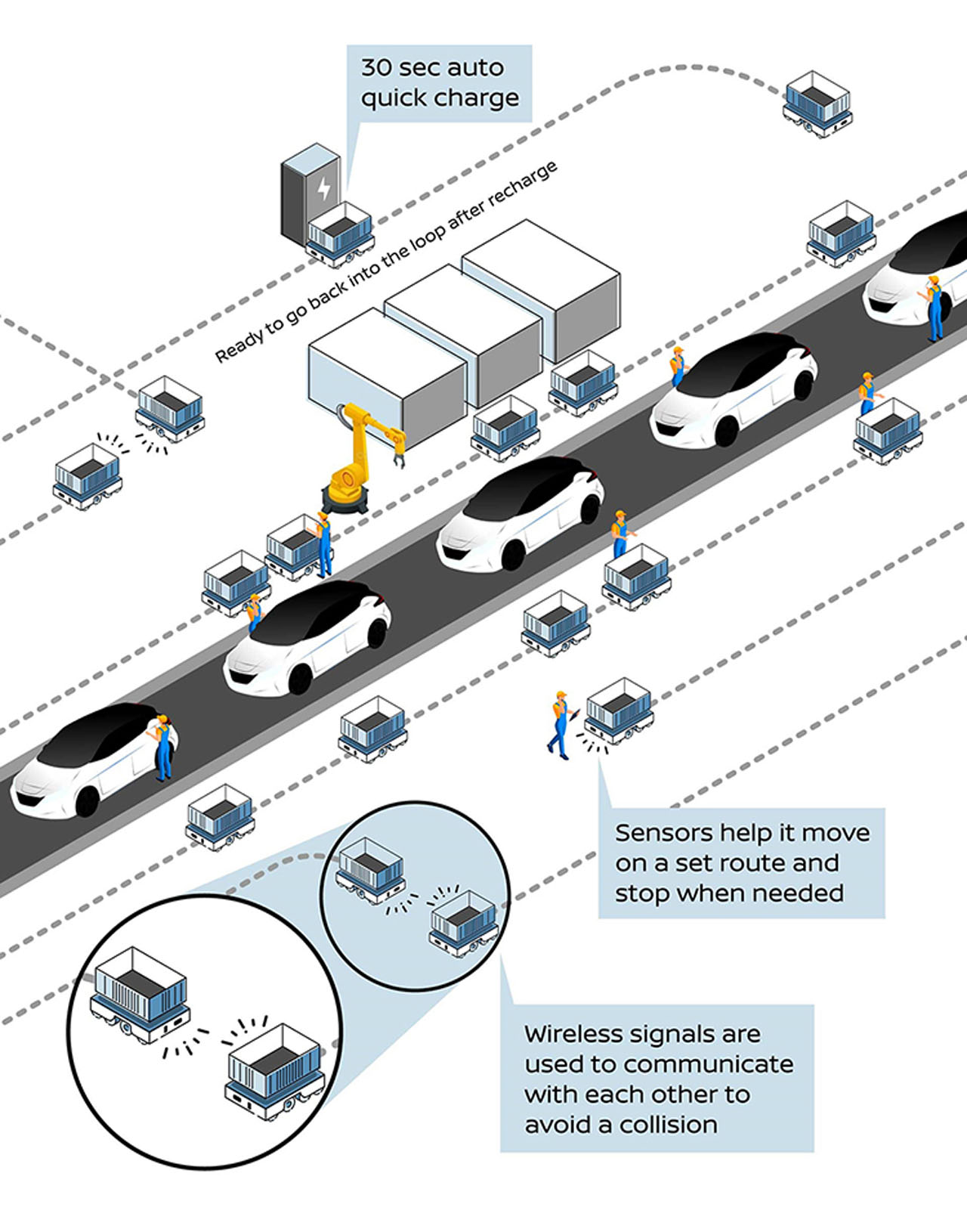
Nissan finds use for old LEAF batteries in their factory. Still no way to recycle them.

Nissan has found a second-life for old LEAF batteries inside mobile machines that help workers at Nissan factories worldwide. The old batteries are being used in automated guided vehicles or AGVs used for various tasks inside the manufacturing facilities, including delivering parts to workers on the assembly line.

AGVs are used as robotic mail carriers operating on magnetic tracks taking mail and parts exactly where they’re needed on the assembly line. The idea is to use the AGV to deliver parts so the worker doesn’t waste time searching for a component and can stay focused on installing parts. Nissan and other automotive manufacturers have found that AGVs are indispensable when it comes to saving time and increasing productivity on the assembly line.

Nissan currently operates more than 4000 AGVs around the world at its various manufacturing facilities. The factories have a system that includes 30-second automatic quick charging to keep battery packs on the electric vehicles topped off and working correctly. AGVs also have sensors that keep them operating on a set route and allow them to stop when needed. They also have wireless communications capabilities that enable them to communicate with each other to avoid collisions.

Nissan says that it has been exploring ways to reuse old LEAF batteries since 2010. The first-generation LEAF used a 24-kilowatt hour battery pack made by combining 48 modules. Nissan said eight years ago, its engineers discovered a way to take three of those modules and repackage them to fit inside the AGV. Last year, the engineers began to repurpose used battery modules instead of using new ones to power the AGVs. The team also found the repurposed LEAF batteries last a lot longer thanks to their lithium-ion design compared to the lead-acid batteries used previously.

Source: Nissan finds a second use for old LEAF batteries – SlashGear

Feeding cattle seaweed reduces their greenhouse gas emissions 82 percent

A bit of seaweed in cattle feed could reduce methane emissions from beef cattle as much as 82 percent, according to new findings from researchers at the University of California, Davis. The results, published today in the journal PLOS ONE, could pave the way for the sustainable production of livestock throughout the world.

“We now have sound evidence that seaweed in cattle diet is effective at reducing greenhouse gases and that the efficacy does not diminish over time,”

[…]

Over the course of five months last summer, Kebreab and Roque added scant amounts of seaweed to the diet of 21 beef cattle and tracked their weight gain and methane emissions. Cattle that consumed doses of about 80 grams (3 ounces) of seaweed gained as much weight as their herd mates while burping out 82 percent less methane into the atmosphere. Kebreab and Roque are building on their earlier work with dairy cattle, which was the world’s first experiment reported that used seaweed in cattle.

[…]

Results from a taste-test panel found no differences in the flavor of the beef from seaweed-fed steers compared with a control group. Similar tests with dairy cattle showed that seaweed had no impact on the taste of milk.

Also, scientists are studying ways to farm the type of seaweed—Asparagopsis taxiformis—that Kebreab’s team used in the tests. There is not enough of it in the wild for broad application.

Another challenge: How do ranchers provide seaweed supplements to grazing cattle on the open range? That’s the subject of Kebreab’s next study.

[…]

Source: Feeding cattle seaweed reduces their greenhouse gas emissions 82 percent

Also, do the bovines eat the seaweed happily or do they need to be force fed it?

Microsoft Office 365 Down For Some Users

Microsoft is reporting an outage of Office 365, including Microsoft Teams. On its status page, Microsoft adds: Users may be unable to access multiple Microsoft services. User impact: Users may be unable to access multiple Microsoft 365, Azure, and Dynamics 365 services, including the Service Health Dashboard. More info: Any service that leverages Azure Active Directory (AAD) may be affected. This includes but is not limited to Microsoft Teams, Forms, Exchange Online, Intune and Yammer. Current status: We’ve identified the underlying cause of the problem and are taking steps to mitigate impact. We’ll provide an updated ETA on resolution as soon as one is available. Scope of impact: This issue could affect any user.

Source: Microsoft Office 365 Down For Some Users – Slashdot

Yay cloud

These researchers in Switzerland can get electricity by compressing wood

Researchers at ETH Zurich and Empa have chemically modified wood and made it more compressible, turning it into a mini-​generator. When compressed, it generates an electrical voltage. Such wood could serve as a biosensor or as a building material that harvests energy.

Ingo Burgert and his team at public research university ETH Zurich and Swiss federal laboratory Empa have proven that wood is much more than just a building material. Their research enhances the properties of wood in order to use it for new applications. For instance, they have already developed high-​strength, water-​repellent, and magnetizable wood.

[…]

When a piezoelectric material is elastically deformed, it generates an electrical voltage. Measurement technology, in particular, exploits this phenomenon by using sensors that generate a charge signal when mechanically stressed.

[…]

Wood also has a natural piezoelectric effect but only generates a very low electrical voltage. If one wants to increase the voltage, the chemical composition of the wood must be changed – and this also makes it more compressible.

[…]

In order to convert wood into an easily formable material, one component of the cell walls must be dissolved. Wood cell walls consist of three basic substances: lignin, hemicellulose, and cellulose. “Lignin is the stabilizing substance that trees need to grow tall. Without lignin, which connects the cells and prevents the stiff cellulose fibrils from buckling, this would not be possible,” says Burgert.

[…]

The researchers achieved this “delignification” by placing wood in a mixture of hydrogen peroxide and acetic acid. The acid dissolves the lignin, leaving a framework of cellulose layers. “The process retains the hierarchical structure of wood and prevents disassembly of the individual fibers,” Burgert explains.

Even a little pressure can generate usable energy in the wooden sponge. Photo: ACS Nano/Empa

In this way, a piece of balsa wood becomes a white, wooden sponge, made up of layer upon layer of thin cellulose. The sponge can simply be compressed and then returns to its original shape. “The wood sponge generates an electrical voltage 85 times higher than that of native [untreated] wood,” says Sun.

A mini-​generator in the wooden floor

The team subjected a test cube with a side length of approximately 1.5 cm to around 600 load cycles. The wooden sponge proved surprisingly stable: For each load, the researchers measured a voltage of approximately 0.63 volts, which would be appropriate for a sensor. In further experiments, the team tested the scalability of this mini-​generator. If 30 such wooden blocks are connected up and evenly loaded with the body weight of an adult, enough electricity is generated to power a simple LCD display.

Treatment with fungus instead of chemicals

In a follow-​up study just published in Science Advances, the ETH-​Empa research team went one step further, seeking to produce the wooden sponge without using chemicals. The researchers found the solution in nature: The fungus Ganoderma applanatum causes white rot in wood and degrades the lignin and hemicellulose gently. “Although the electrical voltage generated was lower in initial tests than with chemically treated wood, the fungal process is more environmentally friendly,” says Burgert.

[…]

Source: These researchers in Switzerland can get electricity from wood – Electrek

Google halves Android app fee to 15% for lower-earning devs > $1m as monopolist hunters close in

Google will reduce the service fee it charges Android developers from 30 per cent to 15 per cent, though only on the first $1m in Google Play revenue.

[…]

Google’s change of heart follows a similarly structured fee abatement by Apple last year and lawsuits filed recently in the US, the UK, and Australia by Epic Games against both Apple and Google over their app store commissions and restrictions.

“Apple and Google demand that game developers use their payment processing service, which charges an exorbitant rate of 30 per cent,” Epic Games said in its announcement of its lawsuit in Australia. “Apple and Google block developers from using more efficient payment methods such as Mastercard (including Apple Card), Visa, and PayPal, which charge rates of 2.5 per cent to 3.5 per cent, and therefore prevent developers from passing the savings on to customers.”

[…]

Google’s Android revenue concession also arrives in the wake of federal and state antitrust lawsuits against the company and iOS app makers banding together to lobby against Apple’s platform limitations. In 2018, the European Union concluded Google had abused its control over the Android platform and fined the company €4.3bn ($5bn) for forcing hardware makers to pre-install Google apps in order to access the Google Play app store.

A PR move – follow the money

Tim Sweeney, CEO of Epic Games, dismissed the fee reduction as a public relations ploy.

“It’s a self-serving gambit: the far majority of developers will get this new 15 per cent rate and thus be less inclined to fight, but the far majority of revenue is in apps with the 30 per cent rate,” he said via Twitter. “So Google and Apple can continue to inflate prices and fleece consumers with their app taxes.”

According to app analytics biz Sensor Tower, iOS app makers earnings less than $1m account for 97.5 per cent of publishers but only 4.8 percent of the $59.3bn in the Apple App Store revenue between January 1 and October 31, 2020.

[…]

Source: Google halves Android app fee to 15% for lower-earning devs… who aren’t responsible for majority of revenue anyway • The Register

These guys are trying to retain their monopoly by lowering costs for people who make almost no money? Very strange!

California bans website ‘dark patterns’, confusing language when opting out of having your personal info sold

The rule amendments [PDF], just approved by the American state’s Office of Administrative Law, were proposed last October after a set of initial rules for enforcing the California Consumer Privacy Act (CCPA) were adopted last August, a month after CCPA enforcement began.

The CCPA amendments:

  • Clarify that businesses operating offline need to provide a way to opt-out of data sales.
  • Establish a standard Opt-Out Icon for notice and consent of data sales.
  • Prohibit designs that impair or subvert a consumer’s choice to opt-out.
  • Require that opting out takes no more steps or clicks than opting in.
  • Ban confusing language, like the double negative “Don’t not sell my information,” when presenting an opt-out choice.
  • Forbid asking for personal information not necessary to carry out an opt-out request.
  • Disallow forcing people to scroll through a privacy policy if they’ve opted out or to review reasons not to opt-out.

[…]

Research published in 2019 found 22 companies selling manipulative interface design or dark patterns as a service and found 1,841 examples on 1,267 websites employing these dubious techniques out of 11,000 surveyed.

Source: California bans website ‘dark patterns’, confusing language when opting out of having your personal info sold • The Register

Following Supreme Court ruling, Uber UK recognizes drivers as workers, offers min wage, holiday pay, pension

After years of aggressively fighting any efforts to force it to recognize its drivers as employees, on Tuesday Uber performed a U-turn on the streets of Britain and recognized all of its drivers as working for the company rather than serving as freelancers.

The change is the result of a court ruling last month that entitled workers to seek more pay and benefits but resisted classifying them as employees. That decision by the UK’s Supreme Court, making it definitive, was unanimous, and actively rejected Uber’s argument that it was just a technology platform that connected suppliers with customers. The court was having none of that, and decided that since Uber set the prices, connected drivers and passengers, and decided which route the drivers should follow, it was more employer than platform.

The ride-hailing app maker initially downplayed the legal loss, and argued the decision only directly benefited the handful of drivers in that specific case. However, experts pointed out that every other Uber driver in the UK could cite the ruling at a tribunal to demand what was owed to them, and reality has since dawned on Uber.

As such, Uber has complied with the court’s wishes, and said that its 70,000 UK drivers will henceforth be “workers” entitled to a minimum wage – £8.72 ($12.11) an hour – plus vacation pay, and a pension plan. The details are laid out in this filing [PDF] to America’s financial watchdog.

[…]

Source: Following Supreme Court ruling, Uber UK recognizes drivers as workers, offers min wage, holiday pay, pension • The Register

A Different Kind Of 3D Printer: Desktop Holograms

Holograms aren’t new, but a desktop machine that spits them out could be available soon, presuming LitiHolo’s Kickstarter pans out. The machine will have a $1600 retail price and fits in a two-foot square. It can generate 4×5 inch holograms with 1mm hogels (the holo equivalent of a pixel).

The machine allows for 23 view zones per hogel and can create moving holograms with a few seconds of motion — like the famous kiss-blowing holograms.

Of course, you’ll also need a special self-developing film and a way to get 3D images into the printer such as software or a camera set up to do a 3D scan. In the 4×5 size, the film runs about $13 a plate which will create one hologram.

Since 5 inches is 127 mm the hogel resolution of the result is about 101×127, and the samples on the website and the video below certainly don’t look like they are in HD.

Will people pay $1600 for low-resolution holograms? More importantly, is there a market for grainy holograms that would let you earn back the investment? Maybe not, but that hasn’t stopped us from buying 3D printers and other workshop toys. Plus, if this catches on, what will be available in ten years time?

Of course, if you have the laser gear, you can already make your own holograms. You can even get kits that have most of what you need.

Source: A Different Kind Of 3D Printer: Desktop Holograms | Hackaday

Facebook is using AI to understand videos and create new products

Facebook has taken the wraps off a project called Learning from Videos. It uses artificial intelligence to understand and learn audio, textual, and visual representations in public user videos on the social network.

Learning from Videos has a number of aims, such as improving Facebook AI systems related to content recommendations and policy enforcement. The project is in its early stages, but it’s already bearing fruit. Facebook says it has already harnessed the tech to enhance Instagram Reels recommendations, such as surfacing videos of people doing the same dance to the same music. The system is showing improved results in speech recognition errors as well, which could bolster auto-captioning features and make it easier to detect hate speech in videos.

[…]

The company says the project is looking at videos in hundreds of languages and from almost every country. This aspect of the project will make AI systems more accurate and allow them to “adapt to our fast moving world and recognize the nuances and visual cues across different cultures and regions.”

Facebook says that it’s keeping privacy in mind when it comes to Learning from Videos. “We’re building and maintaining a strong privacy foundation that uses automated solutions to enforce privacy at scale,” it wrote in a blog post. “By embedding this work at the infrastructure level, we can consistently apply privacy requirements across our systems and support efforts like AI. This includes implementing technical safeguards throughout the data lifecycle.”

[…]

Source: Facebook is using AI to understand videos and create new products | Engadget

Game Artists Not Happy That Developer Is Selling Their Nearly Decade-Old Work As NFTs

[…]

indie developer Jason Rohrer has added a new wrinkle by creating an NFT auction using artwork he commissioned from other people in 2012—long before NFTs were ever created.

NFT is short for “non-fungible token,” a cryptographic token that is, unto itself, one of a kind. NFTs have been tied to images, videos, and even basketball collectibles, with some selling for millions of dollars. The images and videos can exist anywhere—on Twitter, TikTok, YouTube, or what have you—and their original creators can still maintain rights to those works. So what people are really paying for is a token that they verifiably own, via blockchain technology. The value of these tokens is derived entirely from artificial scarcity. While NFTs have been around since 2017, they’ve skyrocketed in popularity in recent months, with (mostly) prominent, established artists cashing in on an unregulated speculative market that has attracted wealthy buyers in droves. It is also, as with many things related to the blockchain, an environmental catastrophe that is riddled with scams.

This week, Rohrer, creator of indie standout games like Passage, The Castle Doctrine, and One Hour One Life, debuted an NFT auction called “The Crypto Doctrine.” It’s a Dutch auction, meaning that prices start high and fall over time. It launched with 155 paintings that Rohrer originally commissioned in 2012 for use in The Castle Doctrine, a controversial game about home defense.

“Inside the game world, only one player can own each painting, but paintings can be stolen by other players through in-game burglaries, which are completely legal,” reads The Crypto Doctrine’s description. “In the real world, only one person can own each non-fungible painting token, but tokens can be stolen by other people through real-life burglaries, which are completely illegal. Please acquire your tokens responsibly.”

As of today, there are 145 paintings in the auction. This, Rohrer told Kotaku, is because three artists have gotten in touch with him asking to have their paintings removed, and he has complied.

Artists were surprised to see their works appear in The Crypto Doctrine, and others took umbrage on their behalf in the responses to Rohrer’s tweet about the auction. In an email, Rohrer told Kotaku that he did not ask permission to sell people’s works as NFTs “mostly because having email conversations with 50+ people would exceed my bandwidth as a solo creator.” Rohrer does not believe many of the paintings will sell, though he did say that people have placed bids on two of them. He added that if any works do sell, he will share the resulting windfall with their creators.

Originally, Rohrer obtained these works in 2012 from creators he characterizes as “personal friends and relatives.” For this reason, he says, there were “no written contracts” involved. The page he made requesting artwork at the time informed creators that “your artwork will be auctioned, bought, prized, collected, coveted, stolen, re-stolen, reclaimed by the state, and auctioned again. Over and over, for the effective life of my game.” Granted, this was in reference to in-game actions and auctions—not real-life ones.

When word reached voice actress and writer Ashly Burch, whose work is part of the auction, she had yet to hear of NFTs. After doing some research, however, she was not pleased to learn that her art was being sold in that form.

“I definitely did not consent to him selling the art as an NFT,” she told Kotaku in a DM. “I mean, it was years ago. And the understanding was that it would be a piece of art in the game. That’s it…Definitely did not foresee this particular development.”

Game creator and scholar Andy Nealen also took issue with his art being included with the NFT auction and said as much publicly.

“I am not a fan, to put it mildly, but am deeply opposed to the current trend towards artificial scarcity of digital objects, for numerous reasons,” Nealen told Kotaku in an email. “The fact that this selfish, techno-anarchist move is also causing unprecedented environmental damage-in a time when we need the opposite-just solidifies my stance…I couldn’t care less whether Jason ‘claims ownership’ over my (infinitely replicable) digital art. But you can see that, for me, being at all involved with the enormous scam and betrayal of humanity that the blockchain represents, that’s simply a step too far.”

[…]

Source: Game Artists Not Happy That Developer Is Selling Their Nearly Decade-Old Work As NFTs

Having Lost Its Original Atmosphere, This Planet Is Now Growing a New One

[…]

Whereas Earth has always been a terrestrial, rocky world, GJ 1132 b began its life as a gaseous, Neptune-like planet. But as new research shows, a nearby red dwarf obliterated its original hydrogen- and helium-rich atmosphere with powerful radiation, so GJ 1132 b, having been stripped down to its rocky core, is now technically a terrestrial planet. The new paper will appear in an upcoming issue of the Astronomical Journal, but a preprint is available at the arXiv.

The authors of the paper reached these conclusions based on direct observations of the exoplanet and theoretical modeling. The telescope of choice was the Hubble Space Telescope, which allowed the team to spot the “secondary atmosphere,” which consists of molecular hydrogen, hydrogen cyanide, methane, and an aerosol haze resembling smog on Earth.

“It’s super exciting because we believe the atmosphere that we see now was regenerated, so it could be a secondary atmosphere,” Raissa Estrela, a co-author of the study and a planetary scientist at NASA’s Jet Propulsion Laboratory in Southern California, explained in a statement. “We first thought that these highly irradiated planets could be pretty boring because we believed that they lost their atmospheres. But we looked at existing observations of this planet with Hubble and said, ‘Oh no, there is an atmosphere there.’

In terms of an explanation, the authors say much of the planet’s current hydrogen was retained from before, having been absorbed into the molten magma mantle. Volcanic processes are now causing this stored hydrogen to leak out from below, refueling the new atmosphere, according to the research.

[…]

Source: Having Lost Its Original Atmosphere, This Freaky Planet Is Now Growing a New One

‘Wearable microgrid’ uses the human body to sustainably power small gadgets using sweat and motion

Nanoengineers at the University of California San Diego have developed a “wearable microgrid” that harvests and stores energy from the human body to power small electronics. It consists of three main parts: sweat-powered biofuel cells, motion-powered devices called triboelectric generators, and energy-storing supercapacitors. All parts are flexible, washable and can be screen printed onto clothing.

The technology, reported in a paper published Mar. 9 in Nature Communications, draws inspiration from community microgrids.

“We’re applying the concept of the microgrid to create wearable systems that are powered sustainably, reliably and independently,” said co-first author Lu Yin, a nanoengineering Ph.D. student at the UC San Diego Jacobs School of Engineering. “Just like a city microgrid integrates a variety of local, renewable power sources like wind and solar, a wearable microgrid integrates devices that locally harvest energy from different parts of the body, like sweat and movement, while containing energy storage.”

The wearable microgrid is built from a combination of flexible electronic parts that were developed by the Nanobioelectronics team of UC San Diego nanoengineering professor Joseph Wang, who is the director of the Center for Wearable Sensors at UC San Diego and corresponding author on the current study. Each part is screen printed onto a shirt and placed in a way that optimizes the amount of energy collected.

Source: ‘Wearable microgrid’ uses the human body to sustainably power small gadgets | EurekAlert! Science News

Pixels Are Bluetooth Dice That Let You Play Online Games and Flash An internal LED

A pair of good dice is a guilty pleasure for a tabletop RPG gamer. You can never have enough, but I can tell you this: None are going to be as flashy as Pixels. These dice have an ace up their sleeve that the rest of your dice don’t have, because they light up and allow you to play online.

Yes, Pixels are electronic dice. Externally they look like ordinary resin dice, but when you throw them, their numbers light up using programmable LEDs. This alone would be enough for many players to smash the buy button on Kickstarter, where the product has already raised $2 million. But there’s more: The Pixels have a Bluetooth connection.

These days it’s not easy to get together with friends to play. Lockdowns have made things very complicated, but even without a pandemic, RPG players live in different cities, move to other countries, or simply can’t meet for meet several hours at other people’s houses on a regular basis. Online role-playing platforms that allow you to play different games over video calls are popping up, and these dice are compatible with popular services like D&D Beyond, Roll20, and Foundry.

Gif: Pixels

Both the lights and the Bluetooth run on small batteries and one die lasts around five hours on a charge. You can also turn off the LEDs to get in 20,000 rolls before the battery dies. Charging is wireless and uses an inductor hidden under one of its faces. The dice are sold separately or in kits containing D20, D12, D10, D8, D6, and D4 models.

[…]

Source: Pixels Are Bluetooth Dice That Let You Play Online Games

Towards real-time photorealistic 3D holography with deep neural networks for every device

The ability to present three-dimensional (3D) scenes with continuous depth sensation has a profound impact on virtual and augmented reality, human–computer interaction, education and training.

[…]

The computationally taxing Fresnel diffraction simulation further places an explicit trade-off between image quality and runtime, making dynamic holography impractical4. Here we demonstrate a deep-learning-based CGH pipeline capable of synthesizing a photorealistic colour 3D hologram from a single RGB-depth image in real time. Our convolutional neural network (CNN) is extremely memory efficient (below 620 kilobytes) and runs at 60 hertz for a resolution of 1,920 × 1,080 pixels on a single consumer-grade graphics processing unit. Leveraging low-power on-device artificial intelligence acceleration chips, our CNN also runs interactively on mobile (iPhone 11 Pro at 1.1 hertz) and edge (Google Edge TPU at 2.0 hertz) devices, promising real-time performance in future-generation virtual and augmented-reality mobile headsets.

Source: Towards real-time photorealistic 3D holography with deep neural networks | Nature

What this means is that they can make really nice holograms (3D objects) on your phone for a fraction of the memory costs than other methods, by using lookup tables.

Cracking of Sky CC app dealt major blow to organised crime

The cracking of the expensive messaging app, called “Sky ECC,” was what allowed over 1,500 police officers across Belgium to be simultaneously deployed in at least 200 raids, many of which were centred around Antwerp and involved special forces.

Investigators succeeded in cracking Sky ECC at the end of last year, according to reporting by De Standaard, and as a result were able to sort through thousands of messages major criminals were sending each other over the course of a month.

Information gained from those conversations is what led to Tuesday’s historic operation, two years in the making.

[…]

Sky ECC became popular with drug criminals after its successor Encrochat was cracked in 2020 by French and Dutch investigators, who were able to intercept over 100 million messages sent via the app.

That led to over a hundred suspects being arrested in the Netherlands, uncovering a network of laboratories where crystal meth and other drugs were being produced and allowing police to seize 8,000 kilos of cocaine and almost €20 million.

A number of investigations are also still currently underway in Belgium based on the information from that cracking. While it led to panic among major criminal operations in the Netherlands, there wasn’t much of a reaction at the time in the Belgian underworld.

“Almost everyone in Antwerp switched from Encrochat to Sky two years ago,” a source told the Gazet van Antwerpen in July last year, adding that major Antwerp criminals in Dubai also used Sky ECC.

The company, which calls itself “the world’s most secure messaging app,” had previously said “hacking is impossible.” It defended its services, stating they “strongly believe that privacy is a fundamental human right.”

[…]


Source: Cracking of Sky CC app dealt major blow to organised crime

Bucks County woman created ‘deepfake’ videos to harass rivals on her daughter’s cheerleading squad, DA says

A Bucks County woman anonymously sent coaches on her teen daughter’s cheerleading squad fake photos and videos that depicted the girl’s rivals naked, drinking, or smoking, all in a bid to embarrass them and force them from the team, prosecutors say.

The woman, Raffaela Spone, also sent the manipulated images to the girls, and, in anonymous messages, urged them to kill themselves, Bucks County District Attorney Matt Weintraub’s office said.

[…]

The affidavit says Spone last year created the doctored images of at least three members of the Victory Vipers, a traveling cheerleading squad based in Doylestown. There was no indication that her high school-age daughter, who was not publicly identified, knew what her mother was doing, according to court records.

Police in Hilltown Township were contacted by one of the victim’s parents in July, when that girl began receiving harassing text messages from an anonymous number, the affidavit said. The girl and her coaches at Victory Vipers were also sent photos that appeared to depict her naked, drinking, and smoking a vape. Her parents were concerned, they told police, because the videos could have caused their daughter to be removed from the team.

As police investigated, two more families came forward to say their daughters had been receiving similar messages from an unknown number, the affidavit said. The other victims were sent photos of themselves in bikinis, with accompanying text saying the subjects were “drinking at the shore.”

After analyzing the videos, detectives determined they were “deepfakes” — digitally altered but realistic looking images — created by mapping the girls’ social media photos onto other images.

[…]

Source: Bucks County woman created ‘deepfake’ videos to harass rivals on her daughter’s cheerleading squad, DA says

Two Companies are Turning Airborne CO2 into Diamonds

two companies are selling diamonds made in a laboratory from CO2 that once circled the Earth.

[…]

Each carat of a diamond removes 20 tons of CO2. That, he said, is more invisible gas than the average person produces in a year.

With the purchase of a 2-carat diamond, Shearman pointed out, “you’re essentially offsetting 2 ½ years of your life.”

It can take Mother Nature as long as a billion years to make diamonds, which are formed in rocks. But as Shearman explained in an interview with E&E News, he has developed a patent-pending process that can make a batch of diamonds in a laboratory in four weeks.

Unlike other laboratory-made diamonds, his process starts with CO2 removed from the air. The gas undergoes a chemical reaction where it is subjected to high pressure and extremely high temperatures. All of this is created using solar, wind or hydraulic power.

[…]

Aether has been selling its diamonds since the beginning of the year at prices ranging from $7,000 for a ring to around $40,000 for earrings with sparkling stone arrangements.

[…]

Aether has a competitor, a British company called Skydiamond founded by Dale Vince, an entrepreneur and self-styled environmentalist who says he spent five years researching how to make what he calls the world’s first “zero-impact diamonds.”

Vince takes frequent potshots at the traditional diamond industry, noting that it has a history of using child labor and underpaid women. He also points to diamond mines that have scarred the Earth and damaged wildlife. He argues that a lack of regulations has fostered civil wars in Africa that can be funded by smuggled stones sometimes called “conflict diamonds” or “blood diamonds.”

[…]

In 1954, an American chemist, Tracy Hall, invented an alternative to natural stones: the first diamonds made in a laboratory. He worked for General Electric Co. and used a reactor combined with a press to subject powdered carbon to high temperatures and pressures.

The result was diamond crystals made within a few weeks. It eventually led to a new industry that manufactured “laboratory diamonds” using two competing methods. Both required a lot of energy.

[…]

According to Shearman, the CO2 is sent to a facility in Europe where it is converted into methane. That is sent to a reactor in Chicago, where pressure and heat fueled by renewable energy convert it into diamonds.

Climeworks has gone on to make a business out of accepting donations of CO2 from various sources and, for a fee, injecting it into a rock formation near a power plant in Iceland. Once it’s underground, the gas is mixed with water, and it will turn into stone in two years. The company is building a pilot plant called Orca that is designed to bury 4,000 tons of CO2 each year.

So far, over 3,000 companies and individuals from 52 countries have made contributions in exchange for a certificate showing that they have permanently stored CO2 underground

[…]

Source: Modern Alchemists Turn Airborne CO2 into Diamonds – Scientific American

California will soon be home to the world’s first 3D-printed housing community

Mighty Buildings, a construction tech company, specializes in 3D printed homes of varying sizes, presenting a technology-forward solution that could address issues like the housing crisis and sustainability. And so far, this formula has found the company success: last month, Mighty Buildings raised $40 million in a Series B round.

The California-based business isn’t the first or only company taking advantage of this growing 3D printing tech. But unlike other companies, Mighty Building’s upcoming project in Rancho Mirage, California will have the title of “world’s first planned community of 3D printed homes,” according to its maker.

Read more: This company is building 3-D printed, small homes on existing residential properties to fight back against California’s housing shortage. Look inside a unit that was move-in ready in one week.

[…]

To create this first-of-its-kind community, Mighty Buildings partnered with development-focused Palari Group, a working relationship that first started from other property designs in September 2020.

In December of last year, Palari Group officially ordered Mighty’s “Cinco” models for the Rancho Mirage, California housing development.

[…]

The tech-forward housing development will consist of 15 homes across five-acres. This $15 million project will be built using the Mighty Kit system, which utilizes prefabbed panels to create custom homes.

[…]

The development will be completed next spring, and Mighty Buildings is already in talks with a “number of developers” for potential future communities.

Read the original article on Business Insider
Source: MSN

FarmBot | Open-Source CNC Farming robot

Drag and Drop Farming

Graphically design your farm by dragging and dropping plants into the map. The game-like interface is learned in just a few minutes so you’ll have the whole growing season planned in no time.

Farm from Anywhere

The FarmBot web app can be loaded on any computer, tablet, or smartphone with a modern web browser, giving you the power to manage your garden from anywhere at any time.

Using the manual controls, you can move FarmBot and operate its tools and peripherals in real-time. Scare birds away while at work, take photos of your veggies, turn the lights on for a night time harvest, or simply impress your friends and neighbors with a quick demo.

Source: FarmBot | Open-Source CNC Farming

Belgium’s Hard-Worked F-16 with P&W F100 engines Fighter Fleet Has Just Been Grounded

Belgium’s entire fleet of F-16 fighter jets, the backbone of its combat air force, has been grounded since yesterday after one of the Vipers experienced problems with its Pratt & Whitney F100 engine. As of today, the air defense of the European country has now been taken over by the neighboring Netherlands.

“While technicians work hard to get our Vipers airborne asap and the Belgium Control and Reporting Center monitors the airspace above Belgium 24/7, the Koninklijke Luchtmacht [Royal Netherlands Air Force] will temporarily take over the Quick Reaction Alert from the Belgian Air Force to safeguard the BENELUX skies as from 12 o’clock,” the Belgian Air Force tweeted today.

Belgian Ministry of Defense

The view from the cockpit of a Belgian F-16.

Belgium’s F-16 grounding order follows a February 11 incident at Florennes Air Base, in which one of the jets had engine problems on takeoff and immediately made a precautionary landing, leaving some debris within the confines of the base and on the end of the runway.

The F-16 in question had a “nozzle burn through,” in which the engine’s “turkey feather” exhaust petals begin to disintegrate due to excessive temperatures. The engine of the affected aircraft was dismantled and sent to the Patria Belgium Engine Center, the contractor that handles maintenance of the powerplants.

[…]

Source: Belgium’s Hard-Worked F-16 Fighter Jet Fleet Has Just Been Grounded

Construction Of A Large Runway Suddenly Appears On Highly Strategic Island In The Red Sea

Satellite imagery shows that, earlier this year, construction began on a new, approximately 6,150-foot-long runway on Perim, an island right in the middle of the highly strategic Bab Al Mandeb Strait, which links the Red Sea and the Gulf of Aden. In addition to its location inside this critical maritime junction, which is an important route for both naval and commercial ships, Perim is situated less than five miles off the coast of Yemen, making it a valuable potential staging area for military operations in that country, possibly against Iranian-backed Houthi rebels, as well as elsewhere in the region.

Images from Planet Labs that The War Zone reviewed show that construction of the airstrip, which is around 165 feet wide, on the northwest portion of Perim, also known as Mayyun, only began sometime between Feb. 18 and Feb. 22, 2021. The full outline of the runway, with a turnout at the western end, was visible by March 3.

PHOTO © 2021 PLANET LABS INC. ALL RIGHTS RESERVED. REPRINTED BY PERMISSION / Google Earth

A satellite image showing Perim island in the Bab Al Mandeb Strait as of March 9, 2021. The new runway is plainly visible in the northwest portion of the island.

PHOTO © 2021 PLANET LABS INC. ALL RIGHTS RESERVED. REPRINTED BY PERMISSION / Google Earth

Another shot of Perim as of Feb. 2, 2021.

Available imagery also shows that two new small hangar-like structures appeared on a concrete pad to the south of this runway work sometime after Feb. 24. That paved area is part of an apron left over from a separate, now-dormant project that began in 2016 and that was working toward the establishment of an air base with a nearly 10,000-feet-long runway.

There has been no active work on this larger facility since 2017. It’s not entirely clear what happened, but Perim, a remnant of an ancient volcano, has an unforgiving climate that has frustrated attempts to build military outposts on it for centuries.

[…]

As to who is carrying out any of this work and what their ultimate goal is, it’s unclear, but the United Arab Emirates (UAE), as well as Saudi Arabia, are distinct possibilities. There has already been significant discussion about this construction being linked to the UAE. This follows earlier satellite imagery that The Associated Press obtained indicating that the Emiratis had dismantled many, if not all of their facilities at Assab in the East African country of Eritrea on the other side of the Bab Al Mandeb Strait sometime between January and February of this year.

The UAE had begun expanding airfield and port facilities in Assab just months after it, as part of a Saudi Arabian-led coalition, had intervened in Yemen to push back Iranian-backed Houthi rebels. That Eritrean base became an important hub for the UAE’s contribution to that campaign, including as a forward base to launch airstrikes against the Houthis and as a point through which to funnel various forces, including Sudanese troops and foreign mercenaries, onto the Arabian Peninsula.

It is certainly possible that some of the UAE forces that had been based at Assab have now moved to Perim. The Intel Lab suggests that the two-new structures could house a small UAE contingent, with at least some of that space serving as a headquarters of some kind. In addition, the runway being built now would definitely be long enough to support tactical airlift aircraft, such as C-130s, as well as the UAE’s Boeing C-17A Globemaster III airlifters, among other types.

[…]

Source: Construction Of A Large Runway Suddenly Appears On Highly Strategic Island In The Red Sea

Someone is doing a China!

Hackers Looted Passenger Data From Some of the Biggest Airlines through Supplier SITA

SITA, a data firm that works with some of the world’s largest airlines, announced Thursday that it had been the victim of a “highly sophisticated cyberattack,” the likes of which compromised information on hundreds of thousands of airline passengers all over the world.

The attack, which occurred in February, targeted data stored on SITA’s Passenger Service System servers, which are responsible for storing information related to transactions between carriers and customers. One of the things SITA does is act as a mechanism for data exchange between different airlines—helping to ensure that passenger “benefits can be used across different carriers” in a systematized fashion.

Understanding what specific data the hackers accessed is, at this point, a little tough—though it would appear that some of it was frequent flier information shared with SITA by members of the Star Alliance, the world’s largest global airline alliance.

An airline alliance is basically an industry consortium, and Star’s membership is comprised of some of the world’s most prominent airlines—including United Airlines, Lufthansa, Air Canada, and 23 others. Of those members, a number have already stepped forward to announce breaches in connection with the attack—and SITA itself would appear to have acknowledged that the affected parties are connected to alliance memberships.

[…]

So far, it would appear that the nature of the breach is more wide than deep. That is, a lot of people seem to have been affected, though in most cases the data that was being shared with SITA does not seem that extensive. In the case of Singapore Airlines, for instance, upwards of 500,000 people had their data compromised, though the data did not include things like member itineraries, passwords, or credit card information. The airline has stated:

Around 580,000 KrisFlyer and PPS members have been affected by the breach of the SITA PSS servers. The information involved is limited to the membership number and tier status and, in some cases, membership name, as this is the full extent of the frequent flyer data that Singapore Airlines shares with other Star Alliance member airlines for this data transfer.

[…]

Source: Hackers Looted Passenger Data From Some of the Biggest Airlines

Facebook uses one billion Instagram photos to build massive object-recognition AI that partly trained itself

Known as SEER, short for SElf-supERvised, this massive convolutional neural network contains over a billion parameters. If you show it images of things, it will describe in words what it recognizes: a bicycle, a banana, a red-and-blue striped golfing umbrella, and so on. While its capabilities aren’t all that novel, the way it was trained differs from the techniques used to teach other types of computer vision models. Essentially, SEER partly taught itself using an approach called self-supervision.

First, it learned how to group the Instagram pictures by their similarity without any supervision, using an algorithm nicknamed SwAV. The team then fine-tuned the model by teaching it to associate a million photos taken from the ImageNet dataset with their corresponding human-written labels. This stage was a traditional supervised method: humans curated the photos and labels, and this is passed on to the neural network that was pretrained by itself.

[…]

“SwAV uses online clustering to rapidly group images with similar visual concepts and leverage their similarities. With SwAV, we were able to improve over the previous state of the art in self-supervised learning — and did so with 6x less training time.”

SEER thus learned to associate an image of, say, a red apple with the description “red apple.” Once trained, the model’s object-recognition skills were tested using 50,000 pictures from ImageNet it had not seen before: in each test it had to produce a set of predictions of what was pictured, ranked in confidence from high to low. Its top prediction in each test was accurate 84.2 per cent of time, we’re told.

The model doesn’t score as highly as its peers in ImageNet benchmarking. The downside of models like SEER is that they’re less accurate than their supervised cousins. Yet there are advantages to training in a semi-supervised way, Goyal, first author of the project’s paper on SEER, told The Register.

“Using self-supervision pretraining, we can learn on a more diverse set of images as we don’t require labels, data curation or any other metadata,” she said. “This means that the model can learn about more visual concepts in the world in contrast to the supervised training where we can only train on limited or small datasets that are highly curated and don’t allow us to capture visual diversity of the world.”

[…]

SEER was trained over eight days using 512 GPUs. The code for the model isn’t publicly available, although VISSL, the PyTorch library that was used to build SEER, is now up on GitHub.

[…]

Source: Facebook uses one billion Instagram photos to build massive object-recognition AI that partly trained itself • The Register

Results of US ‘Universal Basic Income’ Program? Employment Increased

After getting $500 per month for two years without rules on how to spend it, 125 people in California paid off debt, got full-time jobs and reported lower rates of anxiety and depression, according to a study released Wednesday. The program in the Northern California city of Stockton was the highest-profile experiment in the U.S. of a universal basic income, where everyone gets a guaranteed amount per month for free…

Stockton was an ideal place, given its proximity to Silicon Valley and the eagerness of the state’s tech titans to fund the experiment as they grapple with how to prepare for job losses that could come with automation and artificial intelligence. The Stockton Economic Empowerment Demonstration launched in February 2019, selecting a group of 125 people who lived in census tracts at or below the city’s median household income of $46,033. The program did not use tax dollars, but was financed by private donations, including a nonprofit led by Facebook co-founder Chris Hughes.

A pair of independent researchers at the University of Tennessee and the University of Pennsylvania reviewed data from the first year of the study, which did not overlap with the pandemic. A second study looking at year two is scheduled to be released next year. When the program started in February 2019, 28% of the people slated to get the free money had full-time jobs. One year later, 40% of those people had full-time jobs. A control group of people who did not get the money saw a 5 percentage point increase in full-time employment over that same time period.

“These numbers were incredible. I hardly believed them myself,” said Stacia West, an assistant professor at the University of Tennessee who analyzed the data along with Amy Castro Baker, an assistant professor at the University of Pennsylvania.
The Stockton mayor who’d started the program told reporters to “tell your friends, tell your cousins, that guaranteed income did not make people stop working.”

Source: Results of ‘Universal Basic Income’ Program? Employment Increased – Slashdot