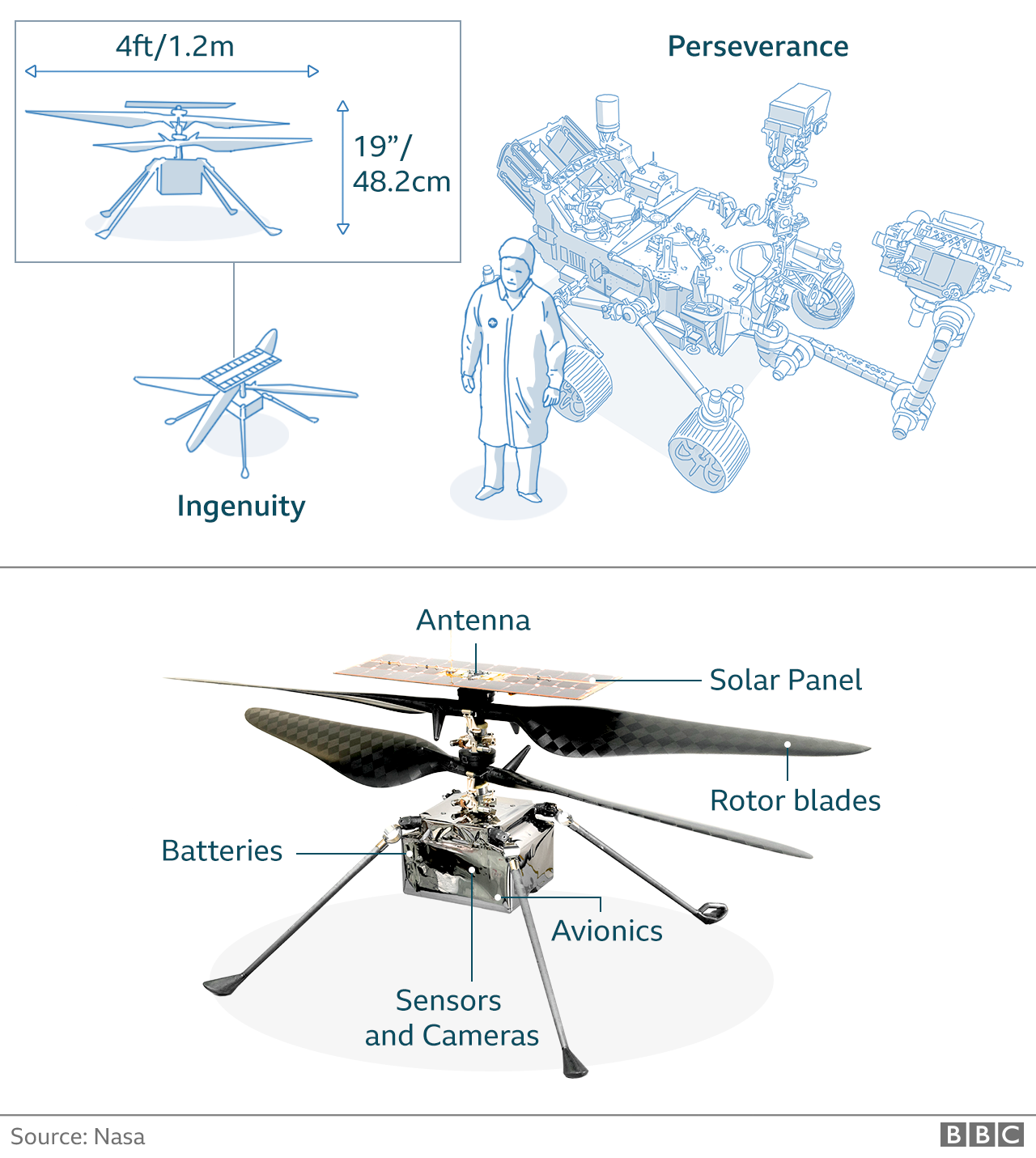
In recent days, NASA published three aerial photos taken by Ingenuity. These aren’t the first photos taken by the rover. It has previously sent back images of its shadows taken with its downward-facing navigation camera. And let’s not forget its watchful and proud surrogate parent, the Perseverance rover, which snaps magnificent photos of the helicopter in action. However, this latest set of images is special because they’re the first color photos of Mars taken by an aerial vehicle while it’s in the air.
Ingenuity’s First Aerial Color Image of Mars
At the time of this image, Ingenuity was 17 feet (5.2 meters) above the surface and pitching (moving the camera’s field of view upward) so the helicopter could begin its 7-foot (2-meter) translation to the west.
This is the first color image taken by Ingenuity, which is equipped with a high-resolution color camera that contains a 4208 x 3120-pixel sensor, on its April 22 test flight. According to NASA, Ingenuity was 17 feet (5.2 meters) above the surface. It was also moving its field of view upward as it prepared to move sideways for its 51.9-second flight.
“The image, as well as the inset showing a closeup of a portion of the tracks [of] the Perseverance Mars rover and Mars surface features, demonstrates the utility of scouting Martian terrain from an aerial perspective,” NASA explained in the photo’s description.
Speaking of Perseverance, you can check out the six-wheeled rover’s tracks in the winding parallel discolorations on the surface. Apparently, Perseverance itself isn’t too far away, but rather top center and unfortunately out of frame.
“Wright Brothers Field,” which is what NASA has named Ingenuity’s official launch zone, is in the vicinity of the helicopter’s shadow at the bottom center, the space agency said, and its point of takeoff is just below the image. Meanwhile, the black objects on the sides of the photo are Ingenuity’s landing pads. And in case this photo couldn’t get any better, you can see a small part of the horizon on the upper left and right corners.
Ingenuity’s Second Aerial Color Image of Mars
This is the second color image taken by NASA’s Ingenuity helicopter.
Besides stating that this photo was also taken at an altitude of 17 feet (5.2 meters), NASA didn’t have much to say. Nonetheless, the space agency noted that you could see tracks made by Perseverance here as well.
Ingenuity’s Third Aerial Color Image of Mars
This is the third color image taken by NASA’s Ingenuity helicopter.
NASA was short on words for this photo, too, but helpfully reminded us that Perseverance’s tracks can be seen in this case if you’re looking. (I was). I see the tracks at the bottom of the photo, but the rest of the picture is a lot more captivating to me.
The drone, called Ingenuity, was airborne for less than a minute, but Nasa is celebrating what represents the first powered, controlled flight by an aircraft on another world.
Confirmation came via a satellite at Mars which relayed the chopper’s data back to Earth.
The space agency is promising more adventurous flights in the days ahead.
Ingenuity will be commanded to fly higher and further as engineers seek to test the limits of the technology.
The rotorcraft was carried to Mars in the belly of Nasa’s Perseverance Rover, which touched down in Jezero Crater on the Red Planet in February.
“We can now say that human beings have flown a rotorcraft on another planet,” said a delighted MiMi Aung, project manager for Ingenuity at Nasa’s Jet Propulsion Laboratory (JPL) in Pasadena, California.
[…]
Ingenuity even carries a small swatch of fabric from one of the wings of Flyer 1, the aircraft that made that historic flight at Kitty Hawk, North Carolina, more than 117 years ago.
image copyrightNASA/JPL-CALTECH
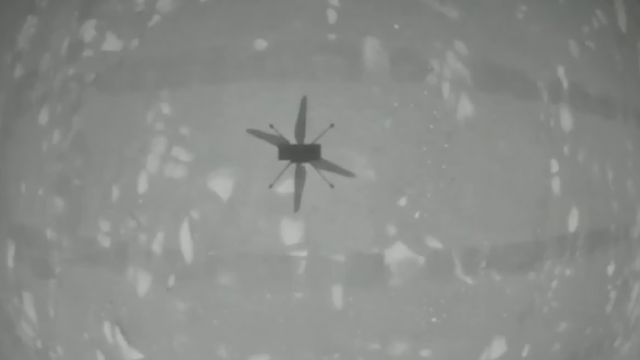
image captionThe chopper took this image of its own shadow on the ground
[…]
The demonstration saw the Mars-copter rise to about 3m, hover, swivel and then land. In all, it managed almost 40 seconds of flight, from take-off to landing.
Getting airborne on the Red Planet is not easy. The atmosphere is very thin, just 1% of the density here at Earth. This gives the blades on a rotorcraft very little to bite into to gain lift.
There’s help from the lower gravity at Mars, but still – it takes a lot of work to get up off the ground
Ingenuity was therefore made extremely light and given the power (a peak power of 350 watts) to turn those blades extremely fast – at over 2,500 revolutions per minute for this particular flight.
Control was autonomous. The distance to Mars – currently just under 300 million km – means radio signals take minutes to traverse the intervening space. Flying by joystick is simply out of the question.
[…]
Ingenuity has two cameras onboard. A black-and-white camera that points down to the ground, which is used for navigation, and a high-resolution colour camera that looks out to the horizon.
A sample navigation image sent back to Earth revealed the helicopter’s shadow on the floor of the crater as it came back in to land. Satellites will send home more pictures of the flight over the next day. There was only sufficient bandwidth in the orbiters’ first overflight to return a short snatch of video from Perseverance, which was watching and snapping away from a distance of 65m. Longer sequences should become available in due course.
image copyrightNasa
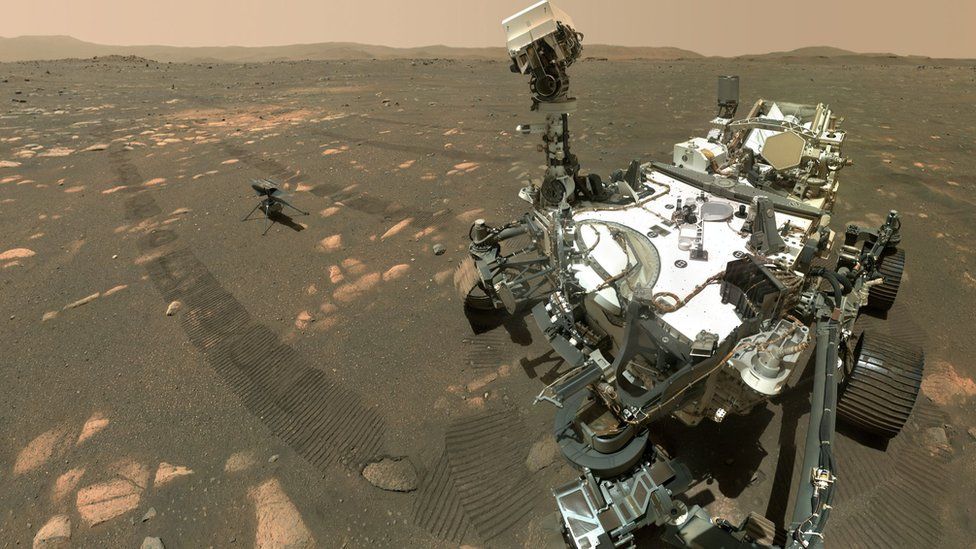
image captionA selfie of the Ingenuity helicopter and the Perseverance rover
Nasa has announced that the “airstrip” in Jezero where Perseverance dropped off Ingenuity for its demonstration will henceforth be known as the “Wright Brothers Field”.
The International Civil Aviation Organization (ICAO) – the United Nations’ civil aviation agency – has also presented the Nasa and the US Federal Aviation Administration with an official ICAO designator: IGY, call-sign INGENUITY.
A successful maiden outing means that a further four flights will be attempted over the coming days, each one taking the helicopter further afield.
Two satellites from the fast-growing constellations of OneWeb and SpaceX’s Starlink dodged a dangerously close approach with one another in orbit last weekend, representatives from the US Space Force and OneWeb said. It’s the first known collision avoidance event for the two rival companies as they race to expand their new broadband-beaming networks in space.
On March 30th, five days after OneWeb launched its latest batch of 36 satellites from Russia, the company received several “red alerts” from the US Space Force’s 18th Space Control Squadron warning of a possible collision with a Starlink satellite. Because OneWeb’s constellation operates in higher orbits around Earth, the company’s satellites must pass through SpaceX’s mesh of Starlink satellites, which orbit at an altitude of roughly 550 km.
One Space Force alert indicated a collision probability of 1.3 percent, with the two satellites coming as close as 190 feet — a dangerously close proximity for satellites in orbit. If satellites collide in orbit, it could cause a cascading disaster that could generate hundreds of pieces of debris and send them on crash courses with other satellites nearby.
Currently, there’s no national or global authority that would force satellite operators to take action on predicted collisions. Space Force’s urgent alerts sent OneWeb engineers scrambling to email SpaceX’s Starlink team to coordinate maneuvers that would put the two satellites at safer distances from one another.
While coordinating with OneWeb, SpaceX disabled its automated AI-powered collision avoidance system to allow OneWeb to steer its satellite out of the way, according to OneWeb’s government affairs chief Chris McLaughlin. It was unclear why exactly SpaceX disabled the system. SpaceX, which rarely responds to reporters, did not return multiple requests for comment for this story, nor did David Goldman, the company’s director of satellite policy.
SpaceX’s automated system for avoiding satellite collisions has sparked controversy, raising concerns from other satellite operators who say they have no way of knowing which way the system will move a Starlink satellite in the event of a close approach. “Coordination is the issue,” McLaughlin says. “It is not sufficient to say ‘I’ve got an automated system,’ because the other guy may not have, and won’t understand what yours is trying to do.”
[…]
the sharp increase of satellites in orbit, mainly driven by SpaceX’s Starlink venture, has moved faster than any authority can regulate the industry for safety. McKissock says SpaceX has made efforts to increase its transparency in orbit; the company currently provides location data of its satellites to other operators. But its automated system for avoiding collisions is a closed book where openness and coordination are needed the most, analysts and operators say.
“What is the point of having it if you have to turn it off when there’s going to be a potential collision?” Victoria Samson of the Secure World Foundation says, adding that the void of any clear international framework for managing active objects in space makes it largely unclear who would be held responsible if a collision actually occurred.
NASA has chosen Elon Musk‘s SpaceX to build the spacecraft that take the first woman and next man to the moon.
The American space agency made the official announcement Friday, which includes SpaceX’s $2.9 billion contract to build the lunar lander that is reportedly much lower than what competitors bid.
The Washington Post shared the news hours before saying the Musk-owned firm beat out Jeff Bezos’ Blue Origin and Dynetics.
Bezos owns the Post, which branded Musk’s win a ‘stunning victory’ over his Amazon tycoon’s rival effort.
To speed up the pace of NTP tech development, the Pentagon’s Defense Advanced Research Projects Agency (DARPA) has selected a trio of companies to build and demonstrate a nuclear-based propulsion system on a spacecraft above low-Earth orbit by 2025. The prime contractors include Jeff Bezos’ private space project Blue Origin, Lockheed Martin, and General Atomics.
Over the next 18 months, phase 1 of the DRACO (Demonstration Rocket for Agile Cislunar Operations) program will see the companies split across two tracks to develop a craft that has the ability to rapidly maneuver in cislunar space (between the Earth and the moon). The award win marks a new national security contract for Blue Origin, according to CNBC, while its DRACO counterparts are regulars on the defense circuit.
Bezos’ company and Lockheed Martin — granted $2.5 million and $2.9 million, respectively — will now work on competing designs for an operational spacecraft powered by an NTP system. DARPA awarded General Atomics $22 million to develop the nuclear reactor.
Blue Origin has successfully completed a test launch and landing of its reuseable New Shepard rocket with an advanced capsule design, bringing the outfit one step closer to eventually sending up paying passengers.
The test flight, codenamed NS-15 as it’s the 15th to date, was conducted at 1651 UTC (1151 CDT) at a Blue Origin site near Van Horn, Texas, on Wednesday. Two Blue Origin employees climbed up the launch tower, entered the capsule, and were strapped into their seats, and followed final procedures to prepare for a fake take off. Just before the New Shepard was due to fly, however, they left the capsule, with just Mannequin Skywalker, the instrument-stuffed dummy Blue Origin uses, to make the short journey.
The flight was the first test of the new capsule design that’ll be more comfortable for people paying six-figure sums to go into space. New acoustic and temperature controls were tested, as well an improved radio and control systems. NASA wants to see all is right before putting humans on it.
You can watch the whole thing again here. Skip to 1:53:39 to get to the countdown.
NS-15 was completed in just over ten minutes, according to the mission’s broadcast. First, the capsule separated from the booster at about three minutes into the flight. After the booster reached its highest point – about 350,000 feet or 106.7 kilometres – it slowed down and reentered the atmosphere.
It was guided back onto is landing pad and performed a rocket burn to slow its speed down to five miles per hour at seven minutes into the flight for a soft landing. The capsule touched down around three minutes later.
Intelsat’s IS-10-02 communications satellite was running low on fuel — it’s been in orbit since 2004, after all, and has already exceeded its original mission lifespan by five years. Thanks to Northrop Grumman’s Mission Extension Vehicle-2 (MEV-2), however, it gained another five years of life and will stay operational instead of being decommissioned. MEV-2 launched in August and has been making its way to the satellite in geosynchronous orbit since then. On Monday, it caught up to its target and clamped onto it to provide the IS-10-02 with more fuel.
According to TechCrunch, a representative described the robotic spacecraft as a “jetpack for the 10-02 satellite.” The spokesperson explained the docking process as follows:
“The MEV-2 docking system consists of a probe that we insert into the liquid apogee engine on the aft end of a satellite. Nearly 80% of satellites in orbit have this featuring, allowing the MEV service a variety of customers. The liquid apogee engine acts as a “cone to capture” to help guide the probe which once it passes through the throat of the engine, expands to capture the client satellite. The probe is then retracted pulling three stanchions, or feet, up against the launch adaptor ring, securely clamping the two vehicles together.”
This marks the first time a life-extension services vehicle was able to dock with an active satellite in its operational GEO orbital location. MEV-2’s predecessor, the MEV-1, clamped onto Intelsat’s IS-901 last year. That satellite was already out of fuel and was docked out of its original orbit at the time, though. As TechCrunch notes, Northrop Grumman had to ensure that MEV-2’s approach wouldn’t disrupt its target’s operation and orbit. By successfully doing so, the aerospace corporation proved that it’s possible to service active satellites, which means companies can potentially save millions by extending the life of their older space objects.
MEV-2 will stay with IS-10-02 before moving on to extend the life of another satellite. In addition to the MEV, the company is working on robotic vehicles that can do in-orbit repair, augmentation, assembly and inspection. Those vehicles will also be used to deliver life-extending pods to satellites to extend their mission lifespan without the need to remain docked with their targets. Northrop Grumman is hoping to launch both those technologies by 2024.
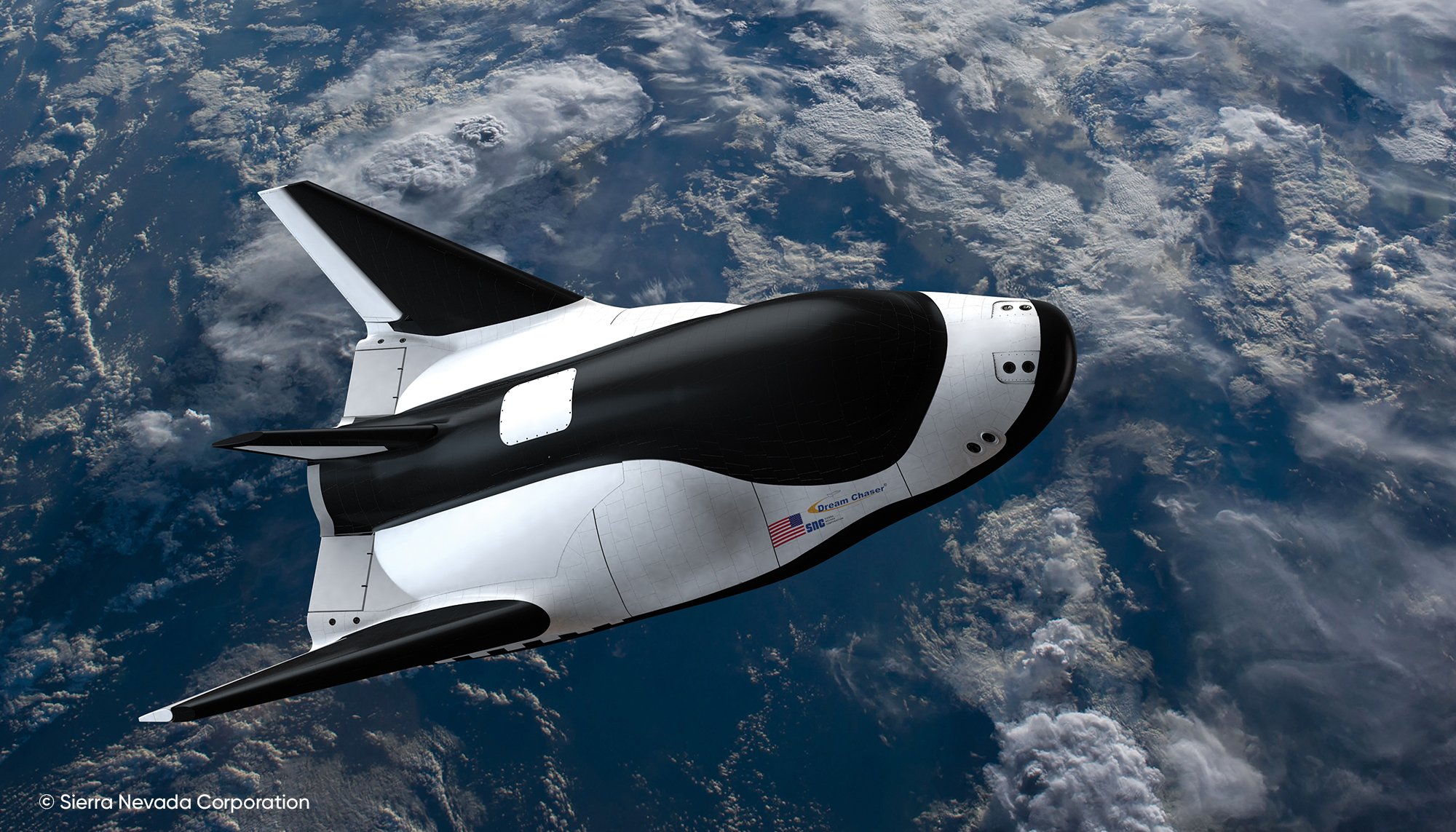
Sierra Nevada Corporation (SNC) has unveiled plans for an enormous inflatable space station tended by cargo and crew carrying versions of its Dream Chaser spaceplane.
“There is no scalable space travel industry without a spaceplane,” said SNC chair and owner Eren Ozmen.
That’s handy, because with the retirement of the Space Shuttle, the Dream Chaser is nearasdammit the last spaceplane standing. NASA, however, disagreed and selected Boeing’s Calamity Capsule and SpaceX’s Crew Dragon for transportation purposes to and from the International Space Station (ISS).
The space agency did, however, pop SNC into the second round of ISS Commercial Resupply Services (CRS-2), meaning the reusable cargo version of the spaceplane will see orbital action once assembly is complete (due this summer with launch expected late in 2022), but the crew version was not to be troubling the old Space Shuttle runway at Kennedy Space Center.
SNC’s proposal for a space station as an alternative for the ageing ISS is the LIFE habitat: a 27-foot-long, three-storey inflatable module that launches on a conventional rocket and inflates once in orbit. A full-sized prototype is currently being transferred from Johnson Space Center in Texas to Kennedy Space Center in Florida.
The crewed version of the Dream Chaser has also been resurrected and is planned to be used to both “shuttle” private astronauts (we see what you did there, SNC) as well as “rescuing astronauts from space destinations and returning them to Earth via a safe and speedy runway landing.”
Virgin Galactic took to YouTube to reveal, briefly, its first SpaceShip III, which will start ground tests and “glide flights” later this year. It’s an eye-catching vessel, channeling that Star Wars: The Phantom MenaceNaboo starship look in a wonderful way. It’s finished with a mirror-like material that’s meant to reflect its surroundings, whether that’s the blackness of space or the blueness of Earth’s atmosphere. It’s not all about aesthetics: it also offers thermal protection.
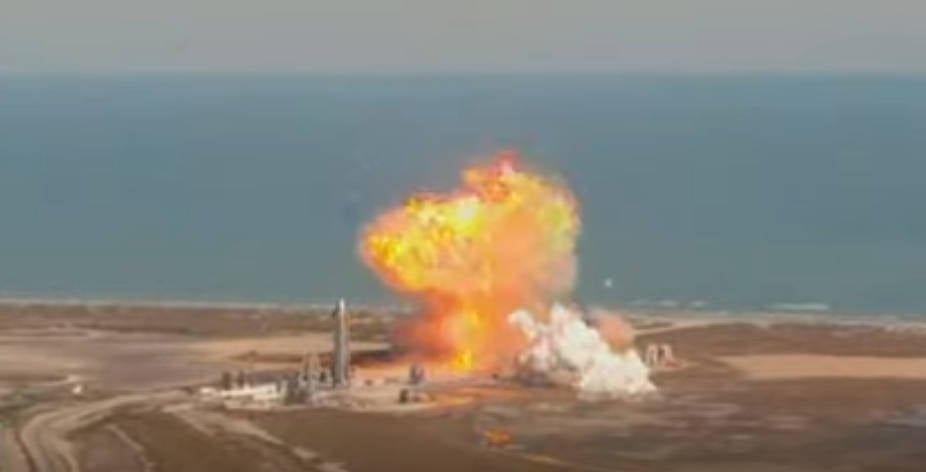
SpaceX continued its rich tradition of destroying Starship prototypes with SN11 succumbing to an explosive end during a high-altitude flight test.
Originally planned for 29 March, the test flight from the company’s facility in Boca Chica, Texas, had been postponed until this morning because a Federal Aviation Administrator (FAA) had been unable reach the site in time to observe the test.
The inspector was present today to witness another demonstration of Tesla Technoking Elon Musk’s prowess at blowing up big, shiny rockets.
The test was a repeat of the Serial Number 10 prototype vehicle flight earlier in March. SN10 broke the heart of SpaceX fanbois around the globe by coming so close to complete success. That vehicle managed to return from its high-altitude test in one piece, landing upright. However, seconds later it exploded spectacularly, leaving the way clear (except for some bits of twisted metal) for SN11.
With SN10 almost succeeding, hopes were high for SN11.
The silver rocket, obscured by mist, launched on time. The three Raptor engines appeared to burn normally during the flight, with one shutting down just after the two-minute mark as planned. A second engine was then shut down before the vehicle reached the desired 10km point and the last engine was cut off.
Despite spotty video, the signature “belly flop” of the vehicle was visible as SN11 flipped over for its return to Earth. As it passed through 1km in altitude (according to the SpaceX announcer) the Raptors could be seen gimballing into position and at least one igniting.
And then the video froze again.
However, the audio continued for a few more seconds before a very audible bang was heard. Shortly after, SpaceX’s announcer returned to the air to confirm “another exciting test.”
Whereas Earth has always been a terrestrial, rocky world, GJ 1132 b began its life as a gaseous, Neptune-like planet. But as new research shows, a nearby red dwarf obliterated its original hydrogen- and helium-rich atmosphere with powerful radiation, so GJ 1132 b, having been stripped down to its rocky core, is now technically a terrestrial planet. The new paper will appear in an upcoming issue of the Astronomical Journal, but a preprint is available at the arXiv.
The authors of the paper reached these conclusions based on direct observations of the exoplanet and theoretical modeling. The telescope of choice was the Hubble Space Telescope, which allowed the team to spot the “secondary atmosphere,” which consists of molecular hydrogen, hydrogen cyanide, methane, and an aerosol haze resembling smog on Earth.
“It’s super exciting because we believe the atmosphere that we see now was regenerated, so it could be a secondary atmosphere,” Raissa Estrela, a co-author of the study and a planetary scientist at NASA’s Jet Propulsion Laboratory in Southern California, explained in a statement. “We first thought that these highly irradiated planets could be pretty boring because we believed that they lost their atmospheres. But we looked at existing observations of this planet with Hubble and said, ‘Oh no, there is an atmosphere there.’
In terms of an explanation, the authors say much of the planet’s current hydrogen was retained from before, having been absorbed into the molten magma mantle. Volcanic processes are now causing this stored hydrogen to leak out from below, refueling the new atmosphere, according to the research.
SpaceX rocket prototype, known as SN10, soared over South Texas during test flight Wednesday before swooping down to a pinpoint landing near its launch site. Approximately three minutes after landing, however, multiple independentvideofeeds showed the rocket exploding on its landing pad.
SpaceX’s SN10, an early prototype of the company’s Starship Mars rocket, took off around 5:15 pm CT and climbed about six miles over the coastal landscape, mimicking two previous test flights SpaceX has conducted that ended in an explosive crash. Wednesday marked the first successful landing for a Starship prototype.
“We’ve had a successful soft touch down on the landing pad,” SpaceX engineer John Insprucker said during a livestream of the event. “That’s capping a beautiful test flight of Starship 10.”
It was unclear what caused the rocket to explode after landing, and the SpaceX livestream cut out before the conflagration.
Swarm, developer of the world’s lowest-cost live satellite communications network, today announced that the Swarm network is now commercially live and available for customers to begin using. Swarm is the first low-cost satellite provider to offer commercial services to every point in the world, and companies in markets ranging from agriculture, to logistics to maritime can now globally scale their business with Swarm overnight for only $5/month per device.
The latest prototype of SpaceX’s Starship rocket, the SN9, burst into flames as the vehicle attempted to land on Earth on Tuesday.
All eyes were on the craft after its predecessor, the SN8, exploded during touchdown in December in Boca Chica, Texas. You can watch today’s detonation in the video below. The accident occurs after six minutes into the flight (skip to 11:51 to see it burst into flames).
Like the previous launch, SN9 was also a high-altitude flight test. The vehicle got ten kilometres (32,800 feet) into the sky before shifting to a near-horizontal position to descend but, unfortunately, it exploded in the air before it could flip the right way up and touch down.
Let’s just say not an ideal landing … the SN9’s explosion Source: SpaceX. Click to enlarge
It’s not clear what caused the rapid unscheduled disassembly this time. It’s possible the rocket suffered the same mishap as SN8, considering how similar both launches unfolded. SpaceX CEO Elon Musk blamed SN8’s blowout on low pressure in the rocket’s fuel tank that caused it to meet the ground at a faster-than-desired velocity.
Rules? Pah
It has also emerged SpaceX asked the FAA for a waiver to exceed the limits of US federal public safety regulations during the SN8 launch. The regulator declined to issue the waiver, and SpaceX went ahead anyway with the fateful experiment.
As a result of that non-compliance, as the FAA put it, the agency demanded SpaceX carry out an investigation of the explosion and make changes to its public safety procedures in light of the failure. Those changes were approved by the regulator this week, and SpaceX was thus permitted to launch its SN9 craft.
A 70-foot rocket, riding beneath the wing of a retrofitted Boeing 747 aircraft, detached from the plane and fired itself into Earth’s orbit on Sunday — marking the first successful launch for the California-based rocket startup Virgin Orbit.
Virgin Orbit’s 747, nicknamed Cosmic Girl, took off from California around 10:30 am PT with the rocket, called LauncherOne, nestled beneath the plane’s left wing. The aircraft flew out over the Pacific Ocean before the rocket was released, freeing LauncherOne and allowing it to power up its rocket motor and propel itself to more than 17,000 miles per hour, fast enough to begin orbiting the Earth.
“In both a literal and figurative sense, this is miles beyond how far we reached in our first Launch Demo,” the company posted on its Twitter account.
The rocket flew a group of tiny satellites on behalf of NASA’s Educational Launch of Nanosatellites, or ELaNa, program, which allows high school and college students to design and assemble small satellites that NASA then pays to launch into space. The nine small satellites that Virgin Orbit flew on Sunday included temperature-monitoring satellite from the University of Colorado at Boulder, a satellite that will study how tiny particles collide in space from the University of Central Florida, and an experimental radiation-detection satellite from the University of Louisiana at Lafayette.
About four hours after takeoff on Saturday, Virgin Orbit confirmed in a tweet that all the satellites were “successfully deployed into our target orbit.”
Payloads successfully deployed into our target orbit! We are so, so proud to say that LauncherOne has now completed its first mission to space, carrying 9 CubeSat missions into Low Earth Orbit for our friends @NASA. #LaunchDemo2
The successful mission makes Virgin Orbit only the third so-called “New Space” company — startups hoping to overhaul the traditional industry with innovative technologies — to reach orbit, after SpaceX and Rocket Lab. The success also paves the way for Virgin Orbit to begin launching satellites for a host of customers that it already has lined up, including NASA, the military and private-sector companies that use satellites for commercial purposes.
You might think metal satellites burn up on re-entry, but as it turns out, it’s not that simple. “We are very concerned with the fact that all the satellites which re-enter the Earth’s atmosphere burn and create tiny alumina particles which will float in the upper atmosphere for many years,” Takao Doi, an astronaut and Kyoto University professor, told the BBC when speaking about the project. “Eventually it will affect the environment of the Earth.”
Wood, however, would entirely burn up upon re-entry without leaving harmful substances in the atmosphere—or perhaps scattering dangerous debris. According to Nikkei Asia, another reason the researchers are experimenting with wood is that it doesn’t block electromagnetic waves or the Earth’s own magnetic field. That means wooden satellites could have simpler builds, as components like antennas could be placed inside the satellite itself.
[…]
According to the World Economic Forum, there are roughly 6,000 satellites currently in orbit, of which 60% are actually defunct. Meanwhile, 990 satellites are estimated to be launched every year for the next decade. The WEF also notes that there are more than half a million pieces of space trash larger than a marble currently floating around the Earth and 20,000 pieces of debris that are larger than a softball. These pieces of trash aren’t static. They are actually moving at speeds up to 17,500 miles per hour, the speed necessary to remain in orbit and not fall back to the Earth itself. According to NASA, more space junk presents an increasing danger of collision to all types of spacecraft, including the International Space Station, shuttles, and any other type of vessel that may carry humans.
[…]
The problem of space clutter is only getting worse, as both Elon Musk’s SpaceX and Amazon’s Project Kuiper race to launch thousands of satellites into orbit to provide low-cost internet. Meanwhile, astronomers have also expressed concern that these satellite constellations could potentially disrupt their ability to observe the cosmos. It’s unclear how much wooden satellites would alleviate the problem, but hey, it’s gotta be better than sticking more metal junk up there.
There’s a giant asteroid somewhere out in the solar system, and it hurled a big rock at Earth.
The evidence for this mystery space rock comes from a diamond-studded meteor that exploded over Sudan in 2008.
NASA had spotted the 9-ton (8,200 kilograms), 13-foot (4 meters) meteor heading toward the planet well before impact, and researchers showed up in the Sudanese desert to collect an unusually rich haul of remains. Now, a new study of one of those meteorites suggests that the meteor may have broken off of a giant asteroid — one more or less the size of the dwarf planet Ceres, the largest object in the asteroid belt.
[…]
“Some of these meteorites are dominated by minerals providing evidence for exposure to water at low temperatures and pressures,” study co-author Vicky Hamilton, a planetary geologist at the Southwest Research Institute in Boulder, Colorado, said in the statement. “The composition of other meteorites points to heating in the absence of water.”
[…]
Amphibole is common enough on Earth, but it’s only appeared once before in trace amounts in a meteorite known as Allende — the largest carbonaceous chondrite ever found, which fell in Chihuahua, Mexico, in 1969
The high amphibole content of AhS suggests the fragment broke off a parent asteroid that’s never left meteorites on Earth before.
And samples brought back from the asteroids Ryugu and Bennu by Japan’s Hayabusa2 and NASA’s OSIRIS-REx probes, respectively, will likely reveal more space rock minerals that rarely turn up in meteorites, the researchers wrote in their study.
Maybe some types of carbonaceous chondrite just don’t survive the plunge through the atmosphere as well, Hamilton said, and that’s kept scientists from studying a flavor of chondrite that might be more common in space.
he fledgling U.S. Space Force has announced the name by which its members will be called: Guardians. This is one of the last remaining organizational changes for America’s newest branch to make to give it a distinct from its parent, the U.S. Air Force. The service already has its own unique unit designations, insignias and uniform devices, as well as a new motto, Semper Supra, or Always Above.
Vice President Mike Pence announced the Guardians moniker at a gathering at the White House on Dec. 18, 2020, with Space Force head General John Raymond, Secretary of the Air Force Barbara Barrett, and Acting Secretary of Defense Chris Miller also in attendance. This comes just days before the first anniversary of the service’s founding on Dec. 20 of last year. The Space Force’s Guardians will now join the U.S. Army’s Soldiers, the U.S. Navy’s Sailors, the U.S. Air Force’s Airmen, and, well, the U.S. Marine Corps’ Marines.
[…]
This is hardly the first time the general public has made references to popular media when talking about the Space Force. As Walter Shaub, former Director of the Office of Government Ethics, noted on Twitter after the name’s announcement, there have already been a number of Star Trek references when it comes to the Space Force, generally related to its heavy use of delta symbols in its official insignias and other devices, which are very visually reminiscent of the Starfleet Command logo from that fictional universe.
Space Force
A new Space Force Space Staff uniform badge with a prominent delta motif that was unveiled earlier in December 2020.
With the Guardian’s name in hand, one of the few remaining decisions Space Force has to make with regards to how to distinguish itself from the Air Force, as well as the other service, is the matter of ranks. A provision had been included in earlier versions of the annual defense policy bill, or National Defense Authorization Act (NDAA), for the 2021 Fiscal Year that demanded that Space Force use naval ranks.
William Shatner, the first actor to play Star Trek’s iconic Captain Kirk, went so far as to write an op-ed for Military Times earlier this year promoting that idea. “There was no Colonel Kirk,” he wrote.
However, that provision has since been dropped. If the current version of the Fiscal Year 2021 NDAA becomes law, Space Force will be free to continue its ongoing process to select a rank structure.
So, while we still don’t know what the names for their different ranks might look like in the future, we do know now that members of the Space Force have officially become Guardians.
For the first time in 44 years, a spacecraft has brought lunar samples to Earth. With the Chang’e 5 mission complete, China now joins a very exclusive club, reinforcing the country’s role as a major player in space exploration.
China is now only the third country to collect samples from the Moon and bring them to Earth. The last time this happened was in 1976, when the Soviet Union did the same as part of its Luna 24 mission. NASA, during the course of its six Apollo missions, managed to collect and retrieve 842 pounds of lunar regolith and rocks.
[…]
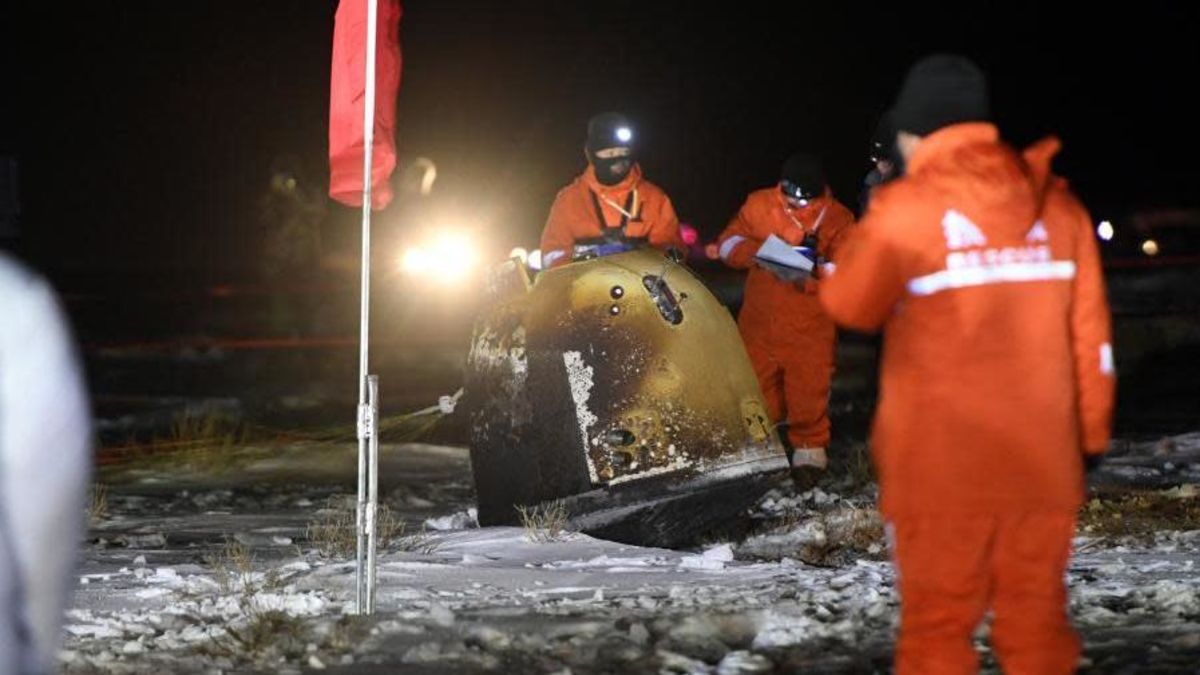
The capsule was 3,100 miles (5,000 km) above the southern Atlantic Ocean when it separated from the orbiter. Prior to making the big plunge, the capsule bounced off the atmosphere while traveling at 7 miles per second (11.2 km/s), which it did to reduce speed, bringing it down to a more manageable 5 miles per second (7.9 km/s). A parachute allowed it to safely drift to the surface, where it was retrieved by ground crews. As Xinhua reports, the recovery team will briefly inspect the capsule, and then fly it to Beijing for further analysis.
Specifically, the sealed samples will be “transferred to specially designed laboratories for analyses, experiments and tests so scientists can determine the extraterrestrial substances’ composition, structure and traits, thus deepening their knowledge about the history of the moon and the solar system,” according to CNSA. “A certain proportion of the samples will also be on public display to enhance science awareness among the public, especially young generations, sources close to the mission have said.”
[…]
Using its drill, the Chang’e 5 lander pulled 18 ounces (500 grams) of material from beneath the surface, while its robotic arm collected upwards of 3.5 pounds (1.5 kg). The research team will have to confirm these quantities once the capsule is opened. After storing the samples in a vacuum chamber, the lander planted a Chinese flag on the surface, bid farewell to the Moon, and then re-joined the orbiter on December 3. It marked the “first time a Chinese spacecraft has blasted off from an extraterrestrial body,” according to CNSA.
Invisible structures generated by gravitational interactions in the Solar System have created a “space superhighway” network, astronomers have discovered.
These channels enable the fast travel of objects through space, and could be harnessed for our own space exploration purposes, as well as the study of comets and asteroids.
By applying analyses to both observational and simulation data, a team of researchers led by Nataša Todorović of Belgrade Astronomical Observatory in Serbia observed that these superhighways consist of a series of connected arches inside these invisible structures, called space manifolds – and each planet generates its own manifolds, together creating what the researchers have called “a true celestial autobahn”.
This network can transport objects from Jupiter to Neptune in a matter of decades, rather than the much longer timescales, on the order of hundreds of thousands to millions of years, normally found in the Solar System.
[…]
They collected numerical data on millions of orbits in the Solar System, and computed how these orbits fit with known manifolds, modelling the perturbations generated by seven major planets, from Venus to Neptune.
And they found that the most prominent arches, at increasing heliocentric distances, were linked with Jupiter; and most strongly with its Lagrange point manifolds. All Jovian close encounters, modelled using test particles, visited the vicinity of Jupiter’s first and second Lagrange points.
A few dozen or so particles were then flung into the planet on a collision course; but a vast number more, around 2,000, became uncoupled from their orbits around the Sun to enter hyperbolic escape orbits. On average, these particles reached Uranus and Neptune 38 and 46 years later, respectively, with the fastest reaching Neptune in under a decade.
Space manifolds act as the boundaries of dynamical channels enabling fast transportation into the inner- and outermost reaches of the Solar System. Besides being an important element in spacecraft navigation and mission design, these manifolds can also explain the apparent erratic nature of comets and their eventual demise. Here, we reveal a notable and hitherto undetected ornamental structure of manifolds, connected in a series of arches that spread from the asteroid belt to Uranus and beyond. The strongest manifolds are found to be linked to Jupiter and have a profound control on small bodies over a wide and previously unconsidered range of three-body energies. Orbits on these manifolds encounter Jupiter on rapid time scales, where they can be transformed into collisional or escaping trajectories, reaching Neptune’s distance in a mere decade. All planets generate similar manifolds that permeate the Solar System, allowing fast transport throughout, a true celestial autobahn.
[…]
igure 1 shows short-term FLI maps of the outer edge of the asteroid belt (∼3 AU) up to near the semimajor axis of Uranus (∼20 AU), for all elliptic eccentricities, and considering the seven-planet dynamical model (top) and the Sun-Jupiter-TP–restricted problem (bottom) in ORBIT9. The large stable island at 5.2 AU, nesting the Greeks, is clearly visible in both panels of Fig. 1, as is the niche for the Hildas at 3.97 AU. A shadow of the chaotic borders of the strongest resonance in the outer belt, the 2:1 mean-motion resonance (MMR) with Jupiter at 3.3 AU, begins to appear, indicating the relative weakness of such orbital resonances compared to the manifolds uncovered herein. The notable feature of Fig. 1, however, is the large “V-shaped” chaotic structure that emerges outside of roughly 5.6 AU, which is connected to a series of arches at increasing heliocentric distances that nearly follows the perihelion line (qj) of Jupiter. Chaos also emanates along the Jovian aphelion line (Qj) in elongated concentric curves, initiating near 4.8 AU.
Fig. 1Global arch-like structure of space manifolds in the Solar System.
Short-term FLI maps of the region between the outer edge of the main asteroid belt at 3 AU to just beyond the semimajor axis of Uranus at 20 AU, for all elliptic eccentricities, adopting a dynamical model in ORBIT9 that contains the seven major planets (from Venus to Neptune) as perturbers (top) or Jupiter as the only perturber (bottom). Orbits located on stable manifolds appear with a lighter color, while darker regions correspond to trajectories off of them.
SpaceX has conducted a test of the Starship it plans to use for flights to Mars, and while the experiment ended badly the flight was judged a success.
Wednesday’s flight used just the Starship – the second stage of SpaceX’s planned heavy lifter. Previous flights had seen the craft ascend to around 500 feet. This time around the goal was a high-altitude test that would take it to 41,000 feet, before returning to terra firma to prove its reusability.
As the video below shows, the vehicle lifted off (at around 1:48:00) and then came down belly-first before pivoting for landing (1:53:00).
SpaceX’s summary of the mission said that Starship “successfully ascended, transitioned propellant, and performed its landing flip maneuver with precise flap control to reach its landing point.”
But not everything went right. The vids above and below show the excitement. Spoiler: big ball of flame!
Despite that excitement, SpaceX founder and CEO Elon Musk was chuffed with the outcome.
Fuel header tank pressure was low during landing burn, causing touchdown velocity to be high & RUD, but we got all the data we needed! Congrats SpaceX team hell yeah!!
Why so upbeat despite the unhappy ending? Musk rated the chances of mission success as one in three, and SpaceX has other prototypes ready to fly. This one didn’t even have the engine configuration planned for the production model. So getting everything right bar the landing is a decent outcome.
Vids’n’pics Japanese and Australian astroboffins have successfully recovered samples taken from Asteroid Ryugu by the Hayabusa2 probe.
Hayabusa2 has had quite a ride and has more adventures ahead of it.
The probe launched in 2014 and spent three-and-a-half years travelling to near-Earth asteroid 162173 Ryugu, which has a diameter of about 1km and occasionally passes within 100,000km of the planet upon which you are (presumably) reading this story.
Hayabusa2 carried four rovers, one of which was used after the spacecraft shot a bullet at the asteroid to disturb its surface and stir up some matter to bring home in a sealed capsule designed to survive the rigours of re-entry to Earth’s atmosphere.
The probe bade farewell to Ryugu in November 2019 and early on Sunday morning, Australian time, the recovery capsule was spotted streaking across the sky as it made its way towards the Woomera prohibited area for a pre-dawn landing.
[…]
The capsule carried the samples from Ryugu, plus a radar-reflective parachute and a radio beacon designed to make it easier to find in the very hot, dry, and nasty conditions often found in the region.
As it happened, everything worked, and news of the capsule’s retrieval emerged before lunchtime.
[…]
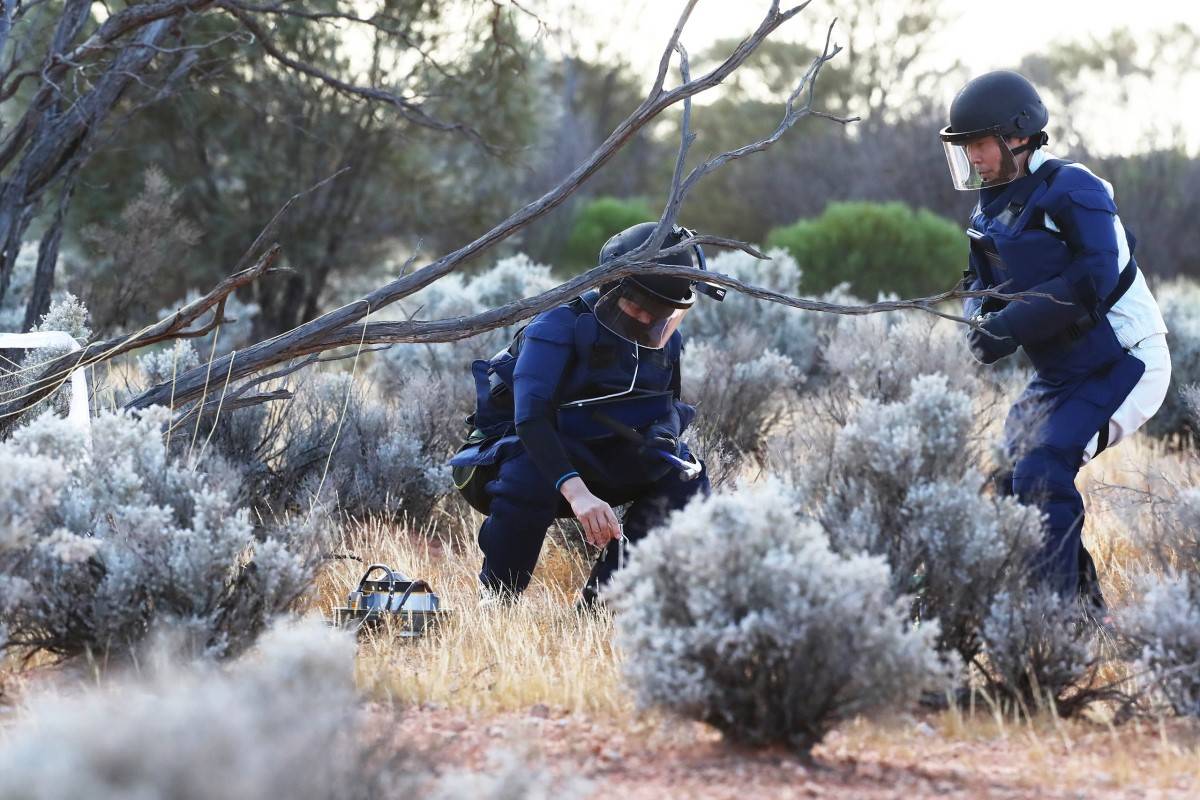
Japan Aerospace Exploration Agency staff approached the capsule wearing protective gear and what looks like some trepidation.
Click to enlarge
Before long, the capsule becamse safe to handle and was popped into a shiny box.
The sample return capsule in its box.
Click to enlarge
The precious cargo was soon on its way to the facility established to handle the landing.
[…]
Another story we’ll have to wait for is news of Hayabusa2’s ongoing adventures, because the probe skipped off past Earth and has enough fuel aboard to line up a 2026 rendezvous with another asteroid, the mysteriously ruddy 2001 CC. Japan’s space agency has even contemplated a third asteroid visit, in 2030, and even a possible fly-by of Venus. As it flits about the inner solar system, the probe’s cameras will also be used for observations of exoplanets and other phenomena
Look up at the night sky and, if you’re away from city lights, you’ll see stars. The space between those bright points of light is, of course, filled with inky blackness.
Some astronomers have wondered about that all that dark space–about how dark it really is.
“Is space truly black?” says Tod Lauer, an astronomer with the National Optical Astronomy Observatory in Arizona. He says if you could look at the night sky without stars, galaxies, and everything else known to give off visible light, “does the universe itself put out a glow?”
It’s a tough question that astronomers have tried to answer for decades. Now, Lauer and other researchers with NASA’s New Horizons space mission say they’ve finally been able to do it, using a spacecraft that’s travelling far beyond the dwarf planet Pluto. The group has posted their work online, and it will soon appear in the Astrophysical Journal.
New Horizons was originally designed to explore Pluto, but after whizzing past the dwarf planet in 2015, the intrepid spacecraft just kept going. It’s now more than four billion miles from home—nearly 50 times farther away from the Sun than the Earth is.
That’s important because it means the spacecraft is far from major sources of light contamination that make it impossible to detect any tiny light signal from the universe itself. Around Earth and the inner solar system, for example, space is filled with dust particles that get lit up by the Sun, creating a diffuse glow over the entire sky. But that dust isn’t a problem out where New Horizons is. Plus, out there, the sunlight is much weaker.
To try to detect the faint glow of the universe, researchers went through images taken by the spacecraft’s simple telescope and camera and looked for ones that were incredibly boring.
“The images were all of what you just simply call blank sky. There’s a sprinkling of faint stars, there’s a sprinkling of faint galaxies, but it looks random,” says Lauer. “What you want is a place that doesn’t have many bright stars in the images or bright stars even outside the field that can scatter light back into the camera.”
Then they processed these images to remove all known sources of visible light. Once they’d subtracted out the light from stars, plus scattered light from the Milky Way and any stray light that might be a result of camera quirks, they were left with light coming in from beyond our own galaxy.
They then went a step further still, subtracting out light that they could attribute to all the galaxies thought to be out there. And it turns out, once that was done, there was still plenty of unexplained light.
In fact, the amount of light coming from mysterious sources was about equal to all the light coming in from the known galaxies, says Marc Postman, an astronomer with the Space Telescope Science Institute in Baltimore, Maryland. So maybe there are unrecognized galaxies out there, he says, “or some other source of light that we don’t yet know what it is.”
The new findings are sure to get astronomers talking.
“They’re saying that there’s as much light outside of galaxies as there is inside of galaxies, which is a pretty tough pill to swallow, frankly,” notes Michael Zemcov, an astrophysicist at Rochester Institute of Technology, who was not part of the research team.
A few years ago, Zemcov and some colleagues analyzed New Horizons data in a similar way. Using fewer images, they made a less precise measurement, but it was still compatible with the current results.
He says for 400 years, astronomers have been studying visible light and the sky in a serious way and yet somehow apparently “missed half the light in the universe.”
AST & Science, a Texas-based company, has applied for approval to build SpaceMobile, which claims to be the “first and only space-based cellular broadband network to be accessible by standard smartphones.” Its proposed network is under review by the FCC. However, NASA reckons it will heighten the risk of contact between spacecraft within a region that is already crowded.
The space agency is particularly concerned about the gap between 690 and 740km above Earth, an area home to the so-called A-train. The A-train consists of ten spacecraft used to monitor Earth, operated by various groups including NASA, the United States Geological Survey, France’s National Centre for Space Studies, and Japan’s Aerospace Exploration Agency. AST wants to place its satellites across 16 orbital planes at an altitude of 700km, a distance that’s too close for comfort.
“The AST constellation would be essentially collocated with the A-Train if the proposed orbit altitude is chosen,” Samantha Fonder, NASA’s Representative to the Commercial Space Transportation Interagency Group, and a member of its Human Exploration and Operations Mission Directorate, wrote in a letter [PDF] addressed to the FCC.
What’s more the area is also particularly risky since it contains chunks of debris leftover from a previous orbital crash. “Additionally, this is an orbit regime that has a large debris object density (resulting from the Fengyun1-C ASAT test and the Iridium33-COSMOS 2251collision) and therefore experiences frequent conjunctions with debris objects,” she continued.
Fonder reckons that placing another 243 satellites near the A-train will increase the chances of a space smash. NASA has arrived at that conclusion by taking into account various factors, including the size of the AST’s SpaceMobile birds. They are much bigger than the spacecraft in the A-train and carry 900-square-metre antennas.
Supermarket chain Iceland has launched a chicken nugget into space to celebrate its 50th anniversary of trading.
The breaded snack was launched into the stratosphere from a location close to the company’s head office in Deeside, North Wales, as part a joint venture with Sent Into Space, a team of experts in the field of stratospheric exploration.
Iceland said the nugget took just under two hours to reach 110,000ft (33,528m) above the Earth, climbing to peak altitude and enduring temperatures of minus 60C before heading back towards terra firma at some 200mph (322kph).
Thankfully, the snack’s parachute deployed at around 62,000ft (19,000m) to enable a safe landing.
The altitude it reached was reported to be equivalent to the height of 880,000 Iceland chicken nuggets, one of the firm’s most popular items.
A Tweet from the retailer said: “We don’t know who needs to hear this, but we sent the first ever chicken nugget into space today.”
It added: “Why? We have no idea, but it was out of this world!”